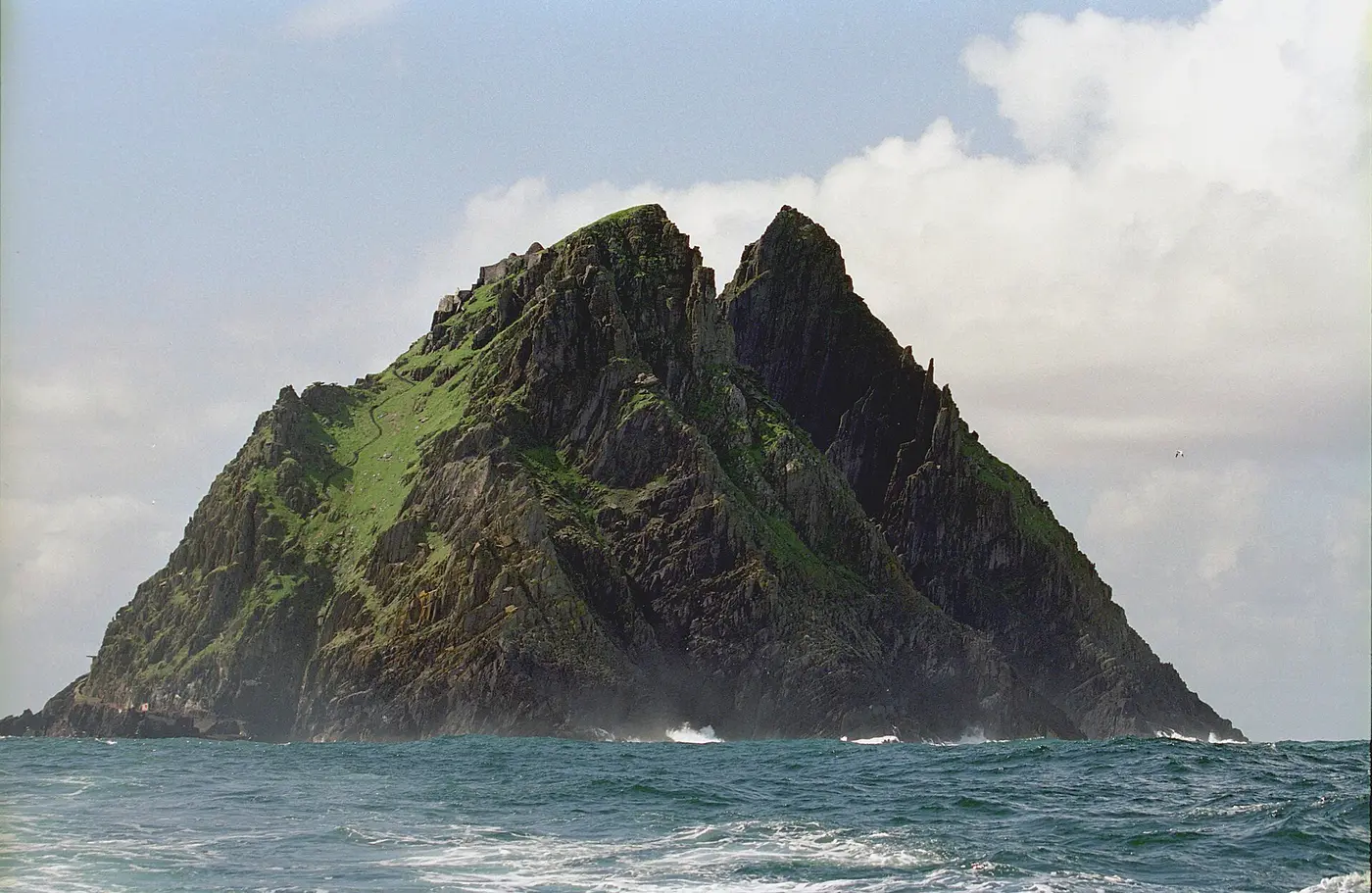
County Kerry
“KEER-ee” · the people of Ciar, from Ciar + raige (people of)
Known as The Kingdom. The county's Irish name is Ciarraí, the people of Ciar, and Ciar was a son of Fergus mac Róich and Medb of Connacht. It has since been claimed by the footballers.
A fact like this for every county and every age →
Compare with another county → · Printable one-page summary →
Kerry is Ciarraí, "the people of Ciar", a tribe whose legendary founder was Ciar, son of Fergus mac Róich; the county's nickname is the Kingdom. In 1329 Maurice FitzGerald, first Earl of Desmond, was confirmed as lord of the county palatine of Kerry, and in the 15th century most of it was still part of the Geraldines' Desmond.
In 1580, at Dún an Óir near Smerwick on the Dingle peninsula, a papal force of about 600 Italian, Spanish and Irish soldiers was besieged and massacred. In 1588 Armada ships sheltered and some were wrecked at the Blaskets. In 1602 the O'Sullivan Beare castle at Dunboy fell, and Donal O'Sullivan Beare marched about a thousand of his people north towards Ulster in winter; very few arrived. In the 1640s the county was held for the Confederates, and Ross Castle near Killarney, in 1652, was among the last strongholds to surrender to Cromwell.
Kerry's tenant farmers lived on the potato, and the Famine hit hard: the population fell 19% between the 1841 and 1851 censuses, and emigration went on into the 1980s. The Land War of the 1870s and 1880s followed. In 1919–23 Kerry was among the counties worst affected — Tralee was besieged by the Black and Tans in November 1920, and nine men died in a shoot-out at Castleisland on the very day of the truce. In the Civil War, in March 1923, National Army soldiers killed republican prisoners in a series of reprisals, the worst at Ballyseedy near Tralee, where eight men were killed with a mine.
Drawn from the History section of the Wikipedia article on County Kerry ↗, rewritten here and adding nothing it does not say; licensed CC BY-SA 4.0. The chronology above is this site's own; where the two differ, the article is the one to check.
Kerry is the fifth largest of Ireland's 32 traditional counties by area and the fifteenth largest by population. It is the second largest of Munster's six counties by area, and the fourth largest by population. It is bordered by two other counties: County Limerick to the east and County Cork to the south-east. The county town is Tralee although the Catholic diocesan seat is Killarney, which is one of Ireland's most famous tourist destinations. The Lakes of Killarney, an area of outstanding natural beauty, are located in Killarney National Park. The Reeks District is home to Carrauntoohil, Ireland's highest mountain at 1,039m. The tip of the Dingle Peninsula is the westernmost point of Ireland.
Places of interestKerry, with its mountains, lakes and nearly 1,000 kilometres of Atlantic coastline is among the most scenic areas in Ireland and is among the most significant tourist destinations in Ireland. Killarney is the centre of the tourism industry, which is a significant element of the economy in Kerry. The Kerry Way, Dingle Way and Beara Way are walking routes in the county. The Ring of Kerry on the Iveragh Peninsula is a popular route for tourists and cyclists. The pedestrian version is the scenic Kerry Way which follows ancient paths generally higher than that adopted by the Ring of Kerry.
Read the full article ↗ · Text from Wikipedia, licensed CC BY-SA 4.0.
Tap a name for its full page — story, homeland map and neighbours. Or see all surnames from County Kerry, with the other counties each name is tied to.
Towns. Tralee Trá Lí (26,079, 2022), Killarney Cill Airne (14,412, 2022), Listowel Lios Tuathail (4,794, 2022), Kenmare Neidín (2,566, 2022), Castleisland Oileán Ciarraí (2,536, 2022), Killorglin Cill Orglan (2,163, 2022), Dingle An Daingean. What every town name means →
Saints. St Brendan the Navigator (16 May).
Legends set here. Slieve Mish — the Milesian landing · Lough Leane — O'Donoghue's return. On the atlas →
First names that belong here. Mairéad, Eibhlín, Breandán, Cárthach, Tomás, Muiris, Piaras, Gobnait, Finghin, Cróchán.
At the 2022 census, 62,877 people in Kerry said they could speak Irish. 3,763 speak it every day outside school, and 4,302 weekly.
19 primary schools here teach entirely through Irish (2025/26, 1,780 pupils), and 3 secondary schools.
Kerry's Gaeltacht had 9,036 people in 2022, 2,131 of them daily Irish speakers. The Gaeltacht in numbers →
CSO, Census 2022, table SAP2022T3T2CTY. Every county compared →
Carrauntoohil (Corrán Tuathail), 1,039 metres, in the MacGillycuddy's Reeks.
National parks: Killarney (1932), Páirc Náisiúnta na Mara (2024). All the national parks →
Wrecks on its coast: SM U-68 (1916), MV Ranga (1982). Shipwrecks of Ireland →
Rivers and loughs: River Shannon, River Blackwater, River Laune, River Feale, Lough Leane.
MountainViews, via Wikipedia. Every county's highest point → · Rivers and loughs →
Hurling: 1 senior title (1891).
Football: 39 senior titles (1903, 1904, 1909, 1913, 1914, 1924, 1926, 1929, 1930, 1931, 1932, 1937, 1939, 1940, 1941, 1946, 1953, 1955, 1959, 1962, 1969, 1970, 1975, 1978, 1979, 1980, 1981, 1984, 1985, 1986, 1997, 2000, 2004, 2006, 2007, 2009, 2014, 2022, 2025); 25 finals lost.
-
Horatio Kitchener, 1st Earl Kitchener ↗
· 1850–1916
Irish officer and colonial administrator in the British Army, born at Ballylongford -
Brendan the Navigator ↗
Irish monastic saint, born at Fenit -
Daniel O'Connell ↗
· 1775–1847
Irish political leader, born at Cahersiveen -
Richard Cantillon ↗
Irish-French economist and banker -
Thomas Crean ↗
· 1877–1938
Irish explorer, born at Annascaul -
Edward Barrett ↗
· 1877–1932
Olympic wrestler -
Tomas O'Crohan ↗
· 1855–1937
Irish writer, born at Blasket Islands -
John B. Keane ↗
· 1928–2002
Irish playwright, novelist and essayist, born at Listowel -
Thomas Ashe ↗
· 1885–1917
Irish revolutionary and politician, born at Lispole -
Helen Blackburn ↗
· 1842–1903
Women's rights campaigner, editor, writer, born at Valentia Island -
Dennis Fenton ↗
· 1888–1954
Sport shooter, born at Ceann Trá -
Patrick Edward Connor ↗
· 1820–1891
Union Army general -
T. F. O'Rahilly ↗
· 1882–1953
Irish linguist, born at Listowel -
Peig Sayers ↗
· 1873–1958
Irish writer, born at Dún Chaoin -
Robert D. FitzGerald ↗
· 1830–1892
Surveyor, ornithologist, botanist and poet, born at Tralee -
The O'Rahilly ↗
Irish republican, born at Ballylongford -
Mícheál Ó Muircheartaigh ↗
· 1930–2024
Irish Gaelic games commentator, born at Dingle/Daingean Uí Chúis -
Patrick S. Dinneen ↗
· 1860–1934
Irish lexicographer and historian, born at Rathmore -
Michael Joseph Keyes ↗
· 1876–1959
Catholic bishop, born at Dingle/Daingean Uí Chúis -
Eamon Casey ↗
· 1927–2017
Irish bishop (1927-2017) and sexual predator -
Austin Stack ↗
· 1879–1929
Irish republican and politician, born at Tralee -
Muiris Ó Súilleabháin ↗
· 1904–1950
Irish writer, born at Great Blasket Island -
Malachi Martin ↗
· 1921–1999
Irish Catholic priest and writer on the Catholic Church, born at Ballylongford -
Tom Barry ↗
· 1897–1980
Irish soldier and guerrilla leader, born at Killorglin -
Eoghan Rua Ó Súilleabháin ↗
· 1748–1784
Irish poet, born at Meentoges -
Mo Chutu of Lismore ↗
Irish saint, abbot of Rahan -
Robert Hilliard ↗
· 1904–1937
Irish boxer, born at Killarney -
Denis Mary Bradley ↗
· 1846–1903
Irish-American Roman Catholic bishop and educationist, born at Castleisland -
Richard Alphonsus O'Connor ↗
· 1838–1913
Canadian Catholic bishop, born at Listowel -
John McDonald ↗
· 1837–1917
American soldier and politician from Maryland, born at Dingle/Daingean Uí Chúis
From Wikidata: people whose recorded birthplace is in the county, who have a Wikipedia article and are no longer living, with dates shown only where the article confirms them, ordered by how many languages Wikipedia covers them in. Traditional birthplaces of early saints are as Wikidata records them. Dates are left off where the sources disagree.
Kerry had 293,880 people in 1841 and has 156,458 now (-47%). Its peak was 293,880 in 1841; its low point 112,772 in 1971, -62% of 1841. It has never regained the population it had before the Famine.
| 1821 | 1831 | 1841 | 1851 | 1861 | 1871 | 1881 | 1891 | 1901 | 1911 | 1926 | 1936 | 1946 | 1951 | 1956 | 1961 | 1966 | 1971 | 1979 | 1981 | 1986 | 1991 | 1996 | 2002 | 2006 | 2011 | 2016 | 2022 |
|---|---|---|---|---|---|---|---|---|---|---|---|---|---|---|---|---|---|---|---|---|---|---|---|---|---|---|---|
| 216,185 | 263,126 | 293,880 | 238,254 | 201,800 | 196,586 | 201,039 | 179,136 | 165,726 | 159,691 | 149,171 | 139,834 | 133,893 | 126,644 | 122,072 | 116,458 | 112,785 | 112,772 | 120,356 | 122,770 | 124,159 | 121,894 | 126,130 | 132,527 | 139,835 | 145,502 | 147,707 | 155,258 |
Census returns as tabulated in the county's Wikipedia article. All 32 counties, 1821 to today →
- Aghadoe · round tower · incomplete · 5.4 m
- Ardcanaght Stones · ogham stone
- Arraglen Ogham Stone · ogham stone
- Ballintaggart Ogham Stones · ogham stone
- Ballybowler North Ogham Stone · ogham stone
- Cahergall · fort
- Cloghanecarhan · ogham stone
- Darrynane Beg Ogham Stone · ogham stone
- Drung Hill · ogham stone
- Dunbeg Fort · fort
- Dunloe Ogham Stones · ogham stone
- Eightercua · tomb
- Emlagh East Ogham Stone · ogham stone
- Kilcoolaght East ogham stones · ogham stone
- Killaclohane Portal Tomb · dolmen
- Kilmalkedar · ogham stone
- Leacanabuaile · fort
- Loher Cashel · fort
- Ratass Church · ogham stone
- Rattoo · round tower · complete
- Reask · tomb
- Staigue Fort · fort
- Tullygarran ogham stones · ogham stone
- Uragh Stone Circle · stone circle
- 14 castles · Ballycarbery Castle, Ballyheigue Castle, Ballymalis Castle, Castle Conway, Castle Maine and more
Every pin is placed by its documented coordinates. All the monuments of Ireland →
Everything on the site about County Kerry
The county
History
Monuments and heritage
Coast and country
People and culture
What is the Irish name for County Kerry?
Ciarraí. Kerry is one of the 6 counties of Munster (Cúige Mumhan).
Who ruled County Kerry in the Middle Ages?
Around 1014 it was held by Desmond (MacCarthy); by 1450, Earldom of Desmond (FitzGerald). The full era-by-era chronology is on this page.
What surnames come from County Kerry?
Names historically associated with Kerry include Breen, Brosnan, Buckley, Cahill, Canty, Carmody, Crean, Cremin, among others.
What does Ciarraí mean?
Ciarraí, said “KEER-ee”, means the people of Ciar — from Ciar + raige (people of). The Cíarraige were the dominant early people of the region. Ciar means dark or dark-haired.
What is the population of County Kerry?
156,458 at the 2022 census, against 293,880 in 1841, before the Famine.
What is the county town of Kerry?
Tralee. County Kerry covers about 4,807 km², which makes it the 5th largest of the 32 counties.
Who are famous people from County Kerry?
Among the best-known people born in Kerry are Horatio Kitchener, 1st Earl Kitchener, Brendan the Navigator, Daniel O'Connell, Richard Cantillon, Thomas Crean, Edward Barrett. The full list, with their birthplaces, is on this page.
What did the Famine do to County Kerry?
The census counted 293,880 people in Kerry in 1841 and 238,000 in 1851 (the 1851 figure is approximate): a change of -19% in ten years, through death and emigration.
A clean copy for school projects or the family file; collapsed sections print in full.
- Wikipedia — County Kerry ↗
- CSO — Census of Population 2022 ↗
- NISRA — Census 2021 ↗
- Wikipedia — List of Irish counties by population ↗
- 1841 census of Ireland (county table) ↗
- Historical population of Ireland (county series) ↗
- Logainm.ie — the State's Placenames Database of Ireland ↗
- Wikipedia — Counties of Ireland ↗
- Wikipedia — the county articles ↗
- Woulfe, Irish Names and Surnames (1923), for the surnames ↗
The chronology of who held the county is this site's own reading of the standard histories onto today's county borders, and says so where the fit is rough. Quoted passages are marked and licensed. Spotted an error? Say so — corrections are credited.
- 1911 Census — Kerry ↗
- 1901 Census — Kerry ↗
- Griffith's Valuation — search Kerry ↗
- Down Survey maps — Kerry ↗
- Schools' Folklore Collection — Kerry ↗
- Placenames of Kerry (Logainm) ↗
- Landed Estates — Kerry ↗
Free, from the holding institutions. How to begin: the six-step guide → · Spotted an error on this page? Suggest a correction.