On the morning after Christmas, men and boys in straw masks carried a dead
wren through the parish on a staff dressed with holly and ribbons, playing
music at every door but one. The bird was the king of all birds, it was
taboo to harm it, and this was the single day of the year on which it was
killed. Nobody can say why.
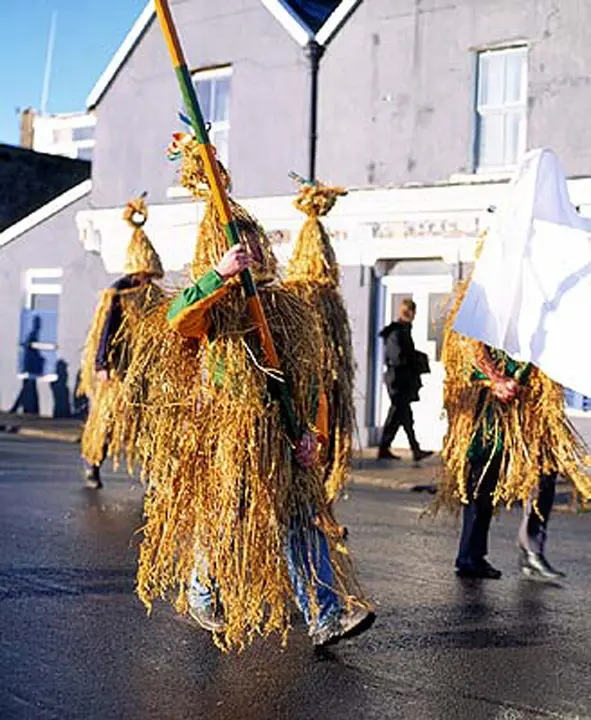
The day, as it was keptWrenboys in Dingle, County Kerry, some time between 1980 and 1999
Photograph: National Library of Ireland on The Commons · No restrictions
·
Wikimedia Commons
The hunt Men and boys beat the hedges with sticks on St Stephen's morning, and when a wren broke cover they threw sticks and stones at it. Whoever killed it was held to have a year's luck. This is the part that has gone: no bird is hunted today, and a fake or stuffed wren is carried instead.
The wren bush The dead bird was fixed inside a ball of holly, ivy and coloured ribbons on top of a long staff — sometimes a wheel or a frame of evergreen wreaths instead. That was the thing carried through the neighbourhood, held high.
The disguise The Wrenboys, lucht an dreoilín, went in straw masks and straw suits, or in masks made from the skin of a goat, a rabbit or a horse, and in motley. In Kerry they were led by a hobby horse, the Láir Bhán, the white mare.
The round of the houses Drums, fifes and melodeons, a song at every door, and money, food or drink collected — which was held to bring the household prosperity for the year. Every house was visited except one where somebody had lately died. That exception is the whole ethic of the custom in a single rule.
The burial At the end of the day the wren was buried, sometimes with full human rites: a tiny coffin, and a keen sung over it — the same caoineadh sung over people.
The wren dance What the money was for. The collection paid for a dance, sometimes called the wren's wake, held to bring the unmarried of the district together. A midwinter death, and then a matchmaking.
Held across rural Ireland into the mid-twentieth century, then thinned by
industrialisation and by changing feeling about the bird. Revived since the
late twentieth century without the hunt.
The song at the door
The wren the wren the king of all birds St Stephen's Day was caught in the furze Her clothes were all torn — her shoes were all worn Up with the kettle and down with the pan Give us a penny to bury the “wran” If you haven't a penny, a halfpenny will do If you haven't a halfpenny, God bless you!
Collected at Edmondstown, County Dublin, and recorded in the Schools' Collection (Volume 0797, page 44). There are as many versions as there were townlands; the last two lines turn up in English begging rhymes too, including 'Christmas is Coming'.
Dúchas — the Schools' Folklore Collection ↗
Why a wren?
The bird was held in real reverence. The ninth-century Cormac's Glossary
derives the Old Irish drean from druí-én, “druid bird”, and
calls it a bird that makes prophecies; another early text names it the magus
bird, “because some take auguries from it”. Harming a wren was taboo — on
every day but one.
What follows are the explanations people gave. They cannot all be right, and
that is the point: the stories contradict each other because they were
invented long afterwards to account for something already old.
Christian
It woke St Stephen's guards
A wren is said to have roused the guards as Stephen tried to escape from captivity, which is why the bird is hunted on his day. Another version gives Stephen a pet wren, stoned to death alongside him.
Christian
It ate St Moling's fly
Possibly the earliest written reference to a wren hunt at all: a medieval Irish legend in which the saint curses the wren to be hunted by the young, for eating his pet fly.
Patriotic
It betrayed the Irish
That a wren drummed on a soldier's drum, or beat its wings, and gave away an Irish force about to spring an ambush. The enemy is given variously as the Vikings, Cromwell's army or the Williamites — which is a good sign that the story is older than any of them and keeps being re-pointed at the most recent invader.
Fable
It cheated the eagle
The widespread European fable: the birds agree that whoever flies highest is king, and the wren hides in the eagle's feathers and pops out above him at the top. In some Irish versions the wren must pay for the title, or is put under a geis never to fly higher than a bush — and in Irish story, a king who breaks his geis dies for it.
Manx
She was a fairy woman
The Manx account. A fairy woman enchanted every man on the island into following her, and drowned them in the sea; when a hero finally found a way past her charms she turned into a wren and escaped, cursed to reappear as one each year.
Folklore scholarship
It is a sacrifice, and much older than any of these
The folklorists' reading. Edward Armstrong noted that the bird was revered yet killed at one season only, its feathers kept as talismans, its body buried with respect, and both bird and chief hunter given a royal title — the marks of a sacrifice. Others read the wren as the old king or the old year, killed at midwinter so the year can begin again. Christina Hole called every one of the tales above a rationalisation of a rite older than Christianity.
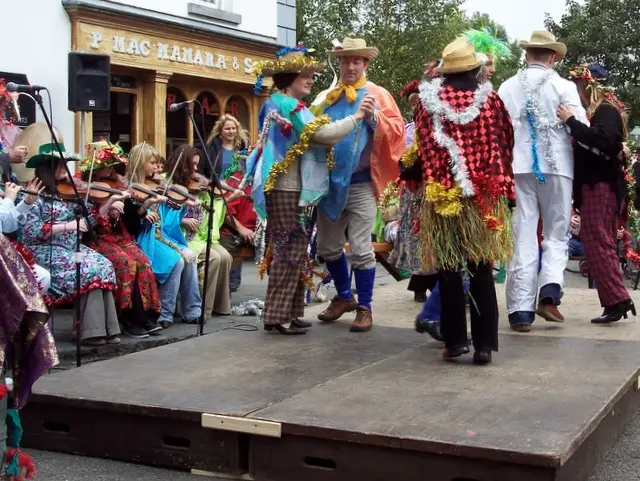
Wren Boys at Bunratty: the straw suits, still made and still worn
Photograph: Trish Steel ·
CC BY-SA 2.0
·
Wikimedia Commons
The honest answer
The origin of the wren hunt is unknown. It is probably pre-Christian and
probably sacrificial, and every confident single explanation you will read —
including the patriotic one about Cromwell — is a later rationalisation of a
rite whose reason had already been forgotten when the first of them was told.
The same day, elsewhere
The wren hunt was not only Irish. It was kept wherever, as one folklorist put
it, Celtic tradition was firmly entrenched — and in a few places that were not.
Isle of Man The strongest survival outside Ireland. The wren was buried at the parish church by torchlight, George Waldron recorded in 1731 that they sang dirges over her in Manx, and a donor might be given one of her feathers to keep as a charm against witchcraft. Revived in the 1990s; no bird is killed.↗
Wales Hela'r Dryw, held on Twelfth Day rather than St Stephen's, and continuing in Pembrokeshire into the early twentieth century. The bird was carried in a decorated wooden Wren House with windows in it, and was sometimes let go alive at the end.↗
England Kept in places until the authorities and industrialisation put it down by the mid-nineteenth century. Revived in Suffolk in 1994 by the Old Glory Molly Dancers, who have performed it at Middleton every Boxing Day since.↗
France Midwinter wren ceremonies at Carcassonne and elsewhere; the Fête du Roi de l'Oiseau at Le Puy-en-Velay is first recorded in 1524 and still runs. Whoever struck the bird first was made King, and led a torchlit procession that wrote vive le roi! on every door.↗
Galicia The Cacería do rei Charlo, recorded since the sixteenth century: the wren tied to a pole, paraded to the abbot, who fed the hunters and then appointed two of the town's councillors.↗
Quick answersWhat is Wren Day?
Lá an Dreoilín, 26 December — St Stephen's Day. Groups of men and boys in straw masks and motley, the Wrenboys, carried a wren on a decorated staff from house to house with drums and fifes, collecting money, food and drink to bring each household luck for the year. The money paid for a dance. It survives today in a handful of places, above all Dingle in County Kerry, and no bird is hunted any more.
Why was the wren hunted?
Nobody knows, and the folklorists say so. There are at least six competing stories — that a wren woke St Stephen's guards, that one ate St Moling's fly, that one betrayed an Irish ambush to the Vikings or to Cromwell, that it cheated the eagle to become king of the birds. Edward Armstrong argued that the sheer inconsistency of the tales shows the rite is far older than any of them, and reads its features as those of a sacrifice.
Why is the wren called the king of all birds?
From a fable told all over Europe: the birds agree that whoever flies highest will be king, and the wren hides in the eagle's feathers, then pops out above him at the top. In Irish versions the wren pays for the title — put under a geis never to fly higher than a bush.
Is the wren still killed on Wren Day?
No. The hunt itself died out through the twentieth century, and where Wren Day has been revived — Dingle most famously, and on the Isle of Man — a fake or stuffed wren is carried instead. The parades now generally raise money for charity or for a Wren Ball.
What is the wren song?
A begging song sung at each door, with as many versions as there were townlands. One collected at Edmondstown in County Dublin begins: “The wren the wren the king of all birds / St Stephen's Day was caught in the furze”, and ends “If you haven't a halfpenny, God bless you!”
Where does Wren Day still happen?
Mainly in the south of Ireland — Dingle in County Kerry keeps the biggest of them — and on the Isle of Man, where Hunt the Wren was revived in the 1990s. Related midwinter wren rites were kept in Wales, England, France and Galicia.
Did the Wrenboys come to your door? This is a custom that survives in living memory far better than it survives in books — the tune, the words your parish used, the year it stopped. Tell us what you remember.