Lá Fhéile Pádraig · 17 March

St Patrick's Day

More countries mark 17 March than mark any other national day, and a great deal of what they mark was invented a long way from Ireland and a long time after Patrick. That is not a complaint — the diaspora made this day, and made it generously. But it is worth knowing which parts are fifth-century, which are eighteenth-century Boston, and which are a drinks advertisement.

The man, as far as anyone can tell
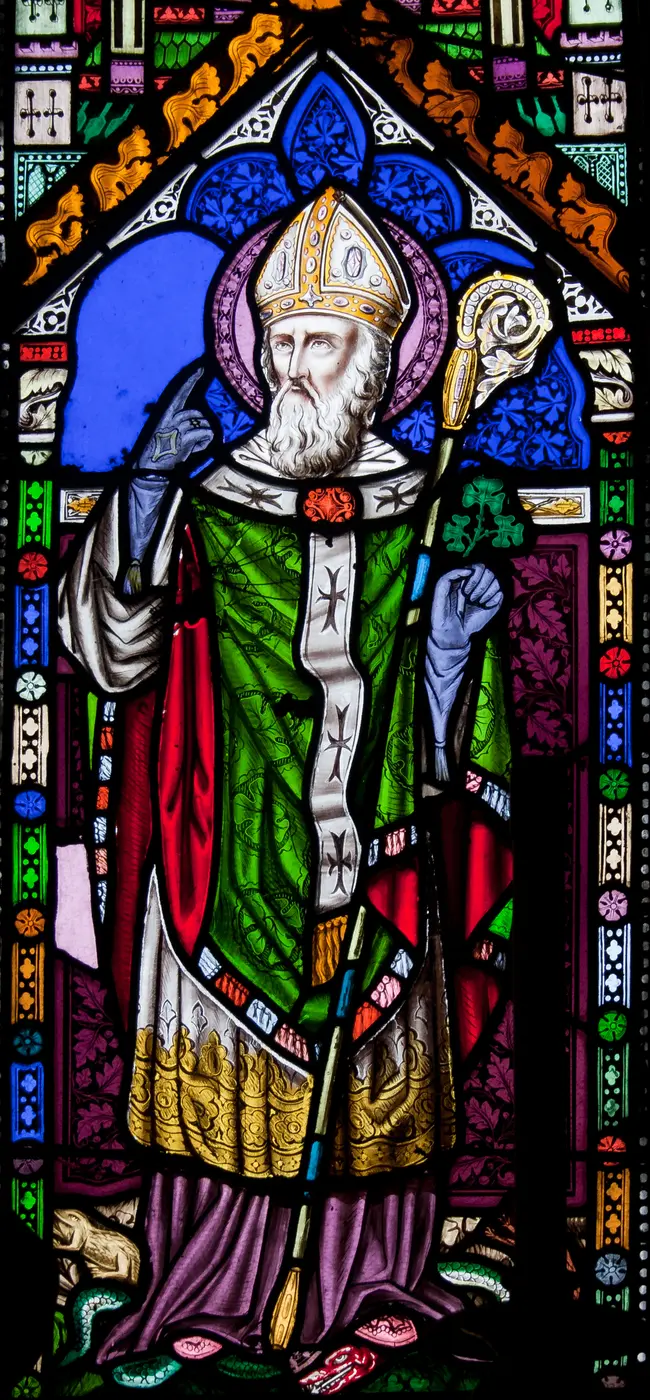
Photograph of Saint Patrick
Photograph: Andreas F. Borchert · CC BY-SA 4.0 · Wikimedia Commons

Almost everything anyone knows about Patrick comes from two short Latin letters he wrote himself: the Confessio and the Letter to the Soldiers of Coroticus. They are among the very few genuinely personal voices to survive from fifth-century Europe, and they are the writing of a man defending himself. He calls himself unlearned and means it.

In them he says he was born in Roman Britain, the son of a deacon and the grandson of a priest, and was not religious as a boy. At sixteen Irish raiders took him and sold him here, and he herded animals for six years before hearing a voice tell him a ship was ready. He walked some two hundred Roman miles to the coast and got home. Then, years later, he came back.

What he does not say No snakes. No shamrock. No paschal fire on the Hill of Slane, no contest with the king at Tara, no forty days on Croagh Patrick. Every one of those enters the record in the seventh century or later, when the church of Armagh was building its claim to primacy over the whole Irish church and needed a founder the size of the claim. They are good stories about what the Irish wanted Christianity to have been. They are not his.

Patrick's saint page · The name Pádraig · Read the Confessio itself ↗

Say it in Irish

The one phrase worth having by heart, and the ones that go around it. Every greeting here is said in Irish, in Ireland, today — which is more than can be said for most of what is printed on a card in March.

Lá Fhéile Pádraig sona duit
“law AY-la PAW-drig SUN-a dit”
Happy St Patrick's Day to you

Not 'St Patty's'. Pádraig shortens to Paddy, never Patty — Patty is short for Patricia.

Céad míle fáilte
“kayd MEE-la FAWL-cha”
A hundred thousand welcomes

On the door of half the pubs in Ireland, and on the arch of a good many towns.

Sláinte!
“SLAWN-cha”
Health! — the toast

Literally just 'health'. Sláinte mhaith is 'good health'; the answer is sláinte agatsa, 'health to you too'.

Fad saol agat, gob fliuch, agus bás in Éirinn
“fad SAYL a-gut, gub flukh, AH-gus baws in AY-rin”
Long life to you, a wet mouth, and death in Ireland

A toast, and a complete philosophy in nine words: live long, never be thirsty, and die at home. The third wish was the one the emigrant ships took away.

Go n-éirí an bóthar leat
“guh NYEE-ree un BOH-har lat”
May the road rise to meet you

The most famous Irish blessing in the world — and a translation that improved on the original by accident. The Irish literally means 'may the road succeed with you'; éirigh means both to rise and to succeed, and the English took the wrong one and made poetry of it.

Slán abhaile
“slawn a-WAL-ya”
Safe home

What you say to someone leaving at the end of a night. It is the sign at the edge of many Irish towns, facing outward.

To more than one person: Lá Fhéile Pádraig sona daoibh — “…SUN-a deev”. Pronunciations are written for an English speaker and give the commonest Irish-English form; Ulster, Connacht and Munster differ.

All the Irish blessings · Sayings & seanfhocail · Write a name in ogham

Eight things nearly everyone gets wrong

None of these are meant to spoil anybody's day. Most are good stories — they are simply younger than they are said to be, and where they came from is usually more interesting than the version on the tea towel.

“Patrick drove the snakes out of Ireland”

There were never any snakes

Post-glacial Ireland has never had snakes, and this was being noted as a curiosity by the Roman writer Solinus in the third century — two hundred years before Patrick. The banishing legend is not even his originally: the earliest Irish text about a saint driving out snakes is the Life of Colmcille, written in the late seventh or early eighth century. It is attached to Patrick only in the late twelfth century, by Jocelyn of Furness. Gerald of Wales repeated it a few decades later and was already sceptical.

Source: Wikipedia ↗
“He used the shamrock to explain the Trinity”

First written down in 1726

The story appears in writing for the first time in 1726, some thirteen hundred years after Patrick, though it may have been told for a while before that. Nothing in his own writings mentions it. Three was a powerful number in pagan Ireland (the triple deities, the triskele) so the idea may have had ground to fall on, but the shamrock as a teaching aid is a legend, not a record.

Source: Wikipedia ↗
“Patrick was Irish”

He was a Roman Briton, and came here as a slave

He was born in Roman Britain to a Romano-British family (his father a deacon and town councillor, his grandfather a priest) and his first language was British Celtic. Irish raiders took him at sixteen and he herded animals here for six years before escaping. He came back years later by choice, to the country that had enslaved him. That is the part of the story worth keeping.

Source: Wikipedia ↗
“It has always been green”

The saint's own colour is blue

Green ribbons and shamrock have been worn on the day since at least the 1680s, but when the Order of St Patrick was founded in 1783 it took blue as its colour — which is why St Patrick's blue exists at all. Green became the national colour through the United Irishmen in the 1790s and the song 'The Wearing of the Green'; Ireland was first called the Emerald Isle in a poem of 1795. The green you are wearing is political before it is religious.

Source: Wikipedia ↗
“It's St Patty's Day”

Paddy. Always Paddy

The Irish is Pádraig, which gives the pet forms Páidín and Paddy. Patty is short for Patricia, which is a different name for a different person. Nobody in Ireland says Patty, and the mistake is the fastest way to mark a greeting as having come from somewhere else.

Source: Wikipedia ↗
“The parade is an ancient Irish tradition”

The parades came home from America

Parades began among the diaspora in eighteenth-century North America and did not reach Ireland until the twentieth century. The first parade in Ireland was held in Waterford in 1903, and the first state-organised parade in Dublin was in 1931. Until the late twentieth century the day was a bigger occasion abroad than at home.

Source: Wikipedia ↗
“Corned beef and cabbage is the traditional dinner”

An Irish-American dish

It was adopted by Irish immigrants in nineteenth-century America, where beef was cheap and the butcher next door was often Jewish. It is a genuine tradition (an Irish-American one, with its own real history) but it is not what was eaten in Ireland, and it is not what is eaten in Ireland now.

Source: Wikipedia ↗
“The drinking is the oldest part of it”

The Irish state banned it for thirty-four years

The revelry has a religious root: 17 March falls in Lent, and the Lenten restrictions on food and drink are lifted for the feast. But the Free State government banned the sale of alcohol on St Patrick's Day in 1927, and the ban was not repealed until 1961 — so for a third of a century the pubs of Ireland were shut on the day the rest of the world now drinks to.

Source: Wikipedia ↗
How the day was made

A feast for a fifth-century bishop became a national day in exile, then a holiday at home, then the most widely celebrated national festival on earth. Almost every step of that happened outside Ireland first.

5th c.
Patrick's mission
The Irish annals put his arrival at 432, but they were compiled centuries later and the date may have been chosen to diminish Palladius, sent as bishop in 431. The annals give several years for his death; one entry records it on 17 March.
7th c.
The legends are written
Muirchú and Tírechán compose the first Lives, two centuries after the fact. The paschal fire on the Hill of Slane, the contest with the king of Tara and the founding of Armagh all enter the record here — as does Armagh's claim to primacy over the Irish church.
9th–10th c.
A national day, in exile first
Irish monks and scholars on the Continent are already keeping his feast as a day for the Irish as a people. The pattern of the whole holiday, Irishness celebrated hardest by the Irish who are elsewhere, is set from the beginning.
c. 1600
Onto the calendar
The Waterford-born Franciscan Luke Wadding, sitting on the commission reforming the Breviary, gets Patrick's feast placed on the Catholic universal calendar. In Ireland it becomes a holy day of obligation.
1600–01
The first parade, in Spanish Florida
Research published by the historian Michael Francis in 2017 found records of a St Patrick's Day celebration at St Augustine in Spanish Florida in 1600, and a parade there in 1601 — organised by the colony's Irish vicar, Ricardo Artur. The first parade in the New World was Spanish, and predates the English colonies entirely.
1680s
Green ribbons and shamrock
The wearing of green ribbons and shamrock on the day is recorded from at least this decade.
1726
The shamrock explains the Trinity
The story appears in print for the first time, thirteen centuries after Patrick.
1737
Boston gathers
The Charitable Irish Society of Boston holds the first observance in the Thirteen Colonies — a Protestant gathering, Irish emigration to the colonies then being largely Protestant, held to honour a homeland rather than a church.
1762
New York begins
New York's first observance is held in the house of John Marshall, an Irish Protestant. Irish soldiers in the British Army march in the city in 1766.
1780
Washington gives the day off
Camped at Morristown, New Jersey, General Washington grants his troops a holiday on 17 March as an act of solidarity with the Irish in their own fight for independence.
1903
A holiday at last — and Waterford marches
The Bank Holiday (Ireland) Act 1903, brought in by the Irish Parliamentary Party MP James O'Mara, makes 17 March a public holiday in Ireland. The Gaelic League declares that week Irish Language Week, and Waterford holds the first St Patrick's Day parade ever held in Ireland — three centuries after St Augustine.
1916
Thirty-eight parades
The Irish Volunteers parade across Ireland on St Patrick's Day: the authorities count 38 parades and 6,000 marchers, almost half of them armed. The Rising follows in April.
1927–1961
The pubs shut
The Free State bans the sale of alcohol on St Patrick's Day. It stays legal across the border in Northern Ireland. The ban is repealed in 1961.
1931
Dublin's first state parade
The first official, state-sponsored parade in Dublin.
1952
A bowl of shamrock
Ambassador John Hearne sends a box of shamrock to President Truman. It becomes a custom, and since 1994 the Taoiseach has handed the bowl over in person every year — the only standing annual audience any head of government has at the White House.
1962
Chicago dyes the river
The plumbers' union tips dye into the Chicago River and keeps the recipe secret. Since 1966 it has been vegetable-based.
1996
Ireland reclaims the day
The first St Patrick's Festival is held in Dublin, deliberately built to project Ireland to the world rather than to receive an image of itself back from abroad. It grows from one day to five.
2010
The world goes green
Tourism Ireland's Global Greening begins with the Sydney Opera House and Auckland's Sky Tower. Over 300 landmarks in fifty countries have since been lit.
When 17 March moves The church calendar will not let a saint's feast sit inside Holy Week, so occasionally the observance shifts: to 3 April in 1940, to 15 March in 2008. It will not happen again until 2160. The parades and the parties, needless to say, stay put on the 17th.

Patrick's Ireland: eight places you can stand in

Every one of these is a claim of tradition rather than a documented fact of his life — but the traditions are old, and the places are real. Two of them contradict each other, which is left in on purpose.

Many of them are pinned on the Hidden Ireland map · The older Irish year · All the saints and their feast days

The other thing that happens in March

The week running up to 17 March is Seachtain na Gaeilge, Irish Language Week — and it is not a modern add-on. The Gaelic League declared the week of St Patrick's Day 1903 Irish Language Week, and Waterford's procession that same week became the first St Patrick's Day parade ever held in Ireland. The language and the parade arrived in Ireland together.

If you do one thing in Irish this March, make it your own name. How to pronounce Irish names · What your surname means in Irish · Trace the family that carried it out of Ireland

Quick answers
Why is St Patrick's Day on 17 March?

It is his feast day — the traditional date of his death in the fifth century. The Irish annals disagree about the year but one entry records the day as 17 March. It became a fixed feast in the Catholic calendar in the early 1600s, largely through the Waterford Franciscan Luke Wadding.

Is it Paddy or Patty?

Paddy. The Irish name is Pádraig, which gives Páidín and then Paddy. Patty is short for Patricia — a different name entirely. In Irish the greeting is Lá Fhéile Pádraig sona duit, “law AY-la PAW-drig SUN-a dit”.

Did St Patrick really banish the snakes from Ireland?

No — Ireland has had no snakes since the Ice Age, and the Roman writer Solinus was already remarking on it in the third century, two hundred years before Patrick. The earliest Irish snake-banishing story belongs to Colmcille, not Patrick; it was attached to Patrick only in the late twelfth century by Jocelyn of Furness.

Was St Patrick Irish?

No. He was a Roman Briton, born to a Romano-British family, whose first language was British Celtic. Irish raiders enslaved him at sixteen and he herded animals here for six years before escaping home. He returned years later as a missionary — by choice, to the country that had held him.

Did Patrick use the shamrock to explain the Trinity?

It is a legend, not a record. The story is first written down in 1726, some thirteen hundred years after him, and nothing in his own surviving writings mentions it.

Where was the first St Patrick's Day parade?

In St Augustine, Spanish Florida, in 1601 — organised by the colony's Irish vicar, according to research published by the historian Michael Francis in 2017. Boston gathered in 1737 and New York in 1762. The first parade held in Ireland was in Waterford in 1903, and Dublin's first state parade was in 1931.

How do you say Happy St Patrick's Day in Irish?

Lá Fhéile Pádraig sona duit — “law AY-la PAW-drig SUN-a dit”, literally “a happy day of the festival of Patrick to you”. To more than one person: Lá Fhéile Pádraig sona daoibh.

Is St Patrick's Day a public holiday in Ireland?

Yes, in both jurisdictions on the island. It became a public holiday under the Bank Holiday (Ireland) Act 1903, introduced by the Irish Parliamentary Party MP James O'Mara. Less famously, the Free State banned the sale of alcohol on the day from 1927 until 1961.

Sources

Dates that cannot be pinned down are not pinned down here: the year of Patrick's death, and where in Ireland he was enslaved, are both genuinely disputed, and this page says so rather than choosing.

How does your family keep the day? The wearing of a St Patrick's Day cross, the drowning of the shamrock, a parade in a town of four hundred people on the other side of the world — a great deal of this survives only in family memory. Tell us yours.

Add a custom →