County Mayo
“my OH” · plain of the yew trees, from magh (plain) + eo (yew)
Known as The Yew County. The name says it. Maigh Eo is the plain of the yew trees, and the nickname is a translation of the county's own name rather than anything added to it. The Maritime County is also used, for the Atlantic coast.
A fact like this for every county and every age →
Compare with another county → · Printable one-page summary →
There were people at Belderrig on the north Mayo coast by about 4500 BC, and the Neolithic farmers who followed laid out the walled fields now under the bog at the Céide Fields; the county has more than 160 recorded megalithic tombs, of all four Irish types. Croagh Patrick is where Patrick is believed to have prayed for forty days and nights, and monasteries followed at Mayo Abbey, Aughagower, Ballintubber, Cong, Killala, Turlough and on islands off the Mullet. Vikings raided from 795 but, unusually, founded no town here.
The Normans took Mayo in 1235 under Richard Mór de Burgh, bringing the Burkes, Gibbons, Stauntons, Prendergasts, Joyces, Walshes, Barretts and Costellos, whose names are still common; after the 1330s they went native, and the Mac William Burkes became the strongest family in the county. Grace O'Malley, the pirate queen, is the best-known Mayo figure of the late 16th century. Armada survivors who came ashore in 1588 were robbed, imprisoned and many killed. Between 1641 and 1653 a third of the population is reported to have died by war, famine and plague, and Cromwell's "to hell or to Connaught" sent displaced families west.
In 1798 the French under Humbert landed at Killala, won the Battle of Castlebar and set up a short-lived Republic of Connacht under John Moore; the reprisals earned the county's high sheriff, Denis Browne, the name "Donnchadh an Rópa". The Famine was especially bad in Mayo, where nearly ninety per cent of people lived on the potato. In 1879 fifteen people reported an apparition at Knock, and the same year Michael Davitt and James Daly began the Land League here; near Lough Mask the ostracism of Charles Boycott gave English a new word. Mary Robinson, the first woman President of Ireland, and Enda Kenny, Taoiseach from 2011, are from Mayo.
Drawn from the History section of the Wikipedia article on County Mayo ↗, rewritten here and adding nothing it does not say; licensed CC BY-SA 4.0. The chronology above is this site's own; where the two differ, the article is the one to check.
It is bounded on the north and west by the Atlantic Ocean; on the south by County Galway; on the east by County Roscommon; and on the northeast by County Sligo. Mayo is the third-largest of Ireland's 32 counties in area and 18th largest in terms of population. It is the second-largest of Connacht's five counties in both size and population. Mayo has of coastline, or approximately 21% of the total coastline of the State. It is one of three counties which claims to have the longest coastline in Ireland, alongside Cork and Donegal. There is a distinct geological difference between the west and the east of the county. The west consists largely of poor subsoils and is covered with large areas of extensive Atlantic blanket bog, whereas the east is largely a limestone landscape. Agricultural land is therefore more productive in the east than in the west. Clew Bay lies on the west coast of the county.
Read the full article ↗ · Text from Wikipedia, licensed CC BY-SA 4.0.
Tap a name for its full page — story, homeland map and neighbours. Or see all surnames from County Mayo, with the other counties each name is tied to.
Towns. Castlebar Caisleán an Bharraigh (13,054, 2022), Ballina Béal an Átha (10,556, 2022), Ballinrobe Baile an Róba (3,148, 2022), Ballyhaunis Béal Átha hAmhnais (2,773, 2022), Westport Cathair na Mart. What every town name means →
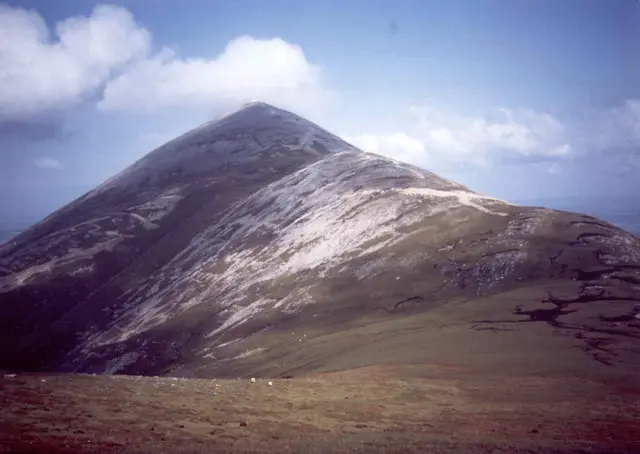
Legends set here. Croagh Patrick — the forty days. On the atlas →
At the 2022 census, 56,346 people in Mayo said they could speak Irish. 2,049 speak it every day outside school, and 3,831 weekly.
13 primary schools here teach entirely through Irish (2025/26, 1,152 pupils), and 2 secondary schools.
Mayo's Gaeltacht had 10,515 people in 2022, 727 of them daily Irish speakers. The Gaeltacht in numbers →
CSO, Census 2022, table SAP2022T3T2CTY. Every county compared →
Mweelrea (Cnoc Maol Réidh), 814 metres, in the Mweelrea Mountains.
National park: Wild Nephin (1998). All the national parks →
Wrecks on its coast: HMS Lee (1909). Shipwrecks of Ireland →
Rivers and loughs: River Moy, River Clare, Boyle River, River Robe, Lough Corrib, Lough Mask, Lough Conn, Lough Carra.
MountainViews, via Wikipedia. Every county's highest point → · Rivers and loughs →
Hurling: no senior title.
Football: 4 senior titles (1936, 1950, 1951, 2026); 15 finals lost.
-
Grace O'Malley ↗
Pirate Queen of Umaill, chieftain of the Ó Máille clan, born at Clare Island -
Charles Haughey ↗
· 1925–2006
7th Taoiseach from 1979 to 1981; 1982; 1987 to 1992, born at Castlebar -
George Moore ↗
· 1852–1933
Irish novelist, short-story writer, poet, art critic, memoirist and dramatist, born at Ballyglass -
William Brown ↗
Admiral in the Argentine Navy, born at Foxford -
Martin Sheridan ↗
· 1881–1918
American athletics competitor, born at Swinford -
Michael Davitt ↗
· 1846–1906
Irish republican and nationalist agrarian agitator, born at Strade -
Joe Lydon ↗
· 1878–1937
Boxer, born at Swinford -
Patrick Browne ↗
· 1720–1790
Irish physician and botanist -
Joseph Maher ↗
· 1933–1998
Irish actor, born at Westport -
John MacBride ↗
· 1868–1916
Irish republican, born at Westport -
John D'Alton ↗
· 1882–1963
Irish Cardinal of the Roman Catholic Church and Archbishop of Armagh, born at Claremorris -
James Clarke ↗
· 1874–1929
British tug of war competitor -
Thomas Gann ↗
· 1867–1938
British physician, archaeologist and looter, born at Murrisk -
Patrick Philbin ↗
British tug of war competitor, born at Castlebar -
William O'Dwyer ↗
· 1890–1964
Irish-American politician and diplomat; 100th Mayor of New York City (1946-1950); attained rank of Brigadier General in WW II -
James T. Kelley ↗
· 1854–1933
Irish actor, born at Castlebar -
Kathleen Lynn ↗
· 1874–1955
Irish politician, activist and medical doctor, born at Killala -
Patrick Peyton ↗
· 1909–1992
Irish Roman Catholic priest and promoter of the Rosary, born at Attymass -
Mick Lally ↗
· 1945–2010
Irish actor, born at Tuar Mhic Éadaigh -
John T. McNicholas ↗
· 1877–1950
Roman Catholic Bishop of Duluth; Archbishop of Cincinnati, born at Kiltimagh -
Louis Brennan ↗
· 1852–1932
Irish mechanical engineer and inventor, born at Castlebar -
Myles McKeon ↗
· 1919–2016
Catholic bishop, born at Drummin -
Seán Flanagan ↗
· 1922–1993
Irish politician, born at Ballyhaunis -
Ernie O'Malley ↗
· 1897–1957
Irish republican, politician and writer, born at Castlebar -
Margaret Burke Sheridan ↗
· 1889–1958
Irish opera singer, born at Castlebar -
William M. Browne ↗
· 1823–1883
Confederate Army general -
Seán Ó hEinirí ↗
· 1915–1998
Irish seanchaí, born at Cill Ghallagáin -
William Joyce Sewell ↗
· 1835–1901
United States Army Medal of Honor recipient, born at Castlebar -
James Hardiman ↗
· 1782–1855
Irish librarian, born at Westport -
Emmet Stagg ↗
· 1944–2024
Irish politician, born at Hollymount
From Wikidata: people whose recorded birthplace is in the county, who have a Wikipedia article and are no longer living, with dates shown only where the article confirms them, ordered by how many languages Wikipedia covers them in. Traditional birthplaces of early saints are as Wikidata records them. Dates are left off where the sources disagree.
Mayo had 388,887 people in 1841 and has 137,231 now (-65%). Its peak was 388,887 in 1841; its low point 109,525 in 1971, -72% of 1841. It has never regained the population it had before the Famine.
| 1821 | 1831 | 1841 | 1851 | 1861 | 1871 | 1881 | 1891 | 1901 | 1911 | 1926 | 1936 | 1946 | 1951 | 1956 | 1961 | 1966 | 1971 | 1979 | 1981 | 1986 | 1991 | 1996 | 2002 | 2006 | 2011 | 2016 | 2022 |
|---|---|---|---|---|---|---|---|---|---|---|---|---|---|---|---|---|---|---|---|---|---|---|---|---|---|---|---|
| 293,112 | 366,328 | 388,887 | 274,499 | 254,796 | 246,030 | 245,212 | 219,034 | 199,166 | 192,177 | 172,690 | 161,349 | 148,120 | 141,867 | 133,052 | 123,330 | 115,547 | 109,525 | 114,019 | 114,766 | 115,184 | 110,713 | 111,524 | 117,446 | 123,839 | 130,638 | 130,507 | 137,231 |
Census returns as tabulated in the county's Wikipedia article. All 32 counties, 1821 to today →
- Aghagower · round tower · incomplete · 16 m
- Balla · round tower · incomplete · 10 m
- Barnacahoge Cashel · fort
- Behy court tomb · tomb
- Breastagh Ogham Stone · ogham stone
- Dolmen of the Four Maols · tomb
- Killala · round tower · complete · 25.5 m
- Meelick · round tower · incomplete · 21 m
- Turlough Abbey · round tower · complete · 22.9 m
- 13 castles · Aghalard Castle, Ashford Castle, Ballylahan Castle, Caherduff Castle, Carrickkildavnet Castle and more
Every pin is placed by its documented coordinates. All the monuments of Ireland →
Everything on the site about County Mayo
The county
History
Monuments and heritage
Coast and country
What is the Irish name for County Mayo?
Maigh Eo. Mayo is one of the 5 counties of Connacht (Cúige Chonnacht).
Who ruled County Mayo in the Middle Ages?
Around 1014 it was held by Kingdom of Connacht (O'Connor); by 1450, Mac William Bourke (Mayo). The full era-by-era chronology is on this page.
What surnames come from County Mayo?
Names historically associated with Mayo include Bannon, Barrett, Blake, Bradley, Brogan, Burke, Cafferty, Carey, among others.
What does Maigh Eo mean?
Maigh Eo, said “my OH”, means plain of the yew trees — from magh (plain) + eo (yew). Named for the village of Mayo, now Mayo Abbey — once a monastery famous enough to be called Mayo of the Saxons.
What is the population of County Mayo?
137,231 at the 2022 census, against 388,887 in 1841, before the Famine.
What is the county town of Mayo?
Castlebar. County Mayo covers about 5,588 km², which makes it the 3rd largest of the 32 counties.
Who are famous people from County Mayo?
Among the best-known people born in Mayo are Grace O'Malley, Charles Haughey, George Moore, William Brown, Martin Sheridan, Michael Davitt. The full list, with their birthplaces, is on this page.
What did the Famine do to County Mayo?
The census counted 388,887 people in Mayo in 1841 and 274,000 in 1851 (the 1851 figure is approximate): a change of -30% in ten years, through death and emigration.
A clean copy for school projects or the family file; collapsed sections print in full.
- Wikipedia — County Mayo ↗
- CSO — Census of Population 2022 ↗
- NISRA — Census 2021 ↗
- Wikipedia — List of Irish counties by population ↗
- 1841 census of Ireland (county table) ↗
- Historical population of Ireland (county series) ↗
- Logainm.ie — the State's Placenames Database of Ireland ↗
- Wikipedia — Counties of Ireland ↗
- Wikipedia — the county articles ↗
- Woulfe, Irish Names and Surnames (1923), for the surnames ↗
The chronology of who held the county is this site's own reading of the standard histories onto today's county borders, and says so where the fit is rough. Quoted passages are marked and licensed. Spotted an error? Say so — corrections are credited.
- 1911 Census — Mayo ↗
- 1901 Census — Mayo ↗
- Griffith's Valuation — search Mayo ↗
- Down Survey maps — Mayo ↗
- Schools' Folklore Collection — Mayo ↗
- Placenames of Mayo (Logainm) ↗
- Landed Estates — Mayo ↗
Free, from the holding institutions. How to begin: the six-step guide → · Spotted an error on this page? Suggest a correction.