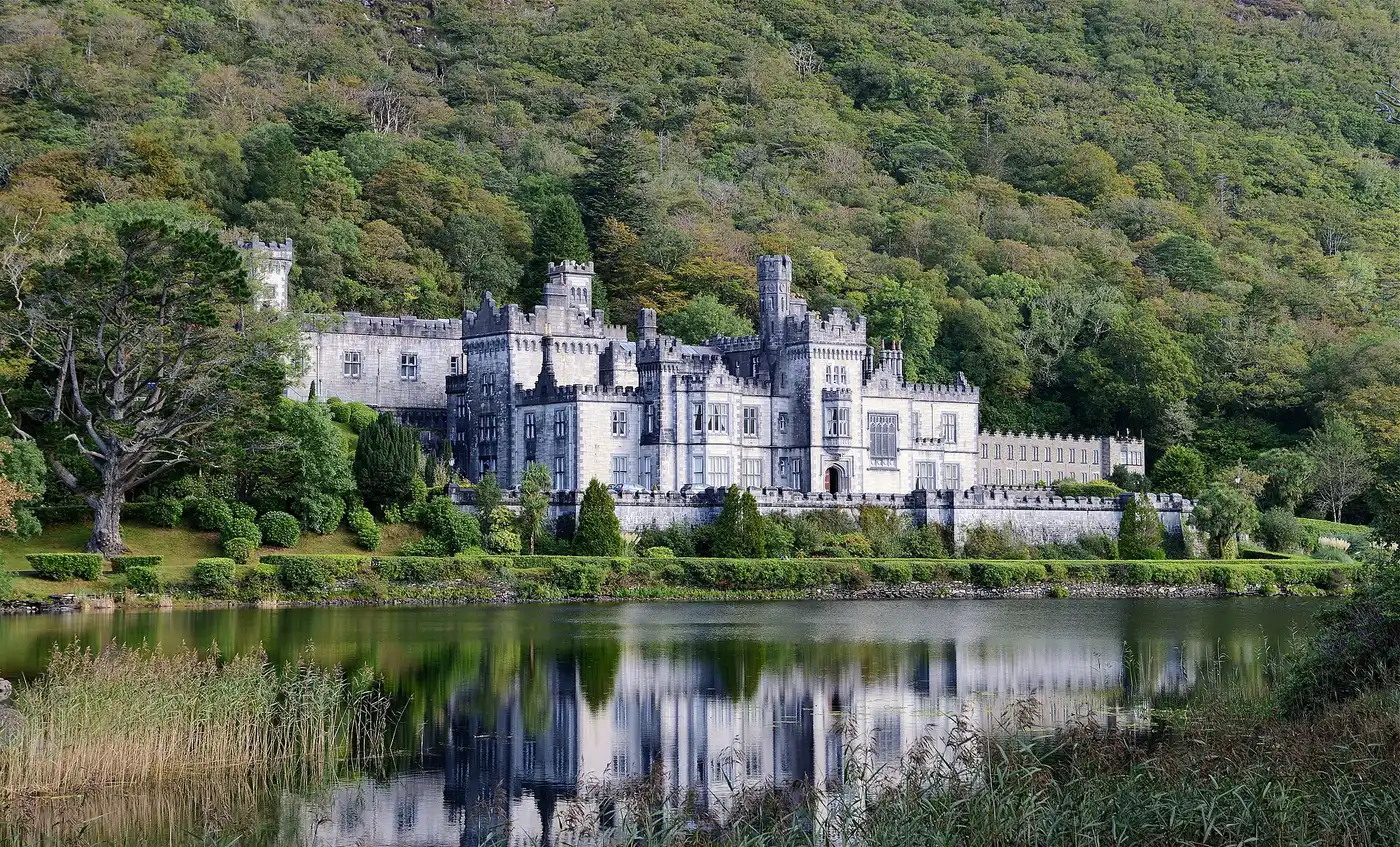
County Galway
“GAL-yiv” · stony — the river Gaillimh, from gall (stone), usually read
Known as The Tribesmen. For the fourteen merchant families who ran the city for centuries: Blake, Joyce, Lynch, Bodkin and the rest. The name was originally an insult from Cromwellian forces, and the families took it up as a badge.
A fact like this for every county and every age →
Compare with another county → · Printable one-page summary →
Shell middens show people in the Galway area by about 5000 BC. Before the county existed its land was several kingdoms — Aidhne, Uí Maine, Maigh Seóla, Conmhaicne Mara, Soghain and Máenmag — and Connemara still keeps its own identity, though nobody agrees where its borders run: somewhere between a fifth and a third of the county.
County Galway became an official entity around 1569. With Christianity came many monasteries, and their written records, law-tracts, genealogies and annals are where the county's early history comes from. It takes in inhabited islands, among them the Aran Islands and Inishbofin.
Drawn from the History section of the Wikipedia article on County Galway ↗, rewritten here and adding nothing it does not say; licensed CC BY-SA 4.0. The chronology above is this site's own; where the two differ, the article is the one to check.
County Galway is home to Na Beanna Beola (Twelve Bens) mountain range, Na Sléibhte Mhám Toirc (the Maum Turk mountains), and the low mountains of Sliabh Echtghe (Slieve Aughty). The highest point in the county is one of the Twelve Bens, Benbaun, at 729m.
County Galway is partly home to a number of Ireland's largest lakes including Lough Corrib (the largest lake in the Republic of Ireland), Lough Derg and Lough Mask. The county is also home to a large number of smaller lakes, many of which are in the Connemara region. These include Lough Anaserd, Ardderry Lough, Aughrusbeg Lough, Ballycuirke Lough, Ballynahinch Lake, Lough Bofin, Lough Cutra, Derryclare Lough, Lough Fee, Glendollagh Lough, Lough Glenicmurrin, Lough Inagh, Kylemore Lough, Lettercraffroe Lough, Maumeen Lough, Lough Nafooey, Lough Rea, Ross Lake and Lough Shindilla.
Read the full article ↗ · Text from Wikipedia, licensed CC BY-SA 4.0.
Tap a name for its full page — story, homeland map and neighbours. Or see all surnames from County Galway, with the other counties each name is tied to.
Towns. Galway Gaillimh (85,910, 2022), Tuam Tuaim (9,647, 2022), Ballinasloe Béal Átha na Sluaighe (6,597, 2022), Loughrea Baile Locha Riach (6,322, 2022), Athenry Baile Átha an Rí (4,603, 2022), Gort Gort Inse Guaire (2,870, 2022), Portumna Port Omna (1,690, 2022), Clifden An Clochán. What every town name means →
Saints. St Enda of Aran (21 March), St Jarlath (6 June).
Legends set here. Hy-Brasil · Dún Aonghasa. On the atlas →
First names that belong here. Nóra, Iarlaith, Enda, Bairbre, Breasal, Murchadh.
At the 2022 census, 121,930 people in Galway said they could speak Irish. 13,507 speak it every day outside school, and 9,182 weekly.
41 primary schools here teach entirely through Irish (2025/26, 5,045 pupils), and 11 secondary schools.
Galway's Gaeltacht had 36,687 people in 2022, 9,373 of them daily Irish speakers. The Gaeltacht in numbers →
CSO, Census 2022, table SAP2022T3T2CTY. Every county compared →
Benbaun (An Bhinn Bhán), 729 metres, in the Twelve Bens.
National park: Connemara (1980). All the national parks →
Wrecks on its coast: MV Plassy (1960). Shipwrecks of Ireland →
Rivers and loughs: River Shannon, River Suck, River Clare, Lough Corrib, Lough Derg, Lough Mask.
MountainViews, via Wikipedia. Every county's highest point → · Rivers and loughs →
Hurling: 5 senior titles (1923, 1980, 1987, 1988, 2017); 21 finals lost.
Football: 9 senior titles (1925, 1934, 1938, 1956, 1964, 1965, 1966, 1998, 2001); 15 finals lost.
-
Augusta, Lady Gregory ↗
· 1852–1932
Irish playwright, poet, folklorist, born at Loughrea -
Richard Kirwan ↗
· 1733–1812
Irish geologist and chemist -
Liam O'Flaherty ↗
Irish writer, born at Inis Mór -
Robert O'Hara Burke ↗
Australian explorer -
Máirtín Ó Cadhain ↗
· 1906–1970
Irish writer, born at An Spidéal -
Éamonn Ceannt ↗
· 1881–1916
Irish republican and 1916 Easter Rising leader, born at Ballymoe -
Ruaidrí Ua Conchobair ↗
· 1116–1198
High King of Ireland, born at Tuam -
Dolores Keane ↗
· 1953–2026
Irish singer -
Edward Martyn ↗
Irish nationalist and cultural activist -
John Conness ↗
· 1821–1909
American politician -
Denis Daly ↗
· 1862–1942
Polo player, born at Athenry -
Henry Benedict Medlicott ↗
· 1829–1905
Irish geologist, born at Loughrea -
Máirtín Ó Direáin ↗
· 1910–1988
Irish poet, born at Inis Mór -
Patrick d'Arcy ↗
· 1725–1779
Irish physicist, born at Kiltullagh -
Richard Trench, 2nd Earl of Clancarty ↗
· 1767–1837
British politician, born at Ballinasloe -
John Riley ↗
Irish soldier, born at Clifden -
R. Luke Concanen ↗
· 1747–1810
Catholic bishop -
Paddy Glynn ↗
· 1855–1931
South Australian politician and barrister, born at Gort -
Frank Fahy ↗
· 1880–1953
Irish politician -
Seumas O'Kelly ↗
Irish journalist, fiction writer, and playwright, born at Loughrea
From Wikidata: people whose recorded birthplace is in the county, who have a Wikipedia article and are no longer living, with dates shown only where the article confirms them, ordered by how many languages Wikipedia covers them in. Traditional birthplaces of early saints are as Wikidata records them. Dates are left off where the sources disagree.
Galway had 440,198 people in 1841 and has 276,451 now (-37%). Its peak was 440,198 in 1841; its low point 148,340 in 1966, -66% of 1841. It has never regained the population it had before the Famine.
| 1821 | 1831 | 1841 | 1851 | 1861 | 1871 | 1881 | 1891 | 1901 | 1911 | 1926 | 1936 | 1946 | 1951 | 1956 | 1961 | 1966 | 1971 | 1979 | 1981 | 1986 | 1991 | 1996 | 2002 | 2006 | 2011 | 2016 | 2022 |
|---|---|---|---|---|---|---|---|---|---|---|---|---|---|---|---|---|---|---|---|---|---|---|---|---|---|---|---|
| 169,503 | 204,691 | 440,198 | 321,684 | 271,478 | 248,458 | 242,005 | 214,712 | 192,549 | 182,224 | 169,366 | 168,198 | 165,201 | 160,204 | 155,553 | 149,887 | 148,340 | 149,223 | 167,838 | 172,018 | 178,552 | 180,364 | 188,854 | 209,077 | 231,670 | 250,541 | 258,058 | 276,451 |
Census returns as tabulated in the county's Wikipedia article. All 32 counties, 1821 to today →
- Aran Islands · round tower · incomplete · 3.02 m
- Ardrahan · round tower · incomplete · 3 m
- Carrownlisheen Wedge Tomb · tomb
- Dún Aonghasa · fort
- Dún Dúchathair · fort
- Kilbennan · round tower · incomplete · 16.5 m
- Kilcoona · round tower · incomplete · 3 m
- Kilmacduagh · round tower · complete · 34.5 m
- Roscam · round tower · incomplete · 10.98 m
- St. Cuan's Well · holy well
- Tuam · high cross
- Turoe Stone · tomb
- 37 castles · Ardamullivan Castle, Arkin's Castle, Athenry Castle, Aughnanure Castle, Ballymore Castle and more
Every pin is placed by its documented coordinates. All the monuments of Ireland →
Everything on the site about County Galway
The county
History
Monuments and heritage
Coast and country
What is the Irish name for County Galway?
Gaillimh. Galway is one of the 5 counties of Connacht (Cúige Chonnacht).
Who ruled County Galway in the Middle Ages?
Around 1014 it was held by Kingdom of Connacht (O'Connor); by 1450, Clanricarde (Burke). The full era-by-era chronology is on this page.
What surnames come from County Galway?
Names historically associated with Galway include Bermingham, Blake, Bodkin, Broderick, Burke, Cahill, Canavan, Clarke, among others.
What does Gaillimh mean?
Gaillimh, said “GAL-yiv”, means stony — the river Gaillimh — from gall (stone), usually read. Named for the river, not the town; the legend of a drowned princess called Gaillimh is later.
What is the population of County Galway?
276,451 at the 2022 census, against 440,198 in 1841, before the Famine.
What is the county town of Galway?
Galway. County Galway covers about 6,151 km², which makes it the 2nd largest of the 32 counties.
Who are famous people from County Galway?
Among the best-known people born in Galway are Augusta, Lady Gregory, Richard Kirwan, Liam O'Flaherty, Robert O'Hara Burke, Máirtín Ó Cadhain, Éamonn Ceannt. The full list, with their birthplaces, is on this page.
What did the Famine do to County Galway?
The census counted 440,198 people in Galway in 1841 and 321,000 in 1851 (the 1851 figure is approximate): a change of -27% in ten years, through death and emigration.
A clean copy for school projects or the family file; collapsed sections print in full.
- Wikipedia — County Galway ↗
- CSO — Census of Population 2022 ↗
- NISRA — Census 2021 ↗
- Wikipedia — List of Irish counties by population ↗
- 1841 census of Ireland (county table) ↗
- Historical population of Ireland (county series) ↗
- Logainm.ie — the State's Placenames Database of Ireland ↗
- Wikipedia — Counties of Ireland ↗
- Wikipedia — the county articles ↗
- Woulfe, Irish Names and Surnames (1923), for the surnames ↗
The chronology of who held the county is this site's own reading of the standard histories onto today's county borders, and says so where the fit is rough. Quoted passages are marked and licensed. Spotted an error? Say so — corrections are credited.
- 1911 Census — Galway ↗
- 1901 Census — Galway ↗
- Griffith's Valuation — search Galway ↗
- Down Survey maps — Galway ↗
- Schools' Folklore Collection — Galway ↗
- Placenames of Galway (Logainm) ↗
- Landed Estates — Galway ↗
Free, from the holding institutions. How to begin: the six-step guide → · Spotted an error on this page? Suggest a correction.