County Antrim
“AYN-trim” · lone ridge, from aon (one) + droim (ridge)
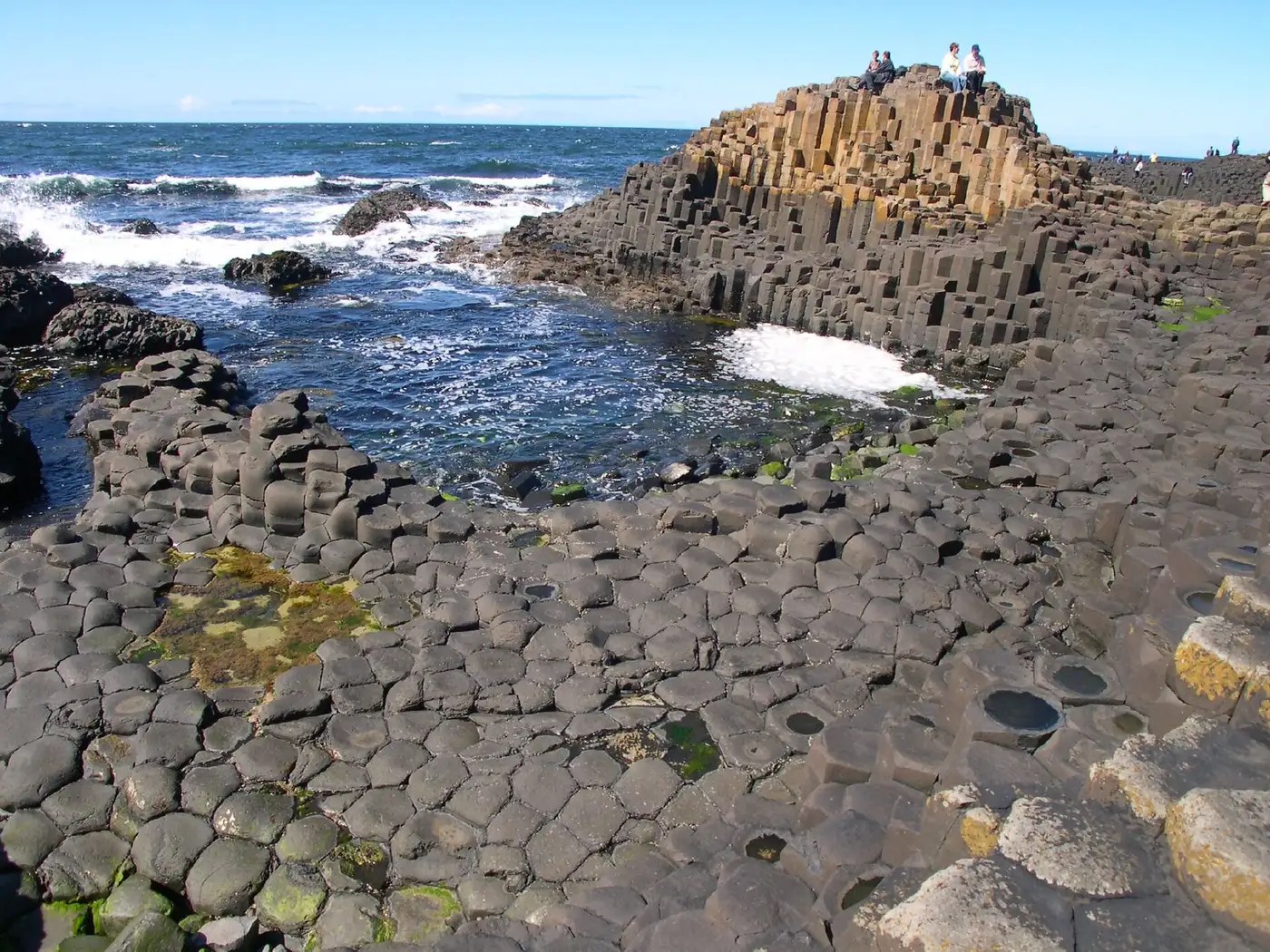
Known as The Glens County. For the nine glens that cut down to the sea along the north-east coast. It is one of the few nicknames that is simply a description of the ground.
A fact like this for every county and every age →
Compare with another county → · Printable one-page summary →
People have lived in Antrim for about nine thousand years: at Mount Sandel, on the east bank of the Bann at Coleraine, hunter-gatherers were settled around 7000 BC, one of the earliest known sites in Ireland. In the early Middle Ages the south of the county belonged to the Ulaid kingdom of Ulidia and the north to Dál Riada, a kingdom that reached across the sea into what is now western Scotland; the Dál nAraide and the Cruthin held land here too. Vikings raided the coast between the 8th and 11th centuries.
Anglo-Normans took Antrim into the Earldom of Ulster in the late 12th century, but after Edward Bruce's campaign of 1315 Carrickfergus was the only English stronghold of any size left. By the late Middle Ages the county was three lordships: Clandeboye, held by a branch of the O'Neills; the Glens, where the MacDonnells, gallowglasses from Scotland, became the strongest family in the 15th century; and the Route, held by the Cambro-Norman MacQuillans. Nobody knows exactly when the county itself was formed, but a district of that name existed before the early 14th century.
Scots settled in numbers in the 16th century. In 1588 the Armada ship La Girona went down off the Giant's Causeway with the loss of nearly 1,300 lives. In 1641 Islandmagee saw a reprisal killing of Catholics by Covenanter soldiers from Carrickfergus, and in 1689 Antrim was a centre of Protestant resistance to James II until Schomberg's army landed in Belfast Lough and took Carrickfergus. Slemish, near Ballymena, is where tradition places Patrick's years as a slave; linen was long an important industry, and after cotton-spinning came to Belfast in 1777 an estimated 27,000 people worked in it within ten miles of the town by 1800.
Drawn from the History section of the Wikipedia article on County Antrim ↗, rewritten here and adding nothing it does not say; licensed CC BY-SA 4.0. The chronology above is this site's own; where the two differ, the article is the one to check.
Tap a name for its full page — story, homeland map and neighbours. Or see all surnames from County Antrim, with the other counties each name is tied to.
Towns. Belfast Béal Feirste (291,386, 2021), Lisburn Lios na gCearrbhach (51,447, 2021), Ballymena An Baile Meánach (31,308, 2021), Carrickfergus Carraig Fhearghais (27,886, 2021), Antrim Aontroim (25,464, 2021), Larne Latharna (18,794, 2021), Ballymoney Baile Monaidh (10,903, 2021), Ballyclare Bealach Cláir (10,848, 2021), Portrush Port Rois (6,050, 2021), Ballycastle Baile an Chaistil (5,628, 2021), Crumlin Cromghlinn (5,340, 2021), Randalstown Baile Raghnaill (5,156, 2021). What every town name means →
Legends set here. Sruth na Maoile — the Sea of Moyle · The Giant's Causeway · Lough Neagh — the flung sod. On the atlas →
First names that belong here. Fionnuala, Fionn, Fearghas, Somhairle.
At the 2021 census, 40,936 people in Antrim aged 3 and over said they could speak Irish, and 23,732 could speak, read, write and understand it. 16,585 speak it daily, and for 3,011 it is their main language.
NISRA, Census 2021, Flexible Table Builder (county geography, built by NISRA from Data Zones; Belfast is split between Antrim and Down). All six counties →
Trostan (Trostán), 550 metres, in the Antrim Hills.
Wrecks on its coast: HMS Thrush (1917), HMS Drake (1917), RMS Andania (1918). Shipwrecks of Ireland →
Rivers and loughs: River Bann, River Lagan, Lough Neagh.
MountainViews, via Wikipedia. Every county's highest point → · Rivers and loughs →
Hurling: no senior title; 2 finals lost.
Football: no senior title; 2 finals lost.
-
Bobby Sands ↗
· 1954–1981
Activist of the Provisional Irish Republican Army, born at Rathcoole -
Stephen Boyd ↗
· 1931–1977
Northern Irish actor, born at Glengormley -
Joseph Larmor ↗
· 1857–1942
Irish physicist and mathematician, born at Magheragall -
Keith O'Brien ↗
· 1938–2018
British catholic cardinal, born at Ballycastle -
John Ballance ↗
· 1839–1893
14th Premier of New Zealand -
Ken McArthur ↗
South African long-distance runner, born at Dervock -
Valerie Hobson ↗
· 1917–1998
British actress, born at Larne -
John Bodkin Adams ↗
· 1899–1983
British general practitioner and fraudster, born at Randalstown -
William Paterson ↗
· 1745–1806
Governor of New Jersey -
James McHenry ↗
· 1753–1816
American politician, born at Ballymena -
George Macartney, 1st Earl Macartney ↗
· 1737–1806
British statesman, colonial administrator and diplomat, born at Loughguile -
Cahal Daly ↗
· 1917–2009
Cardinal, born at Loughguile -
Joey Dunlop ↗
· 1952–2000
British motorcycle racer, born at Ballymoney -
Alexander Campbell ↗
· 1788–1866
Scots-Irish American ordained minister, born at Broughshane -
Matilda Cullen Knowles ↗
· 1864–1933
Irish botanist, born at Ballymena -
Sam English ↗
Northern Irish footballer -
Willie Irvine ↗
· 1943–2025
Northern Irish footballer -
Comgall ↗
Irish saint, founder of the monastery at Bangor -
Richard Kane ↗
British Army general, born at Duneane -
Timothy Eaton ↗
· 1834–1907
Irish-Canadian businessman, born at Ballymena -
James Whiteside McCay ↗
· 1864–1930
Australian general and politician, born at Ballynure -
Arthur McCashin ↗
· 1909–1988
American equestrian, born at Larne -
Robert McKenzie ↗
· 1880–1949
Irish film actor -
Alexander Smyth ↗
· 1765–1830
United States Army general, born at Rathlin Island -
Brian Herbinson ↗
· 1930–2022
Canadian equestrian, born at Ballymena -
Syd Millar ↗
· 1934–2023
Irish rugby union footballer, coach and administrator, born at Ballymena -
Robert Dunlop ↗
· 1960–2008
British motorcycle racer, born at Ballymoney -
James Augustine McFaul ↗
· 1850–1917
Bishop of the Roman Catholic Diocese of Trenton, born at Larne -
Lizzie Halliday ↗
· 1859–1918
Irish-American serial killer -
Ethna Carbery ↗
Irish journalist, writer and poet, born at Ballymena
From Wikidata: people whose recorded birthplace is in the county, who have a Wikipedia article and are no longer living, with dates shown only where the article confirms them, ordered by how many languages Wikipedia covers them in. Traditional birthplaces of early saints are as Wikidata records them. Dates are left off where the sources disagree.
- Antrim · round tower · complete · 28 m
- Armoy · round tower · incomplete · 10.8 m
- Ballylumford Dolmen · dolmen
- Craigs Dolmen · tomb
- Dooey's Cairn · tomb
- Giant's Ring · dolmen
- Ram's Island · round tower · incomplete · 12.8 m
- 15 castles · Antrim Castle, Ballygally Castle, Belfast Castle, Carra Castle, Antrim, Carrickfergus Castle and more
Every pin is placed by its documented coordinates. All the monuments of Ireland →
Everything on the site about County Antrim
The county
History
Monuments and heritage
Coast and country
People and culture
What is the Irish name for County Antrim?
Aontroim. Antrim is one of the 9 counties of Ulster (Cúige Uladh).
Who ruled County Antrim in the Middle Ages?
Around 1014 it was held by Ulaid; by 1450, Clandeboye O'Neills & MacDonnells. The full era-by-era chronology is on this page.
What surnames come from County Antrim?
Names historically associated with Antrim include Adams, Agnew, Beattie, Bell, Campbell, Craig, Diamond, Ferguson, among others.
What does Aontroim mean?
Aontroim, said “AYN-trim”, means lone ridge — from aon (one) + droim (ridge). Named for the town of Antrim on Lough Neagh.
What is the population of County Antrim?
651,321 at the 2021 census, against 285,567 in 1841, before the Famine.
What is the county town of Antrim?
Antrim. County Antrim covers about 3,086 km², which makes it the 9th largest of the 32 counties.
Who are famous people from County Antrim?
Among the best-known people born in Antrim are Bobby Sands, Stephen Boyd, Joseph Larmor, Keith O'Brien, John Ballance, Ken McArthur. The full list, with their birthplaces, is on this page.
What did the Famine do to County Antrim?
The census counted 285,567 people in Antrim in 1841 and 259,903 in 1851: a change of -9% in ten years, through death and emigration.
A clean copy for school projects or the family file; collapsed sections print in full.
- Wikipedia — County Antrim ↗
- CSO — Census of Population 2022 ↗
- NISRA — Census 2021 ↗
- Wikipedia — List of Irish counties by population ↗
- 1841 census of Ireland (county table) ↗
- Historical population of Ireland (county series) ↗
- Logainm.ie — the State's Placenames Database of Ireland ↗
- Wikipedia — Counties of Ireland ↗
- Wikipedia — the county articles ↗
- Woulfe, Irish Names and Surnames (1923), for the surnames ↗
The chronology of who held the county is this site's own reading of the standard histories onto today's county borders, and says so where the fit is rough. Quoted passages are marked and licensed. Spotted an error? Say so — corrections are credited.
- 1911 Census — Antrim ↗
- 1901 Census — Antrim ↗
- Griffith's Valuation — search Antrim ↗
- Down Survey maps — Antrim ↗
- Schools' Folklore Collection — Antrim ↗
- Placenames of Antrim (Logainm) ↗
- PRONI records (Northern Ireland) ↗
- Placenames NI ↗
Free, from the holding institutions. How to begin: the six-step guide → · Spotted an error on this page? Suggest a correction.