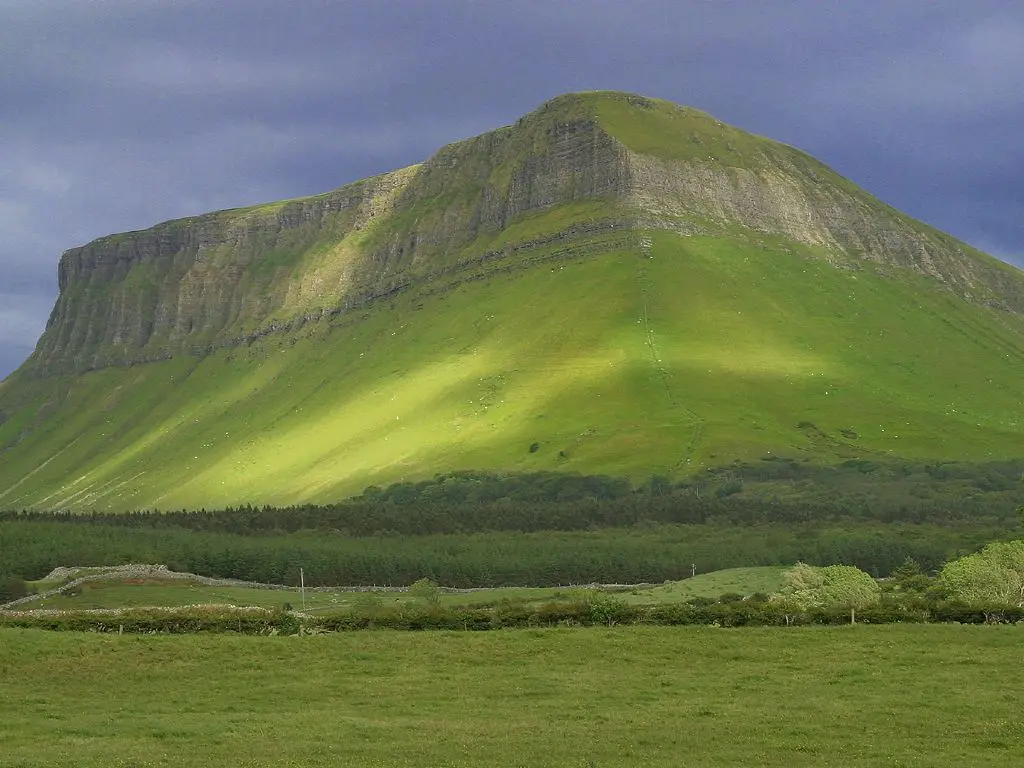
County Sligo
“SLIG-akh” · shelly place, from slige (shell)
Known as Yeats County. For W. B. Yeats, who spent his childhood summers here and put the county into the poems: Innisfree on Lough Gill, the faeries at Glencar, and Ben Bulben, under which he asked to be buried, and where his remains were brought in 1948.
A fact like this for every county and every age →
Compare with another county → · Printable one-page summary →
A causewayed enclosure found at Maugheraboy in 2003 is among the earliest signs of farming on the Cúil Irra peninsula, where the passage-tomb cemetery of Carrowmore and Queen Maeve's cairn on Knocknarea are part of a Stone Age landscape reaching to Carrowkeel and the Ox Mountains. A recent reading of Ptolemy suggests Sligo as the likely site of Nagnata, an Iron Age place of assembly.
The Book of Ballymote and the Great and Yellow Books of Lecan were written in the county, and the patron of the Annals of the Four Masters was Fearghal Ó Gadhra of Coolavin. The county was formed in 1585 by Sir Henry Sidney but took effect only after the Nine Years' War, in 1603; its borders follow the O'Conor Sligo confederation of Lower Connacht, and its six baronies — Carbury, Tireragh, Tirerril, Leyny, Corran and Coolavin — are the old territories renamed.
Drawn from the History section of the Wikipedia article on County Sligo ↗, rewritten here and adding nothing it does not say; licensed CC BY-SA 4.0. The chronology above is this site's own; where the two differ, the article is the one to check.
Sligo is the 22nd largest of Ireland's 32 counties in area, and the 27th largest in terms of population. It is the fourth largest of Connacht's 5 counties in size and third largest in terms of population. The County borders County Mayo to the west, County Roscommon to the south and south-east and County Leitrim to the northeast.
Read the full article ↗ · Text from Wikipedia, licensed CC BY-SA 4.0.
Tap a name for its full page — story, homeland map and neighbours. Or see all surnames from County Sligo, with the other counties each name is tied to.
Towns. Sligo Sligeach (20,608, 2022), Ballymote Baile an Mhóta, Tubbercurry Tobar an Choire. What every town name means →
Saints. St Attracta (11 August).
Legends set here. Moytura · Benbulben — Diarmuid's death · Knocknarea — Medb's cairn · Lough Gill — the Isle of Innisfree. On the atlas →
First names that belong here. Gráinne, Méabh, Diarmaid, Athracht.
At the 2022 census, 26,506 people in Sligo said they could speak Irish. 578 speak it every day outside school, and 1,488 weekly.
1 primary school here teaches entirely through Irish (2025/26, 208 pupils).
CSO, Census 2022, table SAP2022T3T2CTY. Every county compared →
Truskmore (Trosc Mór), 647 metres, in the Dartry Mountains.
Wrecks on its coast: La Juliana (1588), Streedagh Armada wrecks (1588), Greyhound (1770). Shipwrecks of Ireland →
Rivers and loughs: River Moy, Boyle River, Ballisodare River.
MountainViews, via Wikipedia. Every county's highest point → · Rivers and loughs →
Hurling: no senior title.
Football: no senior title.
-
Sir George Stokes, 1st Baronet ↗
· 1819–1903
Irish mathematician and physicist, born at Skreen -
Lola Montez ↗
Irish dancer and actress, born at Grange -
Ambrosio O'Higgins, 1st Marquis of Osorno ↗
· 1720–1801
Irish-Spanish colonial administrator, born at Ballynary -
Eva Gore-Booth ↗
· 1870–1926
Irish writer and activist -
Peter Mair ↗
· 1951–2011
Political scientist, born at Rosses Point -
Brother Walfrid ↗
· 1840–1915
Founder of Celtic FC -
Sean Fallon ↗
· 1922–2013
Irish footballer, born at Sligo -
Thomas Francis Gilroy ↗
· 1840–1911
89th Mayor of New York City, born at Sligo -
William Bourke Cockran ↗
· 1854–1923
Irish-American politician -
Lily Yeats ↗
· 1866–1949
Irish artist, born at Inishcrone -
William Higgins ↗
· 1763–1825
Irish chemist, born at Collooney -
James Duffy ↗
· 1890–1915
Canadian runner, born at Sligo -
Jeremy Swan ↗
· 1922–2005
Irish physician and cardiologist, born at Sligo -
Daniel Clark ↗
· 1766–1813
American politician, born at Sligo -
Stephen Ormsby ↗
· 1759–1844
American politician -
James Booth ↗
· 1806–1878
Irish cleric, mathematician and educationist, born at Lavagh -
Thomas Joseph Drury ↗
· 1908–1992
Bishop of San Angelo, Bishop of Corpus Christi, born at Ballymote -
Joan O'Hara ↗
Stage, television and film actress, born at Rosses Point -
Bill Gorman ↗
· 1911–1978
Irish footballer and manager, born at Sligo -
Francis Taaffe, 3rd Earl of Carlingford ↗
· 1639–1704
Irish peer -
Charles Anderson Read ↗
· 1841–1878
Irish journalist, novelist and anthologist, born at Sligo -
Charles O'Conor ↗
· 1710–1791
Irish writer and antiquarian -
Michael Corcoran ↗
· 1827–1863
Union Army general -
Nicholas Taaffe, 6th Viscount Taaffe ↗
Irish courtier and soldier, born at Sligo -
Charles Alexander MacMunn ↗
· 1852–1911
Irish doctor, born at Easky -
John Ryan ↗
Irish judoka, born at Ballymote -
Michael Coleman ↗
· 1891–1945
Irish musician, born at Ballymote -
Jimmy Dykes ↗
· 1898–1976
Irish footballer, born at Sligo -
John Jinks ↗
Irish politician, born at Drumcliff -
Martin Brennan ↗
Irish politician and medical doctor, born at Tubbercurry
From Wikidata: people whose recorded birthplace is in the county, who have a Wikipedia article and are no longer living, with dates shown only where the article confirms them, ordered by how many languages Wikipedia covers them in. Traditional birthplaces of early saints are as Wikidata records them. Dates are left off where the sources disagree.
Sligo had 180,886 people in 1841 and has 70,198 now (-61%). Its peak was 180,886 in 1841; its low point 50,275 in 1971, -72% of 1841. It has never regained the population it had before the Famine.
| 1821 | 1831 | 1841 | 1851 | 1861 | 1871 | 1881 | 1891 | 1901 | 1911 | 1926 | 1936 | 1946 | 1951 | 1956 | 1961 | 1966 | 1971 | 1979 | 1981 | 1986 | 1991 | 1996 | 2002 | 2006 | 2011 | 2016 | 2022 |
|---|---|---|---|---|---|---|---|---|---|---|---|---|---|---|---|---|---|---|---|---|---|---|---|---|---|---|---|
| 146,229 | 171,765 | 180,886 | 128,515 | 124,845 | 115,493 | 111,578 | 98,013 | 84,083 | 79,045 | 71,388 | 67,447 | 62,375 | 60,513 | 56,850 | 53,561 | 51,263 | 50,275 | 54,610 | 55,474 | 56,046 | 54,756 | 55,821 | 58,200 | 60,894 | 65,393 | 65,535 | 70,198 |
Census returns as tabulated in the county's Wikipedia article. All 32 counties, 1821 to today →
- Carricknagat Megalithic Tombs · tomb
- Carrowmore · tomb
- Cashelmore · fort
- Cashelore · fort
- Cummeen Court Cairn · stone circle
- Drumcliff · round tower · incomplete · 9 m
- Heapstown Cairn · tomb
- Listoghil · tomb
- Miosgán Meadhbha · tomb
- Tobernalt · holy well
- 4 castles · Ballinafad Castle, Ballymote Castle, Markree Castle, Temple House Manor and Castle
Every pin is placed by its documented coordinates. All the monuments of Ireland →
Everything on the site about County Sligo
The county
History
Monuments and heritage
Coast and country
People and culture
What is the Irish name for County Sligo?
Sligeach. Sligo is one of the 5 counties of Connacht (Cúige Chonnacht).
Who ruled County Sligo in the Middle Ages?
Around 1014 it was held by Kingdom of Connacht (O'Connor); by 1450, O'Connor lordships. The full era-by-era chronology is on this page.
What surnames come from County Sligo?
Names historically associated with Sligo include Boland, Brennan, Clifford, Coleman, Conway, Cummins, Cunningham, Diskin, among others.
What does Sligeach mean?
Sligeach, said “SLIG-akh”, means shelly place — from slige (shell). For the shell middens along the Garavogue — the leavings of people eating shellfish there for thousands of years.
What is the population of County Sligo?
70,198 at the 2022 census, against 180,886 in 1841, before the Famine.
What is the county town of Sligo?
Sligo. County Sligo covers about 1,838 km², which makes it the 22nd largest of the 32 counties.
Who are famous people from County Sligo?
Among the best-known people born in Sligo are Sir George Stokes, 1st Baronet, Lola Montez, Ambrosio O'Higgins, 1st Marquis of Osorno, Eva Gore-Booth, Peter Mair, Brother Walfrid. The full list, with their birthplaces, is on this page.
What did the Famine do to County Sligo?
The census counted 180,886 people in Sligo in 1841 and 128,000 in 1851 (the 1851 figure is approximate): a change of -29% in ten years, through death and emigration.
A clean copy for school projects or the family file; collapsed sections print in full.
- Wikipedia — County Sligo ↗
- CSO — Census of Population 2022 ↗
- NISRA — Census 2021 ↗
- Wikipedia — List of Irish counties by population ↗
- 1841 census of Ireland (county table) ↗
- Historical population of Ireland (county series) ↗
- Logainm.ie — the State's Placenames Database of Ireland ↗
- Wikipedia — Counties of Ireland ↗
- Wikipedia — the county articles ↗
- Woulfe, Irish Names and Surnames (1923), for the surnames ↗
The chronology of who held the county is this site's own reading of the standard histories onto today's county borders, and says so where the fit is rough. Quoted passages are marked and licensed. Spotted an error? Say so — corrections are credited.
- 1911 Census — Sligo ↗
- 1901 Census — Sligo ↗
- Griffith's Valuation — search Sligo ↗
- Down Survey maps — Sligo ↗
- Schools' Folklore Collection — Sligo ↗
- Placenames of Sligo (Logainm) ↗
- Landed Estates — Sligo ↗
Free, from the holding institutions. How to begin: the six-step guide → · Spotted an error on this page? Suggest a correction.