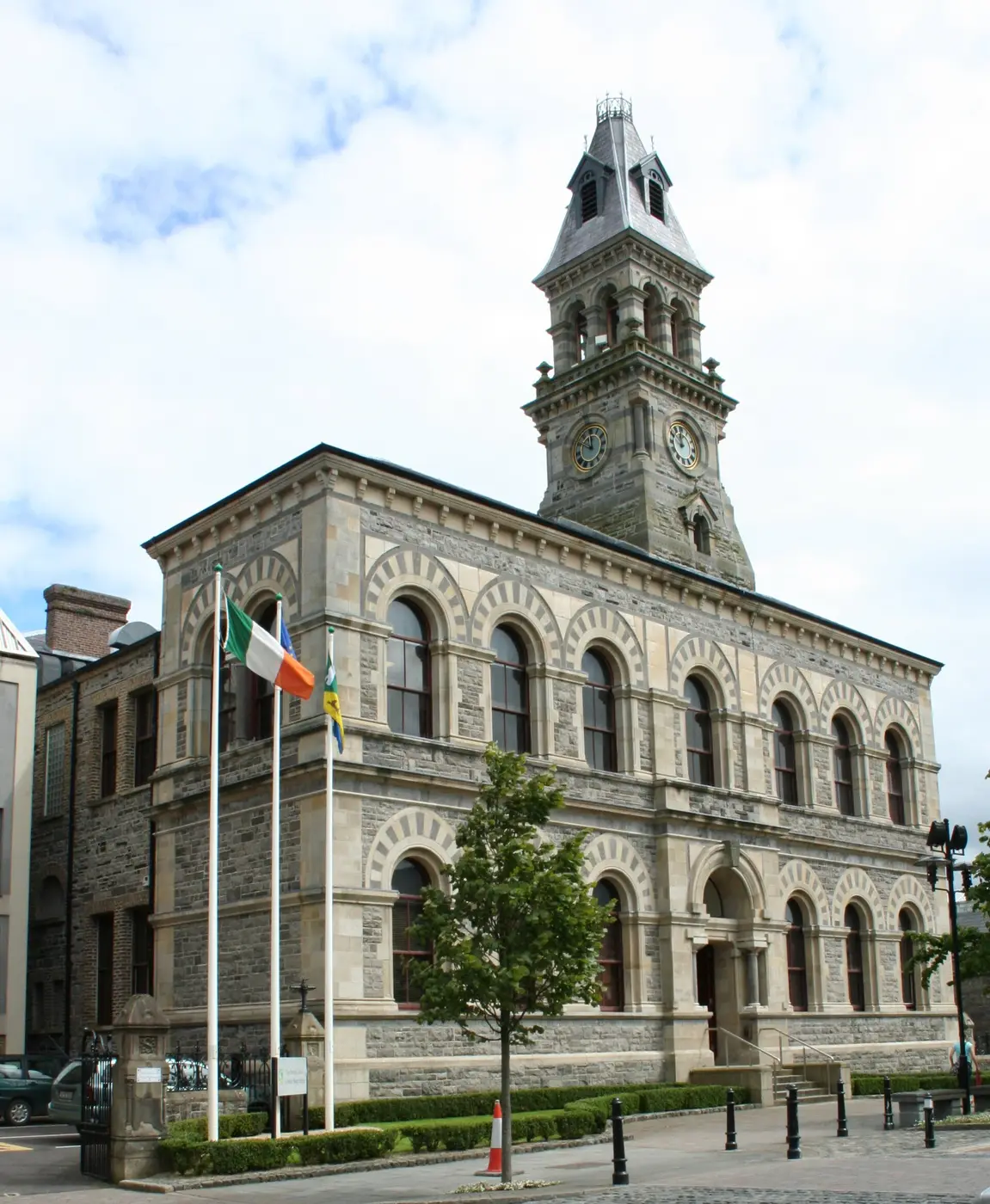
Sligo
'shelly place' — abounding in shells
Yeats country: the poet spent his childhood summers here and is buried at Drumcliffe under Benbulben, 'under bare Ben Bulben's head', with Knocknarea and Queen Medb's cairn across the bay. The town grew as a port under an O'Conor castle and a Dominican friary.
Sligo is Sligeach, the shelly place, after the shellfish of the river and estuary; the river, now the Garavogue, was once called the Sligeach, and in 1836 the Ordnance Survey heard of cartloads of shells dug up under the town's houses. The land around Sligo has one of the densest concentrations of prehistoric sites in Ireland, and is the only place where every class of Irish megalithic monument is found together: the town's first roundabout was built around a passage tomb. The causewayed enclosure at Magheraboy, found in 2002 and built around 4000 BC, is the oldest yet discovered in Britain or Ireland. Some think Sligo Bay is Ptolemy's Nagnata.
In the early Middle Ages the great place was Colmcille's monastery at Drumcliff, five miles north; by the 12th century there was a bridge and a small settlement at Sligo. The Norman Maurice FitzGerald founded the town and port, building Sligo Castle in 1245, and with Felim O'Connor, King of Connacht, founded the Dominican friary in 1253; after a fire in 1414 it was rebuilt by Tighernán O'Rourke, and the Abbey still stands.
Drawn from the History section of the Wikipedia article on Sligo ↗, rewritten here and adding nothing it does not say; licensed CC BY-SA 4.0.
- Cummeen Court Cairn · stone circle · 3 km
- Tobernalt · holy well · 4 km
- Carrowmore · tomb · 4 km
- Listoghil · tomb · 4 km
- Miosgán Meadhbha · tomb · 7 km
- Drumcliff · round tower · 7 km
- Markree Castle · castle · 11 km
Straight-line distances from the town centre, from each site's documented coordinates.
- Carrowkeel passage tombs · Fourteen Neolithic tombs on the Bricklieve ridges, one aligned so the midsummer sunset shines down its passage — the mirror of Newgrange, with no crowds.
- Tobernalt Holy Well · A Penal-era Mass site in a wooded glen where the priest's stone altar still stands — the well older than Patrick, the crowds still gathering on Garland Sunday.
- Inishmurray · A monastic island with a cashel, beehive huts and 'cursing stones' — turned anticlockwise to damn an enemy. The last islanders left in 1948.
- Creevelea Friary · The last Franciscan house founded in Ireland before the suppression — 1508, by Eóghan O’Rourke of West Bréifne and his wife Margaret O’Brian. Burned by accident in 1536 and rebuilt, dissolved about 1598, reoccupied in 1642, cleared out by the Cromwellians, and lived in again after that until 1837. A cloister carving shows Francis preaching to the birds.
- Moytura · Second Battle of Mag Tuired: the Tuatha Dé Danann against the Fomorians. Lugh of the Long Arm kills his grandfather Balor of the Evil Eye with a sling-stone through the eye.
- Benbulben — Diarmuid's death · End of the great elopement: Diarmuid, who fled with Gráinne from Fionn, is gored by the enchanted boar here, and Fionn lets the healing water run through his fingers.
- Knocknarea — Medb's cairn · Queen Medb stands buried upright inside, in armour, facing Ulster. Add a stone for luck — take one and she comes for it.
- Lough Gill — the Isle of Innisfree · Not myth but poem: Yeats's lake isle, where the 'bee-loud glade' and the fairy faith of Sligo gave a modern poet his oldest music.
All of these are pinned on the Hidden Ireland map.
All towns and cities → · Every town name in Irish · Know Sligo better? Add to the story.