County Meath
“un VEE” · the middle, from mide, middle
Known as The Royal County. For Tara, where the high kings were inaugurated, and because Meath was once a province in its own right: the fifth fifth, in the middle, with the seat of the kingship inside it.
A fact like this for every county and every age →
Compare with another county → · Printable one-page summary →
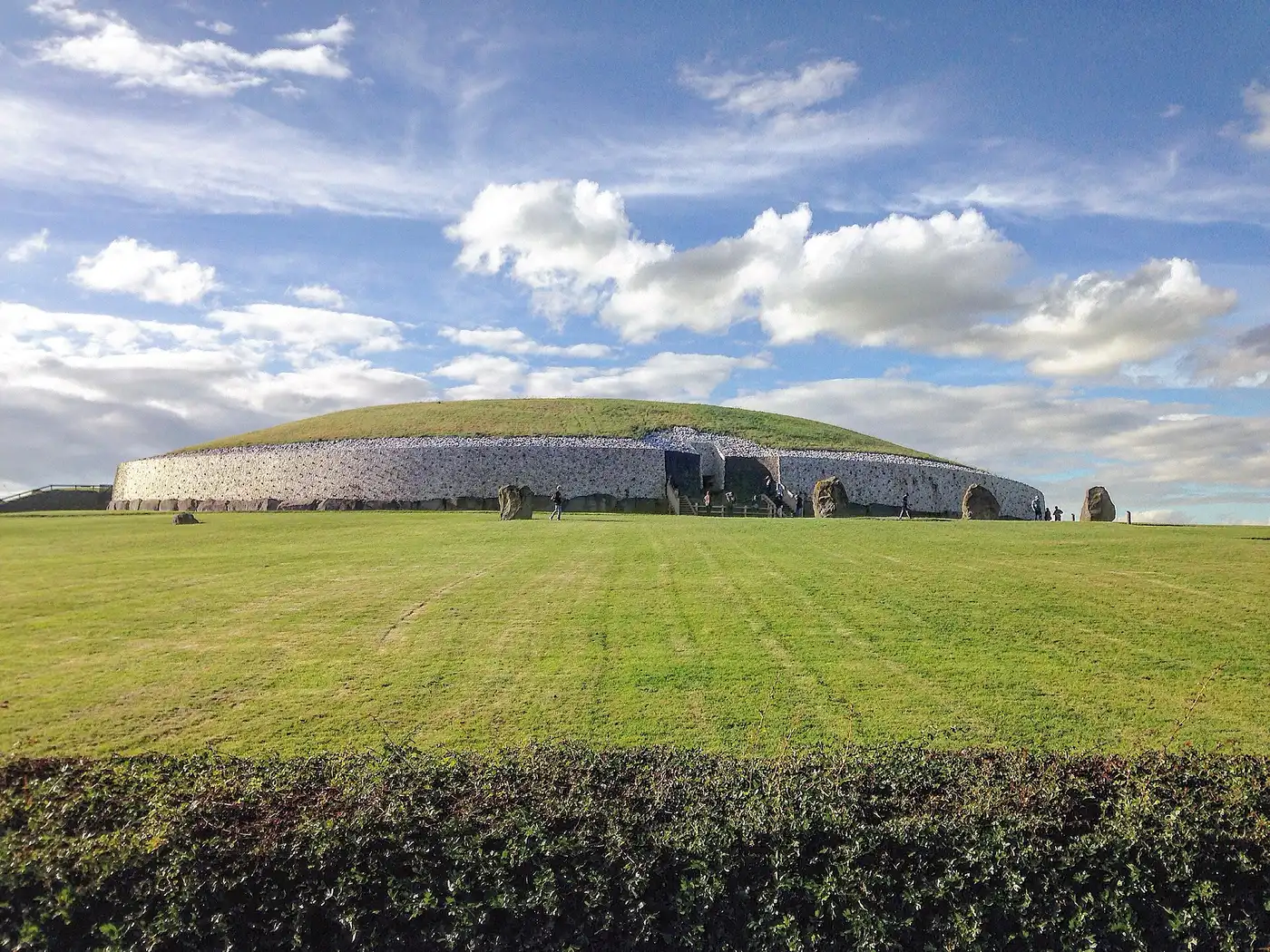
Meath is the Royal County, the seat of the kings of Tara. Mesolithic flints from Randalstown near Navan, found during work on Tara Mines in the 1970s, date to around 9,500 BC; Newgrange, Knowth and Dowth at Brú na Bóinne were built before 3000 BC and are a UNESCO World Heritage Site. In the 400s, Niall of the Nine Hostages's dynasty, the Uí Néill, pushed south from Ulster and made themselves kings of Tara, and by 740 the Clann Cholmáin had united the kingdom of Mide — "the middle". The first king the annals call High King of Ireland was Máel Sechnaill mac Máele Ruanaid of Mide, who died in 862.
In 1002 Brian Boru forced Máel Sechnaill mac Domnaill to give up the high kingship at Tara, ending the Uí Néill's hereditary claim. Tradition has Patrick light his Paschal fire on the Hill of Slane in defiance of the king at Tara, and Meath's kings founded Kells and Clonard, where the Twelve Apostles of Ireland were taught. In 1172 Henry II granted Meath to Hugh de Lacy, who built Trim Castle, killed Tigernán Ua Ruairc at a parley on the Hill of Ward, and founded Trim, Athboy, Kells and Navan as charter towns. The lordship was shired in 1297 and became the largest and richest county in Ireland, and in 1543 it was split into Meath and Westmeath.
In the 1640s the lords of Meath joined the Ulster rebels at the Hill of Crufty, and the Catholic bishops met at Kells in 1642 to declare the rebellion a just war. The Jacobites were defeated at the Boyne in July 1690. In August 1843 Daniel O'Connell's rally on the Hill of Tara drew somewhere between half a million and a million people. The Famine took Meath from over 183,000 people in 1841 to 67,000 by 1900, and the county's Irish-speaking majority was gone by the late 1800s; Navan replaced Trim as county town in 1898. In 1916 the Battle of Ashbourne was the Rising's only success outside Dublin. Meath passed its pre-Famine population again in 2011.
Drawn from the History section of the Wikipedia article on County Meath ↗, rewritten here and adding nothing it does not say; licensed CC BY-SA 4.0. The chronology above is this site's own; where the two differ, the article is the one to check.
Meath is the 14th-largest of Ireland's 32 counties by area, and the eighth-largest in terms of population. It is the second-largest of Leinster's 12 counties in size, and the third-largest in terms of population. Meath borders seven counties – Dublin and Louth to the east, Westmeath and Offaly to the west, Kildare to the south, and Cavan and Monaghan to the north. Meath's coastline stretches for roughly along the Irish Sea between the Boyne and Delvin rivers, making it the second shortest coastline of any coastal county. The county town, Navan, is the largest settlement in Meath, and is situated on the River Boyne in the middle of the county. Navan is approximately from Dublin and from Belfast.
Places of interestAs a consequence of its location in the centre of Ireland, Meath has an abundance of historic sites.
All periods of Irish history are represented in the landmarks of the county, spanning from the prehistoric tombs at Brú na Bóinne, the early Christian monasteries at Kells and Bective, the Norman-era fortifications at Trim and Dunmoe, the manor houses and estates of the 17th and 18th centuries such as those at Bellinter and Slane, the famine-era workhouse and graveyard at Dunshaughlin, all the way up to the Battle of Ashbourne historic site, which commemorates the sole victory of the Irish Volunteers during the 1916 Easter Rising.
Read the full article ↗ · Text from Wikipedia, licensed CC BY-SA 4.0.
Tap a name for its full page — story, homeland map and neighbours. Or see all surnames from County Meath, with the other counties each name is tied to.
Towns. Navan An Uaimh (33,886, 2022), Ashbourne Cill Dhéagláin (15,680, 2022), Dunboyne Dún Búinne (7,155, 2022), Dunshaughlin Dún Seachlainn (6,644, 2022), Athboy Baile Átha Buí (2,596, 2022), Trim Baile Átha Troim, Kells Ceanannas. What every town name means →
Saints. St Oliver Plunkett (1 July).
Legends set here. Brú na Bóinne (Newgrange) · Tara — the Lia Fáil · Loughcrew — the Hag's Chair. On the atlas →
First names that belong here. Cormac, Aonghus, Ultán, Cianán, Tailtiu, Tlachtga, Achall.
At the 2022 census, 80,822 people in Meath said they could speak Irish. 2,594 speak it every day outside school, and 4,725 weekly.
9 primary schools here teach entirely through Irish (2025/26, 1,970 pupils), and 1 secondary school.
Meath's Gaeltacht had 2,093 people in 2022, 276 of them daily Irish speakers. The Gaeltacht in numbers →
CSO, Census 2022, table SAP2022T3T2CTY. Every county compared →
Slieve na Calliagh (Sliabh na Caillí), 276 metres, in the North Midlands.
National park: Boyne Valley (Brú na Bóinne) (2023). All the national parks →
Rivers and loughs: River Boyne, River Blackwater, River Dee, River Glyde, Lough Sheelin.
MountainViews, via Wikipedia. Every county's highest point → · Rivers and loughs →
Hurling: no senior title.
Football: 7 senior titles (1949, 1954, 1967, 1987, 1988, 1996, 1999); 9 finals lost.
-
Francis Beaufort ↗
· 1774–1857
Irish hydrographer and naval officer, born at Navan -
John Bruton ↗
· 1947–2024
Irish politician and prime minister, born at Dunboyne -
Richard Wellesley, 1st Marquess Wellesley ↗
· 1760–1842
British politician -
Turlough O'Carolan ↗
· 1670–1738
Irish harpist and composer -
Owen Moore ↗
Irish-born actor in American films -
Oliver Plunkett ↗
Irish archbishop, martyr and saint;, born at Loughcrew -
Sir William Johnson, 1st Baronet ↗
· 1715–1774
Anglo-Irish official of the British Empire -
Tom Moore ↗
· 1883–1955
Irish-American actor and film director -
Matt Moore ↗
Irish-born American actor, born at Kells -
Francis Ledwidge ↗
· 1887–1917
Irish poet, born at Slane -
Edmund Mortimer, 5th Earl of March ↗
· 1391–1425
Heir presumptive to King Richard II of England -
Robert Barker ↗
· 1739–1806
British artist, born at Kells -
Robert Wood ↗
· 1717–1771
British traveller, classical scholar, civil servant and politician, born at Trim -
John Boyle O'Reilly ↗
· 1844–1890
Irish-born poet and novelist -
Garret Wesley, 1st Earl of Mornington ↗
· 1735–1781
Irish politician and aristocrat -
Joe Moore ↗
· 1894–1926
American actor -
Mary Brück ↗
· 1925–2008
Irish astronomer, born at Ballivor -
William Wellesley-Pole, 3rd Earl of Mornington ↗
· 1763–1845
Anglo-Irish politician -
Enda of Aran ↗
Irish monastic -
Rose Mooney ↗
Irish musician -
Francis Brinkley ↗
· 1841–1912
Irish writer -
Edward Lovett Pearce ↗
· 1699–1733
Irish architect -
Alice Stopford Green ↗
· 1847–1929
Irish historian, politician and nationalist, born at Kells -
Alicia Adélaide Needham ↗
· 1863–1945
Irish composer, born at Oldcastle -
Mark Clinton ↗
· 1915–2001
Irish politician, born at Kells -
Peter Warren ↗
· 1703–1752
Royal Navy vice admiral -
Oran of Iona ↗
6th-century Christian saint -
Margaret Ball ↗
· 1515–1584
Lady Mayoress of Dublic and Catholic martyr -
Thomas Bligh ↗
British Army general -
Brian O'Higgins ↗
· 1882–1963
Irish politician, born at Kilskeer
From Wikidata: people whose recorded birthplace is in the county, who have a Wikipedia article and are no longer living, with dates shown only where the article confirms them, ordered by how many languages Wikipedia covers them in. Traditional birthplaces of early saints are as Wikidata records them. Dates are left off where the sources disagree.
Meath had 183,828 people in 1841 and has 220,826 now (+20%). its low point 61,405 in 1936, -67% of 1841. It is one of the counties that has recovered its pre-Famine population.
| 1841 | 1851 | 1861 | 1871 | 1881 | 1891 | 1901 | 1911 | 1926 | 1936 | 1946 | 1951 | 1956 | 1961 | 1966 | 1971 | 1979 | 1981 | 1986 | 1991 | 1996 | 2002 | 2006 | 2011 | 2016 | 2022 |
|---|---|---|---|---|---|---|---|---|---|---|---|---|---|---|---|---|---|---|---|---|---|---|---|---|---|
| 183,828 | 140,748 | 110,373 | 95,558 | 87,469 | 76,987 | 67,497 | 65,091 | 62,969 | 61,405 | 66,232 | 66,337 | 66,762 | 65,122 | 67,323 | 71,729 | 90,715 | 95,419 | 103,881 | 105,370 | 109,732 | 134,005 | 162,831 | 184,135 | 195,044 | 220,826 |
Census returns as tabulated in the county's Wikipedia article. All 32 counties, 1821 to today →
- Brú na Bóinne · tomb
- Castlekeeran · high cross
- Donaghmore · round tower · complete to cornice · 26.6 m
- Hill of Tara · royal site
- Kells · round tower · complete to cornice · 26 m
- Kells Round Tower · high cross
- Knowth · tomb
- Lia Fáil · tomb
- Monknewtown · tomb
- Newgrange · tomb
- Newgrange cursus · tomb
- 13 castles · Athcarne Castle, Athlumney Castle, Dangan Castle, Dardistown Castle, Donore Castle and more
Every pin is placed by its documented coordinates. All the monuments of Ireland →
Everything on the site about County Meath
The county
History
Monuments and heritage
Coast and country
What is the Irish name for County Meath?
An Mhí. Meath is one of the 12 counties of Leinster (Cúige Laighean).
Who ruled County Meath in the Middle Ages?
Around 1014 it was held by Mide (Kingdom of Meath); by 1450, The English Pale. The full era-by-era chronology is on this page.
What surnames come from County Meath?
Names historically associated with Meath include Conlan, Connolly, Corbett, Cusack, Darcy, Duane, Fitzsimons, Fleming, among others.
What does An Mhí mean?
An Mhí, said “un VEE”, means the middle — from mide, middle. Once a province in its own right — the fifth fifth, in the middle, with Tara in it.
What is the population of County Meath?
220,826 at the 2022 census, against 183,828 in 1841, before the Famine.
What is the county town of Meath?
Navan. County Meath covers about 2,342 km², which makes it the 14th largest of the 32 counties.
Who are famous people from County Meath?
Among the best-known people born in Meath are Francis Beaufort, John Bruton, Richard Wellesley, 1st Marquess Wellesley, Turlough O'Carolan, Owen Moore, Oliver Plunkett. The full list, with their birthplaces, is on this page.
What did the Famine do to County Meath?
The census counted 183,828 people in Meath in 1841 and 140,000 in 1851 (the 1851 figure is approximate): a change of -24% in ten years, through death and emigration.
A clean copy for school projects or the family file; collapsed sections print in full.
- Wikipedia — County Meath ↗
- CSO — Census of Population 2022 ↗
- NISRA — Census 2021 ↗
- Wikipedia — List of Irish counties by population ↗
- 1841 census of Ireland (county table) ↗
- Historical population of Ireland (county series) ↗
- Logainm.ie — the State's Placenames Database of Ireland ↗
- Wikipedia — Counties of Ireland ↗
- Wikipedia — the county articles ↗
- Woulfe, Irish Names and Surnames (1923), for the surnames ↗
The chronology of who held the county is this site's own reading of the standard histories onto today's county borders, and says so where the fit is rough. Quoted passages are marked and licensed. Spotted an error? Say so — corrections are credited.
- 1911 Census — Meath ↗
- 1901 Census — Meath ↗
- Griffith's Valuation — search Meath ↗
- Down Survey maps — Meath ↗
- Schools' Folklore Collection — Meath ↗
- Placenames of Meath (Logainm) ↗
Free, from the holding institutions. How to begin: the six-step guide → · Spotted an error on this page? Suggest a correction.