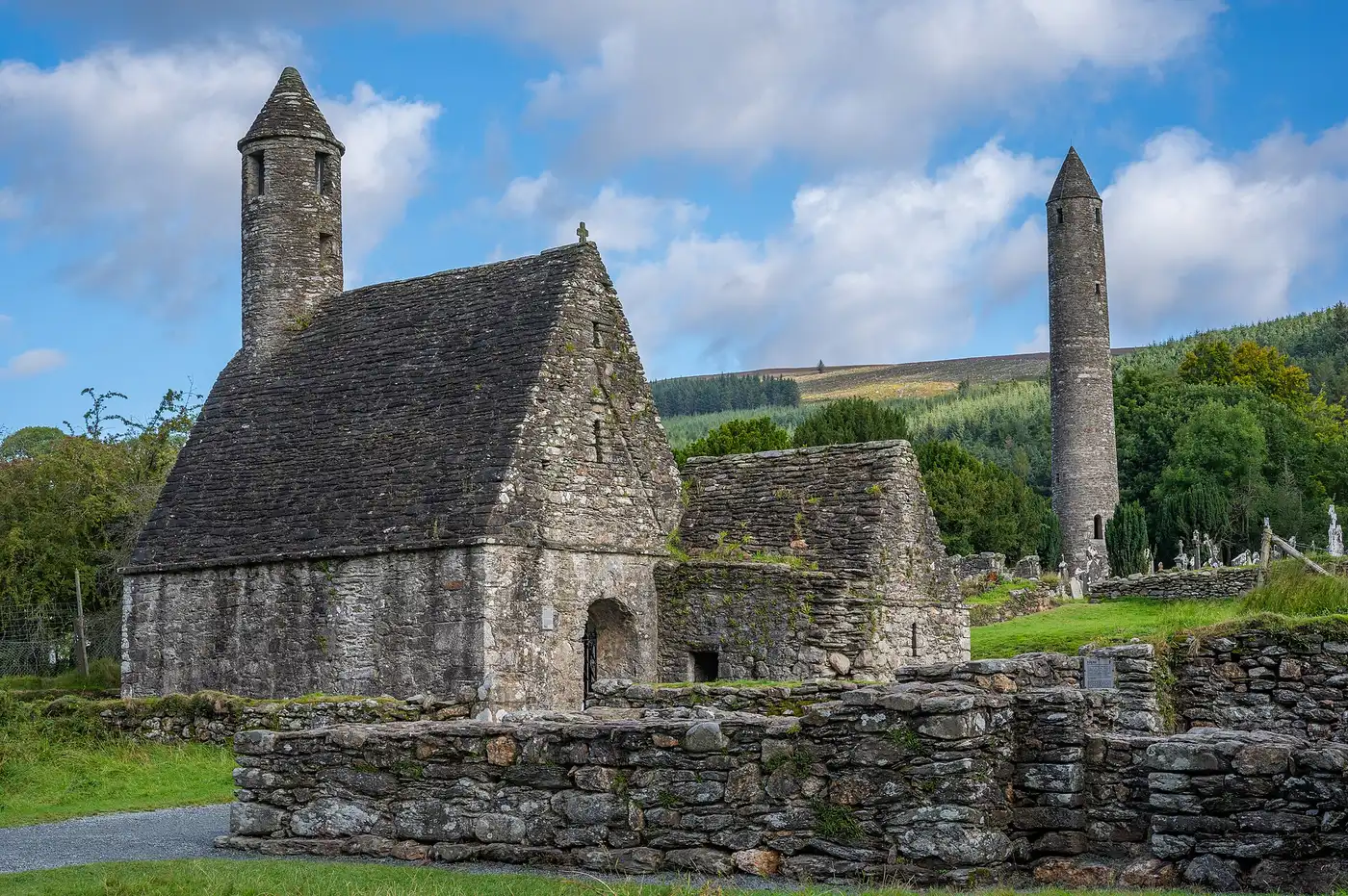
County Wicklow
“kill WAN-tawn” · church of the toothless one, from cill (church) + mantán (toothless one)
Known as The Garden of Ireland. For the gardens and the glens: Powerscourt, Mount Usher, and the wooded valleys running down from the mountains within an hour of Dublin.
A fact like this for every county and every age →
Compare with another county → · Printable one-page summary →
Palladius, sent to "the Irish believing in Christ", is said to have landed at Wicklow harbour in 431 and founded churches at Donard, Tigroney and Colbinstown before leaving for Scotland. Many early saints, women and men, founded churches and convents in Wicklow — Kevin among them — and the ancient monastery of Glendalough is here.
Wicklow was the last of the traditional counties to be created, in 1606, from parts of Dublin and Carlow, to control the O'Byrnes and their neighbours. After 1798, when United Irishmen held out in the mountains and fought at Aughrim and Arklow, the government built the Military Road from Rathfarnham to Aghavannagh. In 1795 a month-long gold rush near Woodenbridge yielded as much as 80 kg of gold. Wicklow was the first county to lose Irish — only about 2% spoke it in the 1770s — and Andrew and Hannah Byrne of Glenealy, who died in 1830, were among its last native speakers.
Drawn from the History section of the Wikipedia article on County Wicklow ↗, rewritten here and adding nothing it does not say; licensed CC BY-SA 4.0. The chronology above is this site's own; where the two differ, the article is the one to check.
Wicklow is part of the Eastern and Midland Region of Ireland, within the province of Leinster. It is bounded by four counties, Dublin to the north; Kildare and Carlow to the west; Wexford to the south; and the Irish Sea to the east. Wicklow is the 17th largest of Ireland's 32 traditional counties by land area, and the 16th most populous. It is the fourth largest of Leinster's 12 counties by size and the fifth most populous. The county is named after the town of Wicklow, located approximately south of Dublin, the capital city of Ireland.
Read the full article ↗ · Text from Wikipedia, licensed CC BY-SA 4.0.
Tap a name for its full page — story, homeland map and neighbours. Or see all surnames from County Wicklow, with the other counties each name is tied to.
Towns. Bray Bré (33,512, 2022), Greystones Na Clocha Liatha (22,009, 2022), Arklow An tInbhear Mór (13,399, 2022), Wicklow Cill Mhantáin (12,957, 2022), Blessington Baile Coimín (5,611, 2022), Baltinglass Bealach Conglais (2,611, 2022). What every town name means →
Saints. St Kevin of Glendalough (3 June).
Legends set here. Glendalough — Kevin and the blackbird. On the atlas →
First names that belong here. Caoimhín.
At the 2022 census, 56,012 people in Wicklow said they could speak Irish. 1,580 speak it every day outside school, and 3,216 weekly.
6 primary schools here teach entirely through Irish (2025/26, 1,221 pupils), and 2 secondary schools.
CSO, Census 2022, table SAP2022T3T2CTY. Every county compared →
Lugnaquilla (Log na Coille), 925 metres, in the Wicklow Mountains.
National park: Wicklow Mountains (1991). All the national parks →
Rivers and loughs: River Liffey, River Slaney, Poulaphouca Reservoir.
MountainViews, via Wikipedia. Every county's highest point → · Rivers and loughs →
Hurling: no senior title.
Football: no senior title.
-
Charles Stewart Parnell ↗
· 1846–1891
Irish politician -
Geraldine Fitzgerald ↗
· 1913–2005
Irish-American actress, born at Greystones -
Cearbhall Ó Dálaigh ↗
· 1911–1978
Irish judge and 5th President of Ireland, born at Bray -
Ninette de Valois ↗
· 1898–2001
British dancer, teacher, choreographer and director of classical ballet, born at Blessington -
Ron Delany ↗
· 1935–2026
Irish middle-distance runner, born at Arklow -
Joshua Pim ↗
· 1869–1942
Irish tennis player, born at Bray -
Cecil Frances Alexander ↗
British hymn-writer and poet, born at Redcross -
William Marsden ↗
· 1754–1836
British orientalist -
Laval Nugent von Westmeath ↗
· 1777–1862
Irish soldier -
Frederic William Burton ↗
· 1816–1900
Artist, Director of National Gallery, born at Wicklow -
Frank Robinson ↗
· 1886–1949
Field hockey player, born at Rathdrum -
Ina Boyle ↗
· 1889–1967
Irish composer, born at Enniskerry -
Edward Ernest Bowen ↗
· 1836–1901
English schoolmaster, songwriter and cricketer, born at Blessington -
Robert Barton ↗
· 1881–1975
Irish lawyer, soldier, statesman and farmer, born at Annamoe -
Oliver Byrne ↗
· 1810–1880
Irish mathematician, engineer and writer, born at Avoca -
Daniel Murray ↗
· 1768–1852
Irish archbishop, born at Arklow -
William Fawcett ↗
· 1851–1926
British botanist, born at Arklow -
Jennie Wyse Power ↗
· 1858–1941
Irish politician, activist, feminist and businesswoman, born at Baltinglass -
Elizabeth Hawkins-Whitshed ↗
Irish mountaineer, author and photographer, born at Greystones -
Seamus Costello ↗
· 1939–1977
Irish politician, born at Bray -
Jack Kirwan ↗
Irish footballer -
S. M. Cyril ↗
· 1936–2023
Irish educationist, born at Bray -
John Mackey ↗
· 1918–2014
Roman Catholic bishop, born at Bray -
Melanie Clark Pullen ↗
Irish actress, born at Bray -
Evelyn Booth ↗
· 1897–1988
Irish botanist, born at Annamoe -
James Doyle Penrose ↗
· 1862–1932
Irish painter, born at Wicklow -
Peter Doyle ↗
· 1945–2025
Irish cyclist, born at Wicklow -
Liam Kavanagh ↗
· 1935–2021
Irish politician -
Edwin Lawrence Godkin ↗
· 1831–1902
American journalist -
Gemma Hussey ↗
· 1938–2024
Irish politician, born at Bray
From Wikidata: people whose recorded birthplace is in the county, who have a Wikipedia article and are no longer living, with dates shown only where the article confirms them, ordered by how many languages Wikipedia covers them in. Traditional birthplaces of early saints are as Wikidata records them. Dates are left off where the sources disagree.
Wicklow had 126,143 people in 1841 and has 155,851 now (+24%). its low point 57,591 in 1926, -54% of 1841. It is one of the counties that has recovered its pre-Famine population.
| 1821 | 1831 | 1841 | 1851 | 1861 | 1871 | 1881 | 1891 | 1901 | 1911 | 1926 | 1936 | 1946 | 1951 | 1956 | 1961 | 1966 | 1971 | 1979 | 1981 | 1986 | 1991 | 1996 | 2002 | 2006 | 2011 | 2016 | 2022 |
|---|---|---|---|---|---|---|---|---|---|---|---|---|---|---|---|---|---|---|---|---|---|---|---|---|---|---|---|
| 110,767 | 121,557 | 126,143 | 98,979 | 86,479 | 78,697 | 70,386 | 62,136 | 60,824 | 60,711 | 57,591 | 58,569 | 60,451 | 62,590 | 59,906 | 58,473 | 60,428 | 66,295 | 83,950 | 87,449 | 94,542 | 97,265 | 102,683 | 114,676 | 126,194 | 136,640 | 142,425 | 155,485 |
Census returns as tabulated in the county's Wikipedia article. All 32 counties, 1821 to today →
- Castletimon Ogham Stone · ogham stone
- Crossoona Rath · ogham stone
- Fassaroe Cross · high cross
- Glendalough · round tower · complete · 30.5 m
- Piper's Stones · stone circle
- Rathcoran · tomb
- Rathgall Hillfort · royal site
- St. Mark's Cross · high cross
- 2 castles · Kindlestown Castle, Rathdown Castle
Every pin is placed by its documented coordinates. All the monuments of Ireland →
Everything on the site about County Wicklow
The county
History
Monuments and heritage
Coast and country
People and culture
What is the Irish name for County Wicklow?
Cill Mhantáin. Wicklow is one of the 12 counties of Leinster (Cúige Laighean).
Who ruled County Wicklow in the Middle Ages?
Around 1014 it was held by Kingdom of Leinster (Mac Murrough); by 1450, O'Byrne & O'Toole country. The full era-by-era chronology is on this page.
What surnames come from County Wicklow?
Names historically associated with Wicklow include Byrne, Cullen, Doyle, Hackett, Kehoe, Keogh, Kinsella, O'Toole, among others.
What does Cill Mhantáin mean?
Cill Mhantáin, said “kill WAN-tawn”, means church of the toothless one — from cill (church) + mantán (toothless one). The English name is Old Norse Víkingaló, the Vikings' meadow — so the two names share nothing at all.
What is the population of County Wicklow?
155,851 at the 2022 census, against 126,143 in 1841, before the Famine.
What is the county town of Wicklow?
Wicklow. County Wicklow covers about 2,027 km², which makes it the 17th largest of the 32 counties.
Who are famous people from County Wicklow?
Among the best-known people born in Wicklow are Charles Stewart Parnell, Geraldine Fitzgerald, Cearbhall Ó Dálaigh, Ninette de Valois, Ron Delany, Joshua Pim. The full list, with their birthplaces, is on this page.
What did the Famine do to County Wicklow?
The census counted 126,143 people in Wicklow in 1841 and 98,000 in 1851 (the 1851 figure is approximate): a change of -22% in ten years, through death and emigration.
A clean copy for school projects or the family file; collapsed sections print in full.
- Wikipedia — County Wicklow ↗
- CSO — Census of Population 2022 ↗
- NISRA — Census 2021 ↗
- Wikipedia — List of Irish counties by population ↗
- 1841 census of Ireland (county table) ↗
- Historical population of Ireland (county series) ↗
- Logainm.ie — the State's Placenames Database of Ireland ↗
- Wikipedia — Counties of Ireland ↗
- Wikipedia — the county articles ↗
- Woulfe, Irish Names and Surnames (1923), for the surnames ↗
The chronology of who held the county is this site's own reading of the standard histories onto today's county borders, and says so where the fit is rough. Quoted passages are marked and licensed. Spotted an error? Say so — corrections are credited.
- 1911 Census — Wicklow ↗
- 1901 Census — Wicklow ↗
- Griffith's Valuation — search Wicklow ↗
- Down Survey maps — Wicklow ↗
- Schools' Folklore Collection — Wicklow ↗
- Placenames of Wicklow (Logainm) ↗
Free, from the holding institutions. How to begin: the six-step guide → · Spotted an error on this page? Suggest a correction.