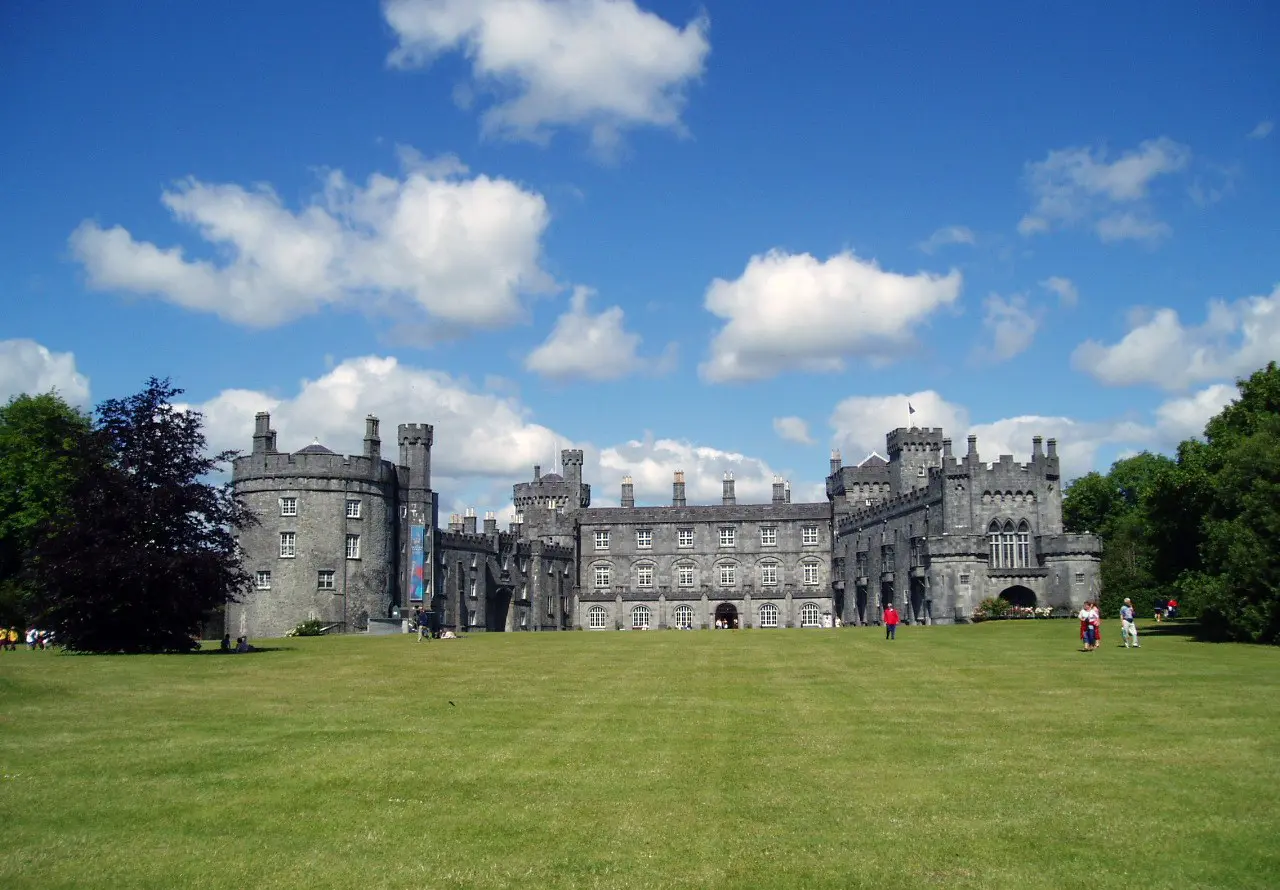
County Kilkenny
“kill KHAN-ee” · church of Cainneach, from cill (church) + Cainneach
Known as The Marble County. For Kilkenny marble, a black carboniferous limestone that polishes like marble without being any. It is in the kerbstones, the shopfronts and the cathedral.
A fact like this for every county and every age →
Compare with another county → · Printable one-page summary →
Kilkenny is Cill Chainnigh, the church of St Canice, whose church and round tower became St Canice's Cathedral. For more than a thousand years this was the heart of Osraige, or Ossory — "the people of the deer" — a kingdom that lay between the Barrow and the Suir, belonged to Munster until the mid-9th century and to Leinster after, and served as a buffer between the two; its kings, the Mac Giolla Phádraig, held Kilkenny as their stronghold. The Diocese of Ossory, founded in 549, still keeps the kingdom's name and outline.
Ptolemy's map puts a tribe called the Usdaie in the same area, and the Iron Age hill-fort at Freestone Hill has produced Roman finds. The Cistercians came to Jerpoint around 1155–60, and Jerpoint Abbey was founded by Donal Mac Giolla Phádraig, king of Ossory, in 1158. After Strongbow's arrival in 1170, Kilkenny became part of the Norman lordship of Leinster, of which Strongbow became lord in 1171.
Drawn from the History section of the Wikipedia article on County Kilkenny ↗, rewritten here and adding nothing it does not say; licensed CC BY-SA 4.0. The chronology above is this site's own; where the two differ, the article is the one to check.
Kilkenny is the 16th-largest of Ireland's 32 counties by area and the 21st-largest in terms of population. It is the third-largest of Leinster's 12 counties in size, the seventh-largest in terms of population, and has a population density of 50 people per km2. Kilkenny borders five counties – Tipperary to the west, Waterford to the south, Carlow and Wexford to the east, and Laois to the north. Kilkenny city is the county's seat of local government and largest settlement, and is situated on the River Nore in the centre of the county. Kilkenny city is approximately from Waterford, from Dublin and from Cork.
Places of interestThe architecture of County Kilkenny contains features from all eras since the Stone Age including Norman and Anglo-Irish castles, Georgian urban buildings, towns and villages with unique architectures, palladian and rococo country houses, Gothic and neo-Gothic cathedrals and buildings. In the late 20th century a new economic climate resulted in a renaissance of culture and design, with some at the cutting edge of modern architecture. County Kilkenny contains varied architecture including passage graves, ringforts, Irish round towers, castles, churches and cathedrals, abbeys and priories, bridges and roads, and townhouses of varying style.
Read the full article ↗ · Text from Wikipedia, licensed CC BY-SA 4.0.
Tap a name for its full page — story, homeland map and neighbours. Or see all surnames from County Kilkenny, with the other counties each name is tied to.
Towns. Kilkenny Cill Chainnigh (27,184, 2022), Callan Callainn (2,678, 2022), Thomastown Baile Mhic Andáin (2,305, 2022), Graiguenamanagh Gráig na Manach. What every town name means →
Saints. St Fiachra (30 August), St Canice (11 October).
Legends set here. Kilkenny — the burning of Petronilla. On the atlas →
At the 2022 census, 41,037 people in Kilkenny said they could speak Irish. 919 speak it every day outside school, and 2,314 weekly.
1 primary school here teaches entirely through Irish (2025/26, 432 pupils), and 1 secondary school.
CSO, Census 2022, table SAP2022T3T2CTY. Every county compared →
Brandon Hill (Cnoc Bhréanail), 515 metres, in the South Midlands (Brandon Hill).
Rivers and loughs: River Barrow, River Suir, River Nore.
MountainViews, via Wikipedia. Every county's highest point → · Rivers and loughs →
Hurling: 36 senior titles (1904, 1905, 1907, 1909, 1911, 1912, 1913, 1922, 1932, 1933, 1935, 1939, 1947, 1957, 1963, 1967, 1969, 1972, 1974, 1975, 1979, 1982, 1983, 1992, 1993, 2000, 2002, 2003, 2006, 2007, 2008, 2009, 2011, 2012, 2014, 2015); 29 finals lost.
Football: no senior title.
-
George Berkeley ↗
Irish idealist philosopher and Anglican bishop, born at Dysart Castle -
James Hoban ↗
Irish architect -
Mabel Cahill ↗
· 1863–1905
Irish tennis player, born at Ballyragget -
James Mason ↗
· 1849–1905
Irish chess player, journalist and writer, born at Kilkenny -
John Ireland ↗
· 1838–1918
Catholic archbishop -
Edmund Ignatius Rice ↗
· 1762–1844
Founder of the Congregation of Christian Brothers, born at Callan -
John Banim ↗
· 1798–1842
Irish writer, born at Kilkenny -
James O'Neill ↗
· 1847–1920
Irish-American theatre actor, born at Kilkenny -
John O'Donovan ↗
· 1806–1861
Irish language scholar -
Cecil Meares ↗
· 1877–1937
British explorer -
Séamus Pattison ↗
· 1936–2018
Irish politician, born at Kilkenny -
James Stephens ↗
· 1825–1901
Irish rebel, born at Kilkenny -
James Butler, 5th Earl of Ormond ↗
· 1420–1461
Lancastrian of the Wars of the Roses, born at Kilkenny -
W. G. Wills ↗
· 1828–1891
Irish painter and playwright, born at Kilkenny -
Abraham Colles ↗
· 1773–1843
Irish doctor, born at Kilkenny -
Thomas Joseph Hutchinson ↗
· 1820–1885
Irish surgeon and explorer -
Patrick Manogue ↗
· 1831–1895
Catholic bishop -
Martin Drennan ↗
· 1944–2022
Irish Roman-Catholic bishop, born at Piltown -
Margaret Butler ↗
· 1454–1539
Irish noblewoman, born at Kilkenny Castle -
James Whelan ↗
· 1823–1878
American Catholic bishop, born at Kilkenny -
Thomas Butler, 6th Earl of Ossory ↗
· 1634–1680
Irish politician, born at Kilkenny -
Thomas Francis Hendricken ↗
· 1827–1886
Catholic bishop, born at Kilkenny -
Mildred Anne Butler ↗
· 1858–1941
Irish artist, born at Thomastown -
William Joseph McDonald ↗
· 1904–1989
Catholic bishop, born at Kilkenny -
Francis Hackett ↗
· 1883–1962
Irish writer, born at Kilkenny -
Jim Gibbons ↗
· 1924–1997
Irish politician -
James Butler, 3rd Marquess of Ormonde ↗
· 1844–1919
British noble, born at Kilkenny Castle -
John Walsh ↗
· 1830–1898
Roman Catholic archbishop in Canada, born at Mooncoin -
Richard Phelan ↗
· 1828–1904
Catholic bishop, born at Ballyragget -
Deborah Alcock ↗
British-Irish author of historical fiction on religious themes, born at Kilkenny
From Wikidata: people whose recorded birthplace is in the county, who have a Wikipedia article and are no longer living, with dates shown only where the article confirms them, ordered by how many languages Wikipedia covers them in. Traditional birthplaces of early saints are as Wikidata records them. Dates are left off where the sources disagree.
Kilkenny had 202,420 people in 1841 and has 103,685 now (-49%). Its peak was 202,420 in 1841; its low point 60,463 in 1966, -70% of 1841. It has never regained the population it had before the Famine.
| 1821 | 1831 | 1841 | 1851 | 1861 | 1871 | 1881 | 1891 | 1901 | 1911 | 1926 | 1936 | 1946 | 1951 | 1956 | 1961 | 1966 | 1971 | 1979 | 1981 | 1986 | 1991 | 1996 | 2002 | 2006 | 2011 | 2016 | 2022 |
|---|---|---|---|---|---|---|---|---|---|---|---|---|---|---|---|---|---|---|---|---|---|---|---|---|---|---|---|
| 181,946 | 193,686 | 202,420 | 158,748 | 124,515 | 109,379 | 99,531 | 87,261 | 79,159 | 74,962 | 70,990 | 68,614 | 66,712 | 65,235 | 64,089 | 61,668 | 60,463 | 61,473 | 69,156 | 70,806 | 73,186 | 73,635 | 75,336 | 80,339 | 87,558 | 95,419 | 99,232 | 103,685 |
Census returns as tabulated in the county's Wikipedia article. All 32 counties, 1821 to today →
- Aghaviller · round tower · incomplete · 9.6 m
- Ballyboodan Ogham Stone · ogham stone
- Church Well, Aughatubbrid or Chatsworth · holy well
- Freestone Hill · royal site
- Grangefertagh · round tower · complete to cornice · 30 m
- Kilkeasy · holy well
- Kilkenny · round tower · complete to cornice · 30 m
- Kilkieran High Crosses · high cross
- Killamery · high cross
- Killamery High Cross · high cross
- Kilmogue Portal Tomb · dolmen
- Kilree · round tower · complete to cornice · 27 m
- Lady's Well, Danesfort · holy well
- Saint Augustine's Well · holy well
- Saint Catherine's Well, Rathbeagh · holy well
- Saint Lachtain's Well, Freshford · holy well
- Tullaherin · round tower · incomplete · 22.5 m
- Tybroughney · holy well
- 15 castles · Burnchurch Castle, Cantwell's Castle, Clara Castle, Clomantagh Castle, Coolhill Castle and more
Every pin is placed by its documented coordinates. All the monuments of Ireland →
Everything on the site about County Kilkenny
The county
History
Monuments and heritage
Coast and country
People and culture
What is the Irish name for County Kilkenny?
Cill Chainnigh. Kilkenny is one of the 12 counties of Leinster (Cúige Laighean).
Who ruled County Kilkenny in the Middle Ages?
Around 1014 it was held by Osraige (Ossory); by 1450, Earldom of Ormond (Butler). The full era-by-era chronology is on this page.
What surnames come from County Kilkenny?
Names historically associated with Kilkenny include Archer, Aylward, Boyce, Brennan, Broderick, Brophy, Butler, Cantwell, among others.
What does Cill Chainnigh mean?
Cill Chainnigh, said “kill KHAN-ee”, means church of Cainneach — from cill (church) + Cainneach. St Canice, whose cathedral and round tower still stand in the city.
What is the population of County Kilkenny?
103,685 at the 2022 census, against 202,420 in 1841, before the Famine.
What is the county town of Kilkenny?
Kilkenny. County Kilkenny covers about 2,073 km², which makes it the 16th largest of the 32 counties.
Who are famous people from County Kilkenny?
Among the best-known people born in Kilkenny are George Berkeley, James Hoban, Mabel Cahill, James Mason, John Ireland, Edmund Ignatius Rice. The full list, with their birthplaces, is on this page.
What did the Famine do to County Kilkenny?
The census counted 202,420 people in Kilkenny in 1841 and 158,000 in 1851 (the 1851 figure is approximate): a change of -22% in ten years, through death and emigration.
A clean copy for school projects or the family file; collapsed sections print in full.
- Wikipedia — County Kilkenny ↗
- CSO — Census of Population 2022 ↗
- NISRA — Census 2021 ↗
- Wikipedia — List of Irish counties by population ↗
- 1841 census of Ireland (county table) ↗
- Historical population of Ireland (county series) ↗
- Logainm.ie — the State's Placenames Database of Ireland ↗
- Wikipedia — Counties of Ireland ↗
- Wikipedia — the county articles ↗
- Woulfe, Irish Names and Surnames (1923), for the surnames ↗
The chronology of who held the county is this site's own reading of the standard histories onto today's county borders, and says so where the fit is rough. Quoted passages are marked and licensed. Spotted an error? Say so — corrections are credited.
- 1911 Census — Kilkenny ↗
- 1901 Census — Kilkenny ↗
- Griffith's Valuation — search Kilkenny ↗
- Down Survey maps — Kilkenny ↗
- Schools' Folklore Collection — Kilkenny ↗
- Placenames of Kilkenny (Logainm) ↗
Free, from the holding institutions. How to begin: the six-step guide → · Spotted an error on this page? Suggest a correction.