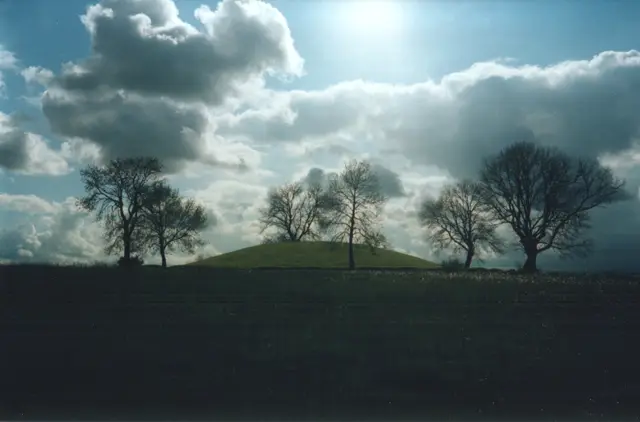
County Armagh
“ard WAH-kha” · Macha's height, from ard (height) + Macha
Known as The Orchard County. For its apple orchards, which are old: Armagh has grown apples for centuries, and the Bramley is the crop it is known for.
A fact like this for every county and every age →
Compare with another county → · Printable one-page summary →
Before the 4th century Armagh was the land of the Ulaid, and Emain Macha — Navan Fort, just outside the city — was their capital, the seat of the Red Branch in the Ulster Cycle. The fort and the city are named after the goddess Macha. In the 4th century the Three Collas drove the Ulaid out, and their descendants ruled the territory of Airgíalla, or Oriel, for about eight hundred years; the chief families of the county, the O'Hanlons and MacCanns among them, traced themselves to the Collas, alongside the O'Neills of the Fews.
Patrick is counted the first bishop of Armagh, and the 9th-century Book of Armagh, now in Trinity College Dublin, holds early accounts of his life and his Confessio. In the 17th and 18th centuries the county was known for its rapparees — outlaws and cattle-raiders such as Count Redmond O'Hanlon. In the late 20th century south Armagh was a stronghold of the Provisional IRA, and in March 2009 Constable Stephen Carroll was shot dead in Craigavon, the first police officer killed in Northern Ireland since 1998.
Drawn from the History section of the Wikipedia article on County Armagh ↗, rewritten here and adding nothing it does not say; licensed CC BY-SA 4.0. The chronology above is this site's own; where the two differ, the article is the one to check.
From its highest point at Slieve Gullion, in the south of the county, Armagh's land falls away from its rugged south with Carrigatuke, Lislea and Camlough mountains, to rolling drumlin country in the middle and west of the county. In the north it gives way to flatlands where rolling flats and small hills reach sea level at Lough Neagh.
County Armagh's boundary with Louth is marked by the rugged Ring of Gullion rising in the south of the county, whilst much of its boundary with counties Monaghan and Down goes unnoticed with seamless continuance of drumlins and small lakes. The River Blackwater marks the border with County Tyrone, and Lough Neagh otherwise marks the county's northern boundary.
Numerous uninhabited islands are located in the county's section of Lough Neagh: Coney Island Flat, Croaghan Flat, Padian, Phil Roe's Flat, and the Shallow Flat.
Read the full article ↗ · Text from Wikipedia, licensed CC BY-SA 4.0.
Tap a name for its full page — story, homeland map and neighbours. Or see all surnames from County Armagh, with the other counties each name is tied to.
Towns. Armagh Ard Mhacha (16,438, 2021), Tandragee Tóin re Gaoith (3,543, 2021), Lurgan An Lorgain, Portadown Port an Dúnáin, Keady An Céide. What every town name means →
Saints. St Patrick (17 March), St Moninne (6 July), St Oliver Plunkett (1 July), St Malachy (3 November).
Legends set here. Emain Macha — the Red Branch · Emain Macha — Macha's curse · Emain Macha — Deirdre of the Sorrows · Slieve Gullion — the Cailleach's lake. On the atlas →
First names that belong here. Deirdre, Neasa, Blinne, Conchobhar, Pádraig, Fearghas, Naoise, Ardghal, Ceallach, Colla, Eochaidh, Macha.
At the 2021 census, 17,008 people in Armagh aged 3 and over said they could speak Irish, and 9,803 could speak, read, write and understand it. 5,743 speak it daily, and for 564 it is their main language.
NISRA, Census 2021, Flexible Table Builder (county geography, built by NISRA from Data Zones; Belfast is split between Antrim and Down). All six counties →
Slieve Gullion (Sliabh gCuillinn), 573 metres, in the Ring of Gullion.
Rivers and loughs: River Bann, River Blackwater, Fane River, Lough Neagh.
MountainViews, via Wikipedia. Every county's highest point → · Rivers and loughs →
Hurling: no senior title.
Football: 2 senior titles (2002, 2024); 3 finals lost.
-
George William Russell ↗
· 1867–1935
Irish writer, editor, critic, poet, and artistic painter, born at Lurgan -
John Dill ↗
· 1881–1944
Army officer, born at Lurgan -
Jimmy Jones ↗
· 1928–2014
Northern Ireland football player, born at Keady -
Tomás Ó Fiaich ↗
· 1923–1990
Catholic cardinal, born at Cullyhanna -
Owen Roe O'Neill ↗
Irish miltary commander -
Wilbur Cush ↗
· 1928–1981
Northern Irish footballer, born at Lurgan -
Seamus Mallon ↗
· 1936–2020
Irish politician, born at Markethill -
Archibald Acheson, 2nd Earl of Gosford ↗
· 1776–1849
Governor General of British North America,, born at Markethill -
Tommy Makem ↗
· 1932–2007
Irish musician, artist and poet, born at Keady -
Edward Bunting ↗
· 1773–1843
Irish musician and music collector -
Paddy Sloan ↗
· 1920–1993
Irish footballer, born at Lurgan -
Annie Patterson ↗
· 1868–1934
Irish composer and organist, born at Lurgan -
Arthur Acheson, 1st Earl of Gosford ↗
· 1745–1807
Irish politician, born at Markethill -
Brian Kerr, Baron Kerr of Tonaghmore ↗
· 1948–2020
Northern Irish senior judge, born at Lurgan -
John Hall ↗
· 1829–1898
Presbyterian pastor from Northern Ireland in New York, died 1898 -
Peter Tilley ↗
· 1930–2008
Northern Irish footballer, born at Lurgan -
Hugh Kelly ↗
· 1919–1977
Football player, born at Lurgan -
Archibald Acheson, 3rd Earl of Gosford ↗
· 1806–1864
British politician, born at Markethill -
Jack McClelland ↗
· 1940–1976
Northern Irish footballer, born at Lurgan -
William Blacker ↗
· 1777–1855
British Army officer -
Thomas Preston ↗
· 1860–1900
Irish physicist -
Joe Coburn ↗
· 1835–1890
American boxer -
Len Ganley ↗
· 1943–2011
Snooker referee, born at Lurgan -
William Dickson ↗
· 1923–2002
Northern Irish footballer, born 1923, born at Lurgan -
Ike Weir ↗
· 1867–1908
British boxer, born at Lurgan -
Lord William Beresford ↗
· 1847–1900
Recipient of the Victoria Cross, born at Mullaghbrack -
Alexander Montagu, 10th Duke of Manchester ↗
· 1902–1977
British duke, born at Tandragee Castle -
James F. Reed ↗
Irish-American businessman, soldier, and pioneer in the American West; organizing member of the Donner Party -
William George Thompson ↗
· 1863–1953
Merchant, soldier and politician in Queensland, Australia, born at Lurgan -
Gilbert Tennent ↗
· 1703–1764
American minister
From Wikidata: people whose recorded birthplace is in the county, who have a Wikipedia article and are no longer living, with dates shown only where the article confirms them, ordered by how many languages Wikipedia covers them in. Traditional birthplaces of early saints are as Wikidata records them. Dates are left off where the sources disagree.
Armagh had 232,393 people in 1841 and has 194,394 now (-16%). Its peak was 232,393 in 1841; its low point 108,815 in 1937, -53% of 1841. It has never regained the population it had before the Famine.
| 1821 | 1831 | 1841 | 1851 | 1861 | 1871 | 1881 | 1891 | 1901 | 1911 | 1926 | 1937 | 1951 | 1961 | 1966 | 1971 | 1981 | 1991 | 2001 | 2011 |
|---|---|---|---|---|---|---|---|---|---|---|---|---|---|---|---|---|---|---|---|
| 197,427 | 220,134 | 232,393 | 196,084 | 190,086 | 179,260 | 163,177 | 143,289 | 125,392 | 120,291 | 110,070 | 108,815 | 114,154 | 117,594 | 125,164 | 133,969 | 133,230 | 141,585 | 162,957 | 174,792 |
Census returns as tabulated in the county's Wikipedia article. All 32 counties, 1821 to today →
- Annaghmare Court Tomb · tomb
- Ballykeel Dolmen · dolmen
- Navan Fort · royal site
- 8 castles · Charlemont Fort, Clare Castle, County Armagh, Creevekeeran Castle, Drumbanagher House, Gosford Castle and more
Every pin is placed by its documented coordinates. All the monuments of Ireland →
Everything on the site about County Armagh
The county
History
Monuments and heritage
Coast and country
What is the Irish name for County Armagh?
Ard Mhacha. Armagh is one of the 9 counties of Ulster (Cúige Uladh).
Who ruled County Armagh in the Middle Ages?
Around 1014 it was held by Airgíalla (Oriel); by 1450, O'Neill of Tír Eoghain. The full era-by-era chronology is on this page.
What surnames come from County Armagh?
Names historically associated with Armagh include Adams, Callan, Devaney, Garvey, Hamill, Hanlon, Hanratty, Hughes, among others.
What does Ard Mhacha mean?
Ard Mhacha, said “ard WAH-kha”, means Macha's height — from ard (height) + Macha. Macha is the goddess of the Ulster Cycle who cursed the men of Ulster; Emain Macha lies two miles west.
What is the population of County Armagh?
194,394 at the 2021 census, against 232,393 in 1841, before the Famine.
What is the county town of Armagh?
Armagh. County Armagh covers about 1,327 km², which makes it the 27th largest of the 32 counties.
Who are famous people from County Armagh?
Among the best-known people born in Armagh are George William Russell, John Dill, Jimmy Jones, Tomás Ó Fiaich, Owen Roe O'Neill, Wilbur Cush. The full list, with their birthplaces, is on this page.
What did the Famine do to County Armagh?
The census counted 232,393 people in Armagh in 1841 and 196,084 in 1851: a change of -16% in ten years, through death and emigration.
A clean copy for school projects or the family file; collapsed sections print in full.
- Wikipedia — County Armagh ↗
- CSO — Census of Population 2022 ↗
- NISRA — Census 2021 ↗
- Wikipedia — List of Irish counties by population ↗
- 1841 census of Ireland (county table) ↗
- Historical population of Ireland (county series) ↗
- Logainm.ie — the State's Placenames Database of Ireland ↗
- Wikipedia — Counties of Ireland ↗
- Wikipedia — the county articles ↗
- Woulfe, Irish Names and Surnames (1923), for the surnames ↗
The chronology of who held the county is this site's own reading of the standard histories onto today's county borders, and says so where the fit is rough. Quoted passages are marked and licensed. Spotted an error? Say so — corrections are credited.
- 1911 Census — Armagh ↗
- 1901 Census — Armagh ↗
- Griffith's Valuation — search Armagh ↗
- Down Survey maps — Armagh ↗
- Schools' Folklore Collection — Armagh ↗
- Placenames of Armagh (Logainm) ↗
- PRONI records (Northern Ireland) ↗
- Placenames NI ↗
Free, from the holding institutions. How to begin: the six-step guide → · Spotted an error on this page? Suggest a correction.