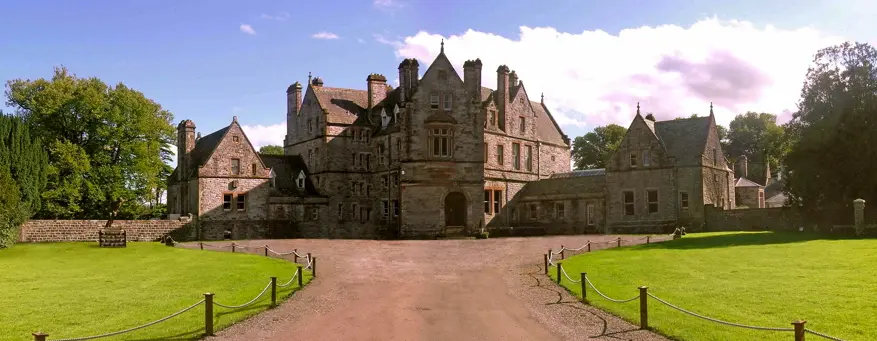
County Monaghan
“MWIN-a-khawn” · place of little thickets, from muine (thicket) + the diminutive
Known as The Drumlin County. For the drumlins, the low egg-shaped hills left by the ice that make the whole of south Ulster hard to cross and easy to hide in.
A fact like this for every county and every age →
Compare with another county → · Printable one-page summary →
Court cairns, dolmens and wedge tombs are scattered across Monaghan. In 1585 the local chiefs asked the Lord Deputy, Sir John Perrot, to divide Ulster into counties and share out the lands of Airgíalla among them, and County Monaghan was the result: five baronies, four held by the MacMahons and Truagh by the McKennas.
Unlike the other Ulster counties, Monaghan was not planted after 1603; its land was left with the native chiefs. The MacMahons and their allies joined the rebellion of 1641, and some Scottish and English settlement followed their defeat.
Drawn from the History section of the Wikipedia article on County Monaghan ↗, rewritten here and adding nothing it does not say; licensed CC BY-SA 4.0. The chronology above is this site's own; where the two differ, the article is the one to check.
County Monaghan is the fifth-smallest of the Republic's 26 counties by area, and the fourth smallest by population. It is the smallest of Ulster's nine counties in terms of population.
Notable mountains include Slieve Beagh (on the Tyrone and Fermanagh borders), Mullyash Mountain and Coolberrin Hill (214 m, 702 ft). Lakes include Lough Avaghon, Dromore Lough, Drumlona Lough, Lough Egish, Emy Lough, Lough Fea, Inner Lough (in Dartrey Forest), Muckno Lough and White Lough. Notable rivers include the River Fane (along the Louth border), the River Glyde (along the Louth and Meath borders), the Ulster Blackwater (along the Tyrone border), and the Dromore River (along the Cavan border, linking Cootehill to Ballybay).
Read the full article ↗ · Text from Wikipedia, licensed CC BY-SA 4.0.
Tap a name for its full page — story, homeland map and neighbours. Or see all surnames from County Monaghan, with the other counties each name is tied to.
Towns. Carrickmacross Carraig Mhachaire Rois (5,745, 2022), Castleblayney Baile na Lorgan (3,926, 2022), Monaghan Muineachán, Clones Cluain Eois. What every town name means →
Saints. St Dymphna (30 May).
Legends set here. The Black Pig’s Dyke. On the atlas →
First names that belong here. Damhnait, Ardghal, Colla, Éibhear.
At the 2022 census, 23,571 people in Monaghan said they could speak Irish. 724 speak it every day outside school, and 1,358 weekly.
4 primary schools here teach entirely through Irish (2025/26, 918 pupils), and 1 secondary school.
CSO, Census 2022, table SAP2022T3T2CTY. Every county compared →
Slieve Beagh (Sliabh Beatha), 373 metres, in the Fermanagh/ S. Tyrone.
Rivers and loughs: River Blackwater, River Annalee, Fane River.
MountainViews, via Wikipedia. Every county's highest point → · Rivers and loughs →
Hurling: no senior title.
Football: no senior title; 1 final lost.
-
John Bagnell Bury ↗
· 1861–1927
Anglo-Irish historian and classical scholar -
Patrick Kavanagh ↗
· 1904–1967
Irish poet, born at Inniskeen -
James Cecil Parke ↗
· 1881–1946
Irish tennis player, born at Clones -
Eoin O'Duffy ↗
Irish political activist, soldier and police commissioner, born at Castleblayney -
John McKenna ↗
· 1855–1936
British footballer, born at Glaslough -
Mary Bailey ↗
· 1890–1960
Anglo-Irish aviator, born at Rossmore Castle -
John Robert Gregg ↗
· 1867–1948
Irish inventor and writer, born at Rockcorry -
Charles Gavan Duffy ↗
· 1816–1903
Irish nationalist, journalist, poet and Australian politician, born at Monaghan -
Thomas Bracken ↗
· 1843–1898
Anglo-New Zealand poet, journalist, politician, born at Clones -
Mary Lee ↗
· 1821–1909
Australian activist -
Alexander Pearce ↗
· 1790–1824
Irish convict transported and imprisoned in Tasmania and escapee cannibal -
Pat McGuigan ↗
· 1935–1987
Irish singer, born at Clones -
Thomas Taggart ↗
· 1856–1929
American politician -
Shane Leslie ↗
· 1885–1971
Anglo-Irish nationalist writer -
Brendan Comiskey ↗
· 1935–2025
Irish Roman Catholic bishop, born at Clontibret -
Thomas J. Fitzpatrick ↗
· 1918–2006
Irish politician, born at Clones -
Patrick Neeson Lynch ↗
· 1817–1882
Catholic bishop, born at Clones -
Fergal O'Hanlon ↗
· 1936–1957
Irish activist, born at Monaghan -
Andrew Blayney, 11th Baron Blayney ↗
· 1770–1834
British Army general, born at Castleblayney -
Juan Mackenna ↗
· 1771–1814
Chilean military officer, born at Monaghan -
James McMahon Graham ↗
· 1852–1945
American politician, born at Castleblayney -
Monica Barnes ↗
· 1936–2018
Irish politician, born at Carrickmacross -
William Whitla ↗
· 1851–1933
British physician and politician, born at Monaghan -
Joseph Finegan ↗
· 1814–1885
Confederate Army general, born at Clones -
Big Tom ↗
· 1936–2018
Singer, born at Castleblayney -
Billy Fox ↗
· 1939–1974
Irish politician -
David Nelson ↗
Recipient of the Victoria Cross -
John McGough ↗
Scottish athlete, born at Monaghan -
Barry Cassin ↗
· 1924–2017
Irish actor and director, born at Monaghan -
John Carroll ↗
· 1838–1897
Irish-born prelate of the Roman Catholic Church, born at Castleblayney
From Wikidata: people whose recorded birthplace is in the county, who have a Wikipedia article and are no longer living, with dates shown only where the article confirms them, ordered by how many languages Wikipedia covers them in. Traditional birthplaces of early saints are as Wikidata records them.
Monaghan had 200,442 people in 1841 and has 65,288 now (-67%). Its peak was 200,442 in 1841; its low point 45,732 in 1966, -77% of 1841. It has never regained the population it had before the Famine.
| 1821 | 1831 | 1841 | 1851 | 1861 | 1871 | 1881 | 1891 | 1901 | 1911 | 1926 | 1936 | 1946 | 1951 | 1956 | 1961 | 1966 | 1971 | 1979 | 1981 | 1986 | 1991 | 1996 | 2002 | 2006 | 2011 | 2016 | 2022 |
|---|---|---|---|---|---|---|---|---|---|---|---|---|---|---|---|---|---|---|---|---|---|---|---|---|---|---|---|
| 174,697 | 195,536 | 200,442 | 141,823 | 126,482 | 114,969 | 102,748 | 86,206 | 74,611 | 71,455 | 65,131 | 61,289 | 57,215 | 55,345 | 52,064 | 47,088 | 45,732 | 46,242 | 50,376 | 51,192 | 52,379 | 51,293 | 51,313 | 52,593 | 55,997 | 60,483 | 61,386 | 65,288 |
Census returns as tabulated in the county's Wikipedia article. All 32 counties, 1821 to today →
- Clones · round tower · complete to cornice · 22.9 m
- Inishkeen · round tower · incomplete · 12.6 m
- Mullyash Kerbed Cairn · tomb
- 3 castles · Hope Castle, Mannan Castle, Rossmore Castle
Every pin is placed by its documented coordinates. All the monuments of Ireland →
Everything on the site about County Monaghan
The county
History
Monuments and heritage
Coast and country
People and culture
What is the Irish name for County Monaghan?
Muineachán. Monaghan is one of the 9 counties of Ulster (Cúige Uladh).
Who ruled County Monaghan in the Middle Ages?
Around 1014 it was held by Airgíalla (Oriel); by 1450, Oriel (MacMahon). The full era-by-era chronology is on this page.
What surnames come from County Monaghan?
Names historically associated with Monaghan include Boylan, Callan, Carolan, Comiskey, Connolly, Corrigan, Donegan, Duffy, among others.
What does Muineachán mean?
Muineachán, said “MWIN-a-khawn”, means place of little thickets — from muine (thicket) + the diminutive. Little hills of scrub, which is exactly what the drumlin country looks like.
What is the population of County Monaghan?
65,288 at the 2022 census, against 200,442 in 1841, before the Famine.
What is the county town of Monaghan?
Monaghan. County Monaghan covers about 1,295 km², which makes it the 28th largest of the 32 counties.
Who are famous people from County Monaghan?
Among the best-known people born in Monaghan are John Bagnell Bury, Patrick Kavanagh, James Cecil Parke, Eoin O'Duffy, John McKenna, Mary Bailey. The full list, with their birthplaces, is on this page.
What did the Famine do to County Monaghan?
The census counted 200,442 people in Monaghan in 1841 and 142,000 in 1851 (the 1851 figure is approximate): a change of -29% in ten years, through death and emigration.
A clean copy for school projects or the family file; collapsed sections print in full.
- Wikipedia — County Monaghan ↗
- CSO — Census of Population 2022 ↗
- NISRA — Census 2021 ↗
- Wikipedia — List of Irish counties by population ↗
- 1841 census of Ireland (county table) ↗
- Historical population of Ireland (county series) ↗
- Logainm.ie — the State's Placenames Database of Ireland ↗
- Wikipedia — Counties of Ireland ↗
- Wikipedia — the county articles ↗
- Woulfe, Irish Names and Surnames (1923), for the surnames ↗
The chronology of who held the county is this site's own reading of the standard histories onto today's county borders, and says so where the fit is rough. Quoted passages are marked and licensed. Spotted an error? Say so — corrections are credited.
- 1911 Census — Monaghan ↗
- 1901 Census — Monaghan ↗
- Griffith's Valuation — search Monaghan ↗
- Down Survey maps — Monaghan ↗
- Schools' Folklore Collection — Monaghan ↗
- Placenames of Monaghan (Logainm) ↗
Free, from the holding institutions. How to begin: the six-step guide → · Spotted an error on this page? Suggest a correction.