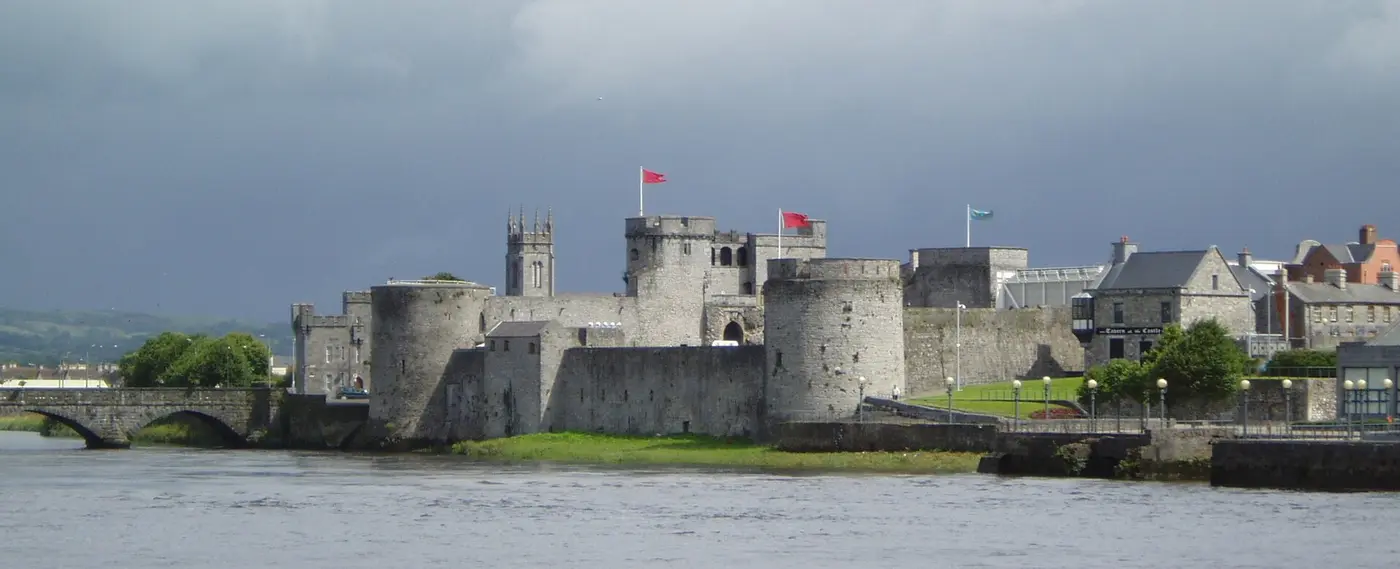
County Limerick
“LIM-nakh” · bare spot, or bare marsh, from loimeanach, bare or barren ground
Known as The Treaty County. For the Treaty of Limerick, signed in 1691 to end the Williamite war, and broken so quickly that Limerick has been called the city of the violated treaty ever since. The stone it was supposedly signed on still stands by the river.
A fact like this for every county and every age →
Compare with another county → · Printable one-page summary →
People were at Lough Gur by about 3000 BC, and the megalithic remains at Duntryleague go back to 3500 BC. From the 4th to the 11th century most of what is now County Limerick was the kingdom of the Uí Fidgenti, whose capital was Dún Eochair near Bruree; the O'Donovans and Collinses were among its leading families. The Ardagh Chalice, one of the masterpieces of early Irish metalwork, was found in a west Limerick fort in 1868.
Vikings founded the city on an island in the Shannon in 922. After the death of Domnall Mór Ua Briain in 1194 the Normans took control, King John's Castle was built around 1200, and the county was formally established in 1210. The Desmond Rebellions from 1569 laid the whole province waste and ended with the confiscation of the Geraldine estates.
Limerick city was besieged again and again: by the Confederate general Garret Barry in 1642, by Ireton for twelve months until October 1651, and twice in the Williamite War, in 1690 — when Patrick Sarsfield destroyed the Williamite siege guns at Ballyneety — and 1691. The Treaty of Limerick that ended the war was not kept, and the city became known as the City of the Broken Treaty. In the 18th century the Maigue Poets kept Gaelic poetry alive at Croom and Bruree; the Famine brought mass emigration and the collapse of spoken Irish in the county.
Drawn from the History section of the Wikipedia article on County Limerick ↗, rewritten here and adding nothing it does not say; licensed CC BY-SA 4.0. The chronology above is this site's own; where the two differ, the article is the one to check.
Limerick borders four other counties: Kerry to the west, Clare to the north, Tipperary to the east, and Cork to the south. It is the fifth-largest of Munster's six counties in size and the second-largest by population. The River Shannon flows through the city of Limerick, then continues as the Shannon Estuary until it meets the Atlantic Ocean past the far western end of the county. Because the estuary is shallow, the county's most important port is several kilometres west of the city, at Foynes. Limerick City is the county town and is also Ireland's third-largest city. Newcastle West, Kilmallock and Abbeyfeale are other important towns in the county.
Read the full article ↗ · Text from Wikipedia, licensed CC BY-SA 4.0.
Tap a name for its full page — story, homeland map and neighbours. Or see all surnames from County Limerick, with the other counties each name is tied to.
Towns. Limerick Luimneach (102,287, 2022), Newcastle West An Caisleán Nua Thiar (7,209, 2022), Abbeyfeale Mainistir na Féile (2,206, 2022), Kilmallock Cill Mocheallóg (1,761, 2022), Adare Áth Dara. What every town name means →
Saints. St Íte (15 January).
Legends set here. Lough Gur — Áine's lake. On the atlas →
At the 2022 census, 78,172 people in Limerick said they could speak Irish. 1,853 speak it every day outside school, and 4,319 weekly.
6 primary schools here teach entirely through Irish (2025/26, 2,013 pupils), and 2 secondary schools.
CSO, Census 2022, table SAP2022T3T2CTY. Every county compared →
Galtymore (Cnoc Mór na nGaibhlte), 918 metres, in the Galty Mountains, on the county boundary and shared with a neighbouring county.
Wrecks on its coast: Cicero (1832). Shipwrecks of Ireland →
Rivers and loughs: River Shannon, River Feale, River Deel, River Maigue, Mulkear River.
MountainViews, via Wikipedia. Every county's highest point → · Rivers and loughs →
Hurling: 13 senior titles (1897, 1918, 1921, 1934, 1936, 1940, 1973, 2018, 2020, 2021, 2022, 2023, 2026); 9 finals lost.
Football: 2 senior titles (1887, 1896).
-
Dolores O'Riordan ↗
· 1971–2018
Irish musician, born at Ballybricken North -
G. E. M. Anscombe ↗
· 1919–2001
British analytic philosopher, born at Limerick -
John Flanagan ↗
· 1868–1938
Irish-American hammer thrower -
Mary Jane Kelly ↗
· 1863–1888
Murder victim, born at Limerick -
Terry Wogan ↗
· 1938–2016
Irish radio and television broadcaster, born at Limerick -
Patrick James Ryan ↗
· 1883–1964
Irish American hammer thrower, born at Limerick -
Peter von Lacy ↗
· 1678–1751
Irish general in Russia, born at Killeedy -
William H. Harvey ↗
· 1811–1866
Irish botanist, born at Limerick -
George Browne ↗
Irish soldier of fortune, born at Limerick -
Tim Ahearne ↗
Irish long and triple jumper, born at Athea -
Hugh Gough, 1st Viscount Gough ↗
· 1779–1869
British field marshal, born at Limerick -
Joanna Hiffernan ↗
Irish model, born at Limerick -
Peter Woulfe ↗
· 1727–1803
Irish chemist, born at Limerick -
De Lacy Evans ↗
· 1787–1870
British Army general -
Eyre Coote ↗
· 1726–1783
British Army general, born at Limerick -
John Casey ↗
· 1820–1891
Irish geometer, born at Coolattin -
Matthew Thornton ↗
· 1714–1803
American politician -
Liam Lynch ↗
Irish general -
Henry Arthur Blake ↗
· 1840–1918
12th Governor of Hong Kong, born at Limerick -
Kate O'Brien ↗
· 1897–1974
Irish novelist, playwright and activist, born at Limerick -
Rosina Bulwer Lytton ↗
· 1802–1882
British writer -
Constance Smith ↗
Irish actress, born at Limerick -
Mary, Lady Heath ↗
· 1896–1939
Irish aviator, born at Knockaderry -
Katherine Sophia Baily ↗
· 1811–1886
Irish botanist -
Desmond O'Malley ↗
· 1939–2021
Irish politician, born at Limerick -
Tom O'Donnell ↗
· 1926–2020
Irish Fine Gael politician, born at Bulgaden -
Jim Hogan ↗
· 1933–2015
Irish distance runner, born at Croom -
Gerald Griffin ↗
· 1803–1840
Irish-born novelist, poet and playwright (1803 – 1840), author of the novel The Collegians, born at Limerick -
Catherine Hayes ↗
Irish operatic soprano, born at Limerick
From Wikidata: people whose recorded birthplace is in the county, who have a Wikipedia article and are no longer living, with dates shown only where the article confirms them, ordered by how many languages Wikipedia covers them in. Traditional birthplaces of early saints are as Wikidata records them. Dates are left off where the sources disagree.
- Ardpatrick · round tower · incomplete · 3 m
- Dísert Óengusa, Croom · round tower · incomplete · 21 m
- Grange stone circle · stone circle
- Kilmallock · round tower · incomplete · 3 m
- 14 castles · Carrigogunnell, Castle Connell, Castle Oliver, Coonagh Castle, Croom Castle and more
Every pin is placed by its documented coordinates. All the monuments of Ireland →
Everything on the site about County Limerick
The county
History
Monuments and heritage
Coast and country
What is the Irish name for County Limerick?
Luimneach. Limerick is one of the 6 counties of Munster (Cúige Mumhan).
Who ruled County Limerick in the Middle Ages?
Around 1014 it was held by Thomond (O'Brien); by 1450, Earldom of Desmond (FitzGerald). The full era-by-era chronology is on this page.
What surnames come from County Limerick?
Names historically associated with Limerick include Canty, Carmody, Casey, Clohessy, Collins, Creagh, Cremin, Culhane, among others.
What does Luimneach mean?
Luimneach, said “LIM-nakh”, means bare spot, or bare marsh — from loimeanach, bare or barren ground. The reading is old and not fully settled; the city sits on an island in the Shannon.
What is the population of County Limerick?
209,536 at the 2022 census, against 330,029 in 1841, before the Famine.
What is the county town of Limerick?
Limerick. County Limerick covers about 2,756 km², which makes it the 10th largest of the 32 counties.
Who are famous people from County Limerick?
Among the best-known people born in Limerick are Dolores O'Riordan, G. E. M. Anscombe, John Flanagan, Mary Jane Kelly, Terry Wogan, Patrick James Ryan. The full list, with their birthplaces, is on this page.
What did the Famine do to County Limerick?
The census counted 330,029 people in Limerick in 1841 and 262,000 in 1851 (the 1851 figure is approximate): a change of -21% in ten years, through death and emigration.
A clean copy for school projects or the family file; collapsed sections print in full.
- Wikipedia — County Limerick ↗
- CSO — Census of Population 2022 ↗
- NISRA — Census 2021 ↗
- Wikipedia — List of Irish counties by population ↗
- 1841 census of Ireland (county table) ↗
- Historical population of Ireland (county series) ↗
- Logainm.ie — the State's Placenames Database of Ireland ↗
- Wikipedia — Counties of Ireland ↗
- Wikipedia — the county articles ↗
- Woulfe, Irish Names and Surnames (1923), for the surnames ↗
The chronology of who held the county is this site's own reading of the standard histories onto today's county borders, and says so where the fit is rough. Quoted passages are marked and licensed. Spotted an error? Say so — corrections are credited.
- 1911 Census — Limerick ↗
- 1901 Census — Limerick ↗
- Griffith's Valuation — search Limerick ↗
- Down Survey maps — Limerick ↗
- Schools' Folklore Collection — Limerick ↗
- Placenames of Limerick (Logainm) ↗
- Landed Estates — Limerick ↗
Free, from the holding institutions. How to begin: the six-step guide → · Spotted an error on this page? Suggest a correction.