Limerick
'bare spot' or 'bare marsh'
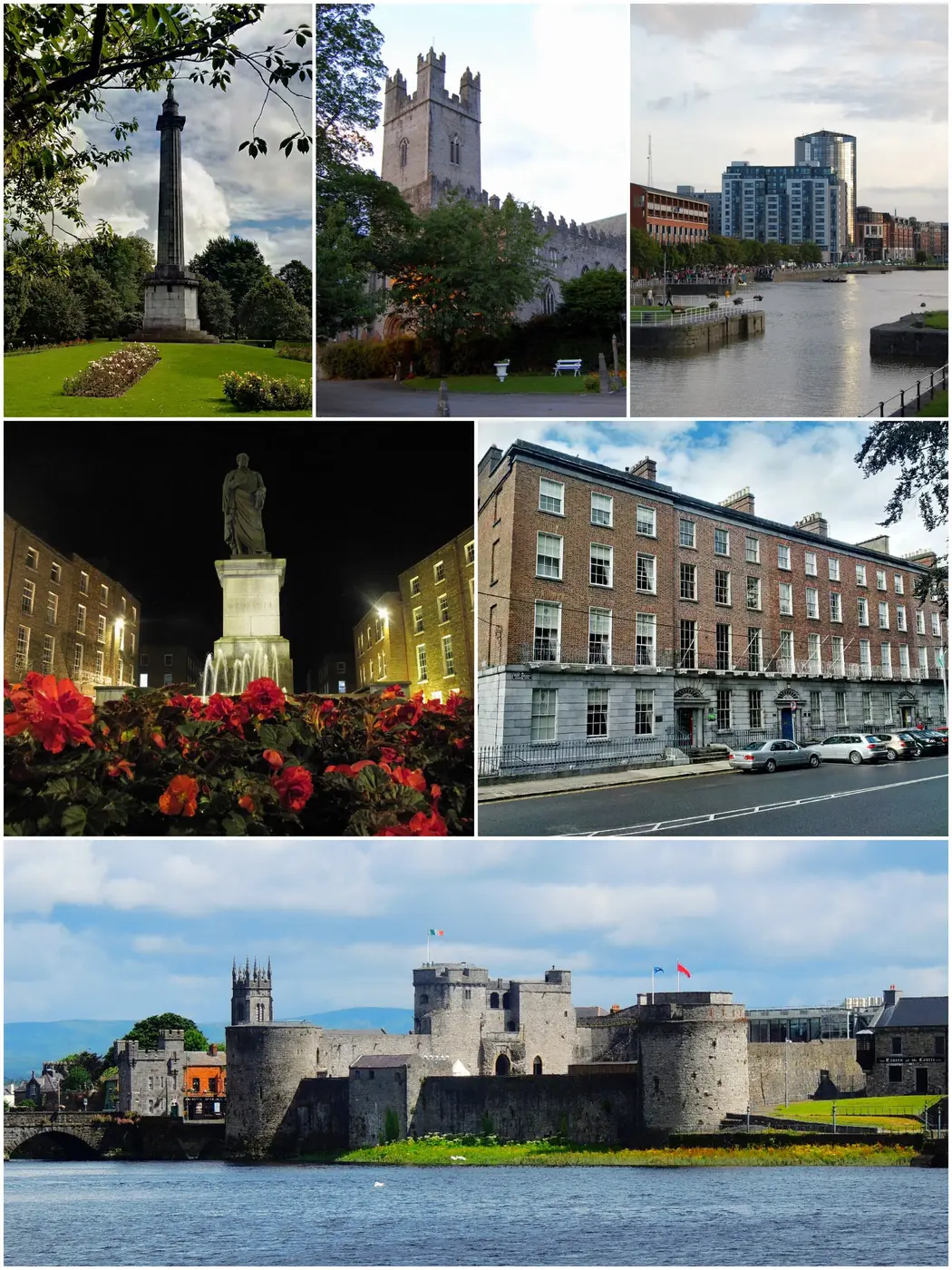
A Viking town on the Shannon, taken by Brian Boru's Dál gCais and made the seat of the O'Brien kings of Thomond. King John's Castle still holds the river crossing. Limerick endured two great sieges in the Williamite war, and the treaty signed here in 1691 (its promises to Catholics broken, they said, before the ink was dry) left it 'the city of the violated treaty'.
The first settlement was on King's Island in the Shannon, known before and during the Viking age as Inis Sibhtonn. Ptolemy's map of about AD 150 marks a place called Regia at the same spot. Saint Munchin, the first bishop, died in 652. Vikings sailed up the Shannon in 812, burned Mungret Abbey and were driven off; later they settled, and the Normans rebuilt the city in the 12th century with King John's Castle and St Mary's Cathedral. Limerick sat at the centre of the O'Brien kingdom of Thomond, whose name survives in Thomondgate, Thomond Bridge and Thomond Park.
Cromwell's army besieged the city in 1651, and the Williamites twice in the 1690s. The Treaty of Limerick that ended the Williamite war promised Catholics toleration, but the Irish parliament never passed those articles and tightened the Penal Laws instead; the treaty is said to have been signed on the Treaty Stone, now on a pedestal at Clancy Strand, and Limerick is still called the Treaty City. Peace brought trade in the late 18th century, when the port shipped the produce of the Golden Vale to Britain and America and the Georgian streets of Newtown Pery were built.
Drawn from the History section of the Wikipedia article on Limerick ↗, rewritten here and adding nothing it does not say; licensed CC BY-SA 4.0.
- Fanning's Castle · castle · under 1 km
- Carrigogunnell · castle · 8 km
- Castle Connell · castle · 10 km
- Rockstown Castle · castle · 12 km
- Bunratty Castle · castle · 13 km
Straight-line distances from the town centre, from each site's documented coordinates.
- Grange stone circle, Lough Gur · Ireland's largest stone circle, 113 stones in a great embanked ring, beside a lake that has yielded more prehistoric finds than almost anywhere in Ireland.
- Lough Gur — Áine's lake · The goddess Áine of Knockainey haunts its shores, and Gearóid Iarla, the earl said to be her son, sleeps in a cave here and rides out around the lake on a silver-shod white horse.
All of these are pinned on the Hidden Ireland map.
All towns and cities → · The 12 cities of Ireland · Know Limerick better? Add to the story.