County Cork
“KUR-kig” · marsh, from corcach, a marsh
Known as The Rebel County. Cork backed Perkin Warbeck, the pretender to the English throne, in 1491, and the name stuck. It was taken up again, and meant differently, during the War of Independence.
A fact like this for every county and every age →
Compare with another county → · Printable one-page summary →
Much of Cork was once Desmond, South Munster, ruled by the MacCarthy Mór. After the Normans came the MacCarthys were pushed west and the FitzGeralds took the north and east, becoming Earls of Desmond; Cork city had an English royal charter by 1318. The Desmond Rebellions of 1569–73 and 1579–83 destroyed the Geraldines and laid much of the county waste, and the Plantation of Munster followed.
The Rebel County has two stories behind the name. The older is 1491, when the pretender Perkin Warbeck landed at Cork claiming to be one of the Princes in the Tower, and the mayor and leading citizens went with him to England and were executed. The newer is the War of Independence. In between came Kinsale in 1601, the battle that ended the Nine Years' War, and the creation of the county from the older County Desmond in 1606; in the early 17th century pirates traded freely at Baltimore and Whiddy Island.
In 1919–21 three IRA brigades fought in the county and one in the city, with the ambushes at Kilmichael in November 1920 and Crossbarry in March 1921. On 11 December 1920 the Black and Tans burned the centre of Cork, destroying more than 300 buildings. In the Civil War most Cork units opposed the Treaty and held the county as the "Munster Republic" until Free State landings in August 1922. Michael Collins, born near Clonakilty, was killed during the Civil War at Béal na Bláth in west Cork.
Drawn from the History section of the Wikipedia article on County Cork ↗, rewritten here and adding nothing it does not say; licensed CC BY-SA 4.0. The chronology above is this site's own; where the two differ, the article is the one to check.
Cork is the largest county in Ireland by land area, and the largest of Munster's six counties by population and area. At the latest census in 2022, the population of the entire county stood at 584,156. Cork is the second-most populous county in the State, and the third-most populous county on the island of Ireland.
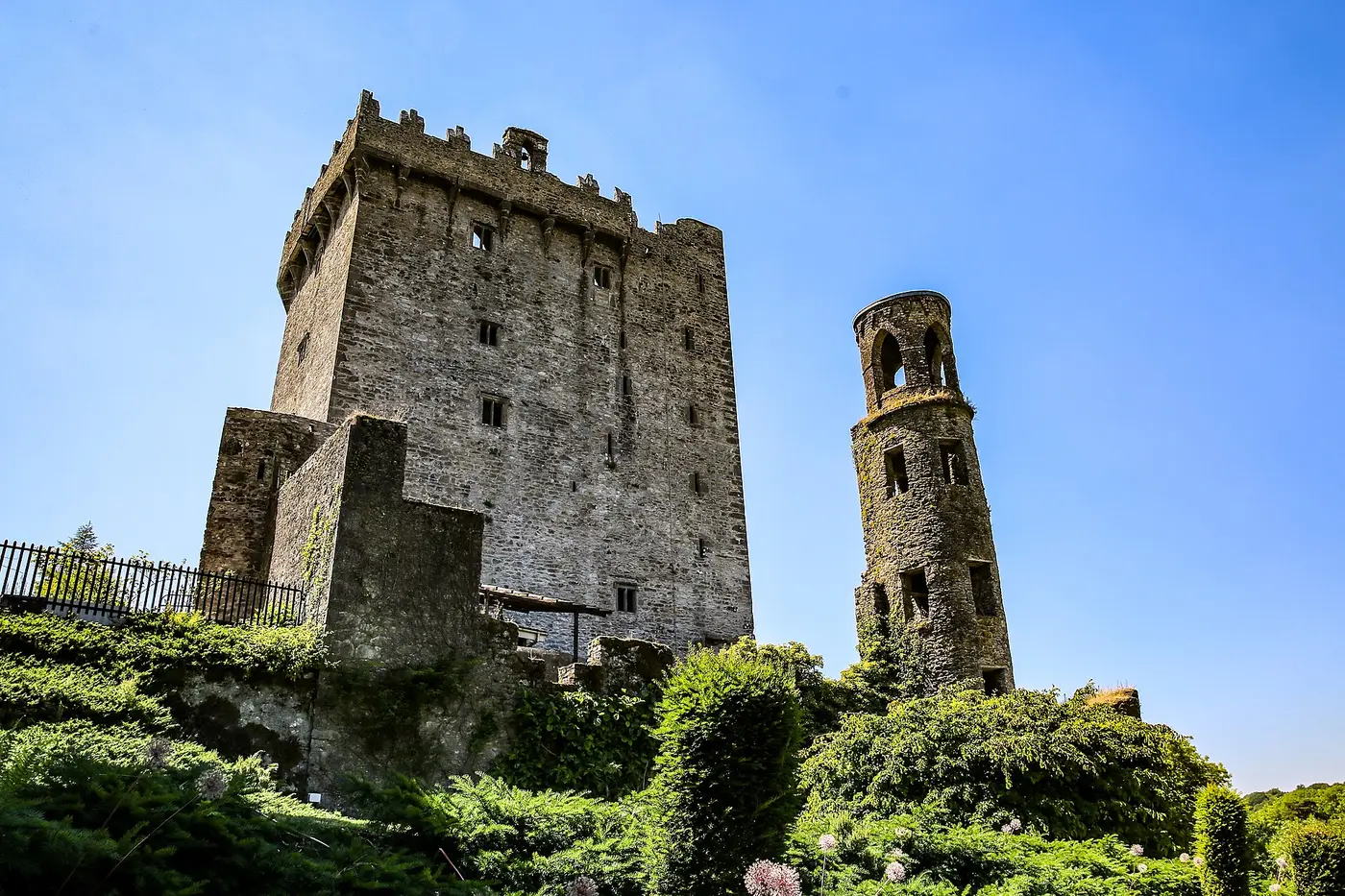
Places of interestTourist sites include the Blarney Stone at Blarney Castle, Blarney. The port of Cobh in County Cork was the point of embarkation for many Irish emigrants travelling to Australia, Canada, New Zealand, South Africa or the United States. Cobh (at the time named 'Queenstown') was the last stop of the RMS Titanic before it departed on its fated journey.
Fota Wildlife Park, on Fota Island, is also a tourist attraction. Nearby is Fota House and Gardens and the Fota Golf Club and Resort; a European Tour standard golf course which hosted the Irish Open in 2001, 2002 and 2014.
West Cork is known for its rugged natural environment, beaches and social atmosphere, and is a common destination for British, German, French and Dutch tourists.
File:Gougane Barra.jpg|St Finbar's church, located on Gougane Barra, a 6th century monastery site.
Read the full article ↗ · Text from Wikipedia, licensed CC BY-SA 4.0.
Tap a name for its full page — story, homeland map and neighbours. Or see all surnames from County Cork, with the other counties each name is tied to.
Towns. Cork Corcaigh (222,526, 2022), Cobh An Cóbh (14,148, 2022), Midleton Mainistir na Corann (13,906, 2022), Mallow Mala (13,456, 2022), Bandon Droichead na Bandan (8,196, 2022), Fermoy Mainistir Fhear Maí (6,720, 2022), Clonakilty Cloich na Coillte (5,112, 2022), Macroom Maigh Chromtha (4,096, 2022), Charleville Ráth Luirc or An Ráth (3,970, 2022), Mitchelstown Baile Mhistéala (3,744, 2022), Bantry Beanntraí (2,929, 2022), Skibbereen An Sciobairín (2,903, 2022), Kanturk Ceann Toirc (2,803, 2022), Blarney An Bhlarna (2,779, 2022), Kinsale Cionn tSáile, Youghal Eochaill. What every town name means →
Saints. St Finbarr of Cork (25 September), St Colman of Cloyne (24 November).
Legends set here. The Blarney Stone. On the atlas →
First names that belong here. Clíodhna, Eibhlín, Micheál, Fachtna, Cárthach, Barra, Ríordán, Art, Rossa, Gobnait, Éibhear, Finghin, Fionnbharr.
At the 2022 census, 238,226 people in Cork said they could speak Irish. 6,906 speak it every day outside school, and 14,424 weekly.
28 primary schools here teach entirely through Irish (2025/26, 6,540 pupils), and 6 secondary schools.
Cork's Gaeltacht had 4,110 people in 2022, 847 of them daily Irish speakers. The Gaeltacht in numbers →
CSO, Census 2022, table SAP2022T3T2CTY. Every county compared →
Knockboy (An Cnoc Buí), 706 metres, in the Shehy Mountains.
Wrecks on its coast: Rockingham (1775), Surveillante (1796), Suffisante (1803), Britannia (1806), Stephen Whitney (1847), RMS Lusitania (1915), SS Iberian (1915), SS Libau (Aud) (1916), Alondra (1916), RMS Laconia (1917), SS Minnehaha (1917), MV Alta (2020). Shipwrecks of Ireland →
Rivers and loughs: River Blackwater, River Lee, River Feale, River Bandon, River Bride, River Deel, River Maigue.
MountainViews, via Wikipedia. Every county's highest point → · Rivers and loughs →
Hurling: 30 senior titles (1890, 1892, 1893, 1894, 1902, 1903, 1919, 1926, 1928, 1929, 1931, 1941, 1942, 1943, 1944, 1946, 1952, 1953, 1954, 1966, 1970, 1976, 1977, 1978, 1984, 1986, 1990, 1999, 2004, 2005); 22 finals lost.
Football: 7 senior titles (1890, 1911, 1945, 1973, 1989, 1990, 2010); 16 finals lost.
-
Michael Collins ↗
· 1890–1922
Irish revolutionary and politician, born at Clonakilty -
Mary Harris Jones ↗
Irish-born American labor and community organizer, born at Cork -
Ethel Lilian Voynich ↗
· 1864–1960
British writer and musician, born at Ballintemple -
William Trevor ↗
· 1928–2016
Irish writer, born at Mitchelstown -
James Barry ↗
· 1789–1865
19th-century military surgeon in the British Army, born at Cork -
Agnes Mary Clerke ↗
· 1842–1907
Irish astronomer and writer, born at Skibbereen -
Jack Lynch ↗
· 1917–1999
Taoiseach of Ireland; from 1966 to 1973 and 1977 to 1979, born at Cork -
Pat O'Callaghan ↗
Irish athletics competitor, born at Kanturk -
William Brouncker, 2nd Viscount Brouncker ↗
· 1620–1684
English mathematician, born at Castlelyons -
Joseph Murphy ↗
· 1898–1981
American writer, born at Ballydehob -
Liam Miller ↗
· 1981–2018
Irish association football player, born at Cork -
Terence MacSwiney ↗
· 1879–1920
Irish playwright, author and nationalist politician, born at Cork -
Paul Kane ↗
· 1810–1871
Irish-Canadian painter, born at Mallow -
George James Allman ↗
· 1812–1898
Irish natural historian, born at Cork -
Eliza Lynch ↗
First Lady of Paraguay, born at Cork -
Alicia Boole Stott ↗
· 1860–1940
Irish-English mathematician, born at Cork -
Edward Bransfield ↗
· 1785–1852
Royal Navy officer and explorer, born at Ballinacurra -
William Thompson ↗
· 1775–1833
Philosopher and political writer from Ireland, born at Cork -
Edward Mulhare ↗
· 1923–1997
Irish American actor, born at Cork -
Conel Hugh O'Donel Alexander ↗
· 1909–1974
British cryptanalyst, chess player, and chess writer, born at Cork -
Edward Hincks ↗
· 1792–1866
Irish Assyriologist, born at Cork -
Fitz James O'Brien ↗
Irish-American writer, born at Cork -
Frank O'Farrell ↗
· 1927–2022
Irish footballer and manager, born at Cork -
Anne Buttimer ↗
· 1938–2017
Irish geographer, born at Cork -
Daniel Maclise ↗
Irish history, literary and portrait painter, and illustrator, born at Cork -
Frank O'Connor ↗
· 1903–1966
Irish writer, born at Cork -
Duncan Hamilton ↗
· 1920–1994
British racecar driver, born at Cork -
Edward Donovan ↗
· 1768–1837
Anglo-Irish writer, natural history illustrator, and amateur zoologist, born at Cork -
Patrick Leahy ↗
· 1877–1927
Irish athlete, born at Charleville -
Creighton Hale ↗
American actor
From Wikidata: people whose recorded birthplace is in the county, who have a Wikipedia article and are no longer living, with dates shown only where the article confirms them, ordered by how many languages Wikipedia covers them in. Traditional birthplaces of early saints are as Wikidata records them. Dates are left off where the sources disagree.
Cork had 854,118 people in 1841 and has 584,156 now (-32%). Its peak was 854,118 in 1841; its low point 330,443 in 1961, -61% of 1841. It has never regained the population it had before the Famine.
| 1821 | 1831 | 1841 | 1851 | 1861 | 1871 | 1881 | 1891 | 1901 | 1911 | 1926 | 1936 | 1946 | 1951 | 1956 | 1961 | 1966 | 1971 | 1979 | 1981 | 1986 | 1991 | 1996 | 2002 | 2006 | 2011 | 2016 | 2022 |
|---|---|---|---|---|---|---|---|---|---|---|---|---|---|---|---|---|---|---|---|---|---|---|---|---|---|---|---|
| 730,444 | 810,732 | 854,118 | 649,308 | 544,818 | 517,076 | 495,607 | 438,432 | 404,611 | 392,104 | 365,747 | 355,957 | 343,668 | 341,284 | 336,663 | 330,443 | 339,703 | 352,883 | 396,118 | 402,465 | 412,735 | 410,369 | 420,510 | 447,829 | 481,295 | 519,032 | 542,868 | 584,156 |
Census returns as tabulated in the county's Wikipedia article. All 32 counties, 1821 to today →
- Ardgroom · stone circle
- Ballycrovane Ogham Stone · ogham stone
- Beenalaght · tomb
- Bohonagh · stone circle
- Breeny More Stone Circle · tomb
- Carrigagulla · stone circle
- Carrigaphooca Stone Circle · tomb
- Clodagh Standing Stones · tomb
- Cloyne Round Tower · round tower · complete to cornice · 30.5 m
- Coolcoulaghta Standing Stones · tomb
- Drombeg stone circle · stone circle
- Farran · holy well
- Farranahineeny Stone Row · tomb
- Glantane East · stone circle
- Greenhill Ogham Stones · ogham stone
- Kealkill stone circle · stone circle
- Kilnaruane Pillar Stone · high cross
- Kinneigh · round tower · complete to cornice · 24.5 m
- Knocknakilla · tomb
- Labbacallee wedge tomb · tomb
- Templebryan Stone Circle · stone circle
- 37 castles · Ballinacarriga Castle, Ballincollig Castle, Ballymaloe House, Barryscourt Castle, Belvelly Castle and more
Every pin is placed by its documented coordinates. All the monuments of Ireland →
Everything on the site about County Cork
The county
History
Monuments and heritage
Coast and country
What is the Irish name for County Cork?
Corcaigh. Cork is one of the 6 counties of Munster (Cúige Mumhan).
Who ruled County Cork in the Middle Ages?
Around 1014 it was held by Desmond (MacCarthy); by 1450, Earldom of Desmond (FitzGerald). The full era-by-era chronology is on this page.
What surnames come from County Cork?
Names historically associated with Cork include Ahern, Barrett, Barry, Begley, Boyce, Broderick, Buckley, Cagney, among others.
What does Corcaigh mean?
Corcaigh, said “KUR-kig”, means marsh — from corcach, a marsh. The swampy ground of the Lee that the city was built on and over.
What is the population of County Cork?
584,156 at the 2022 census, against 854,118 in 1841, before the Famine.
What is the county town of Cork?
Cork. County Cork covers about 7,508 km², which makes it the largest of the 32 counties.
Who are famous people from County Cork?
Among the best-known people born in Cork are Michael Collins, Mary Harris Jones, Ethel Lilian Voynich, William Trevor, James Barry, Agnes Mary Clerke. The full list, with their birthplaces, is on this page.
What did the Famine do to County Cork?
The census counted 854,118 people in Cork in 1841 and 649,000 in 1851 (the 1851 figure is approximate): a change of -24% in ten years, through death and emigration.
A clean copy for school projects or the family file; collapsed sections print in full.
- Wikipedia — County Cork ↗
- CSO — Census of Population 2022 ↗
- NISRA — Census 2021 ↗
- Wikipedia — List of Irish counties by population ↗
- 1841 census of Ireland (county table) ↗
- Historical population of Ireland (county series) ↗
- Logainm.ie — the State's Placenames Database of Ireland ↗
- Wikipedia — Counties of Ireland ↗
- Wikipedia — the county articles ↗
- Woulfe, Irish Names and Surnames (1923), for the surnames ↗
The chronology of who held the county is this site's own reading of the standard histories onto today's county borders, and says so where the fit is rough. Quoted passages are marked and licensed. Spotted an error? Say so — corrections are credited.
- 1911 Census — Cork ↗
- 1901 Census — Cork ↗
- Griffith's Valuation — search Cork ↗
- Down Survey maps — Cork ↗
- Schools' Folklore Collection — Cork ↗
- Placenames of Cork (Logainm) ↗
- Landed Estates — Cork ↗
Free, from the holding institutions. How to begin: the six-step guide → · Spotted an error on this page? Suggest a correction.