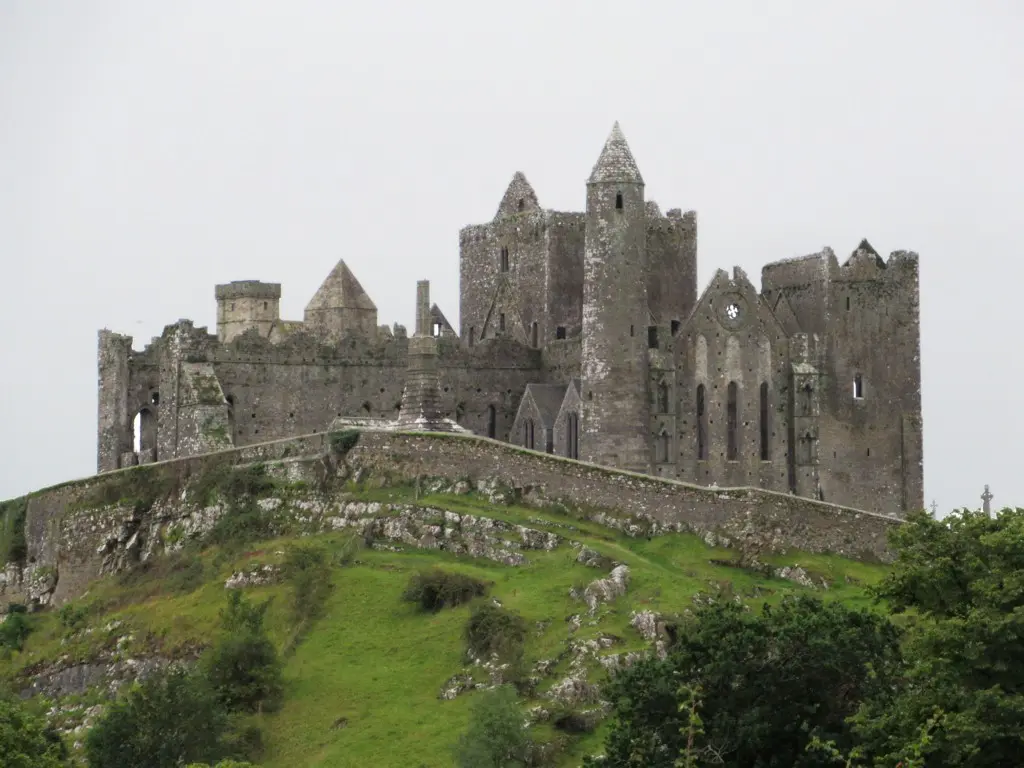
County Tipperary
“TIB-rid AW-run” · well of the Ara, from tiobraid (well) + Ara (the river)
Known as The Premier County. The origin is not documented, which is unusual for a nickname this well known. It is variously put down to the richness of the Golden Vale, or to the Butlers, Earls of Ormond, whose seat was in the county. Neither can be shown. The origin is not settled.
A fact like this for every county and every age →
Compare with another county → · Printable one-page summary →
After the Normans came, the O'Kennedy kingdom of Ormond became a lordship, and by 1210 Tipperary was a shire. In 1328 it was granted to the Earls of Ormond as a county palatine, except for the church lands around Cashel, which made a separate county, Cross Tipperary, until the two were finally joined in 1715.
In 1838 the county was split into North and South Ridings because Clonmel, the county town, was at the southern edge and the roads north were bad. The ridings became separate counties with their own councils in 1898, and were reunited as a single county of Tipperary only in 2014.
Drawn from the History section of the Wikipedia article on County Tipperary ↗, rewritten here and adding nothing it does not say; licensed CC BY-SA 4.0. The chronology above is this site's own; where the two differ, the article is the one to check.
Tipperary is the sixth-largest of the 32 counties by area and the 12th largest by population. It is the third-largest of Munster's six counties by both size and population. It is also the largest landlocked county in Ireland.
Tipperary is bounded (clockwise) by counties Offaly, Laois, Kilkenny, Waterford, Cork, Limerick, Clare and Galway. Its eight neighbours are the most of any county on the island.
Read the full article ↗ · Text from Wikipedia, licensed CC BY-SA 4.0.
Tap a name for its full page — story, homeland map and neighbours. Or see all surnames from County Tipperary, with the other counties each name is tied to.
Towns. Clonmel Cluain Meala (18,369, 2022), Nenagh Aonach Urmhumhan (9,895, 2022), Carrick-on-Suir Carraig na Siúire (5,752, 2022), Roscrea Ros Cré (5,542, 2022), Tipperary Tiobraid Árann (5,387, 2022), Cahir an Chathair / Cathair Dhún Iascaigh (3,679, 2022), Templemore An Teampall Mór (2,005, 2022), Fethard Fiodh Ard (1,738, 2022), Thurles Durlas, Cashel Caiseal. What every town name means →
Legends set here. The Devil's Bit. On the atlas →
First names that belong here. Ciara, Ailbhe, Cormac, Rian, Muircheartach, Séafra, Cronan, Ruadhán.
At the 2022 census, 66,003 people in Tipperary said they could speak Irish. 1,258 speak it every day outside school, and 3,540 weekly.
5 primary schools here teach entirely through Irish (2025/26, 897 pupils).
CSO, Census 2022, table SAP2022T3T2CTY. Every county compared →
Galtymore (Cnoc Mór na nGaibhlte), 918 metres, in the Galty Mountains, on the county boundary and shared with a neighbouring county.
Rivers and loughs: River Shannon, River Suir, River Nore, Little Brosna River, Mulkear River, Lough Derg.
MountainViews, via Wikipedia. Every county's highest point → · Rivers and loughs →
Hurling: 29 senior titles (1887, 1895, 1896, 1898, 1899, 1900, 1906, 1908, 1916, 1925, 1930, 1937, 1945, 1949, 1950, 1951, 1958, 1961, 1962, 1964, 1965, 1971, 1989, 1991, 2001, 2010, 2016, 2019, 2025); 13 finals lost.
Football: 4 senior titles (1889, 1895, 1900, 1920); 1 final lost.
-
Laurence Sterne ↗
· 1713–1768
Anglo-Irish novelist and Anglican cleric, born at Clonmel -
John Desmond Bernal ↗
· 1901–1971
Irish scientist, born at Nenagh -
Lena Rice ↗
· 1866–1907
Irish tennis player, born at New Inn -
Thomas MacDonagh ↗
· 1878–1916
Irish nationalist, poet, playwright and revolutionary, born at Cloughjordan -
Matt McGrath ↗
Olympic athletic competitor, born at Nenagh -
Marguerite Gardiner, Countess of Blessington ↗
· 1789–1849
Irish writer, editor, born at Clonmel -
Geoffrey Keating ↗
· 1569–1644
Irish Roman Catholic priest, poet and historian -
Henry Kellett ↗
· 1806–1875
British Royal Navy vice admiral, born at Clonacody -
William J. Duane ↗
· 1780–1865
American politician, Jackson administration cabinet member, born at Clonmel -
Tom Kiely ↗
· 1869–1951
Irish athlete, born at Carrick-on-Suir -
Julia Kavanagh ↗
· 1824–1877
Irish author, born at Thurles -
James Mitchel ↗
· 1864–1921
American athlete -
Antoine Hamilton ↗
Irish writer in French, born at Roscrea -
Daisy Bates ↗
Irish Australian journalist known for her work with Aboriginal People, born at Roscrea -
Tony Ryan ↗
· 1936–2007
Irish businessman, born at Thurles -
William Francis Butler ↗
· 1838–1910
Irish British Army officer, writer and adventurer, born at Golden -
Charles Monck, 4th Viscount Monck ↗
British politician and first Governor General of Canada, born at Templemore -
Anna Doyle Wheeler ↗
Writer and women's rights advocate -
John Morrissey ↗
· 1831–1878
American boxer and politician, born at Templemore -
Michael O'Kennedy ↗
· 1936–2022
Irish politician, born at Nenagh -
Séamus Freeman ↗
· 1944–2022
Irish bishop -
Lumsden Hare ↗
· 1874–1964
Actor, director, born at Tipperary -
Brendan Bracken, 1st Viscount Bracken ↗
· 1901–1958
Irish-born British politician and peer, born at Templemore -
Anthony O'Connell ↗
· 1938–2012
Irish-born U.S. Roman Catholic bishop, born at Lisheen Mine -
Paddy Ryan ↗
· 1853–1900
American boxer, born at Thurles -
Seán Treacy ↗
· 1923–2018
Irish politician, born at Clonmel -
Cormac mac Cuilennáin ↗
Irish bishop and king of Munster, born at Cashel -
Sackville Carden ↗
· 1857–1930
Royal Navy admiral, born at Templemore -
Rose Maynard Barton ↗
· 1856–1929
Irish artist, born at Rochestown -
Matthew Henry Phineas Riall Sankey ↗
· 1853–1925
Irish engineer, born at Nenagh
From Wikidata: people whose recorded birthplace is in the county, who have a Wikipedia article and are no longer living, with dates shown only where the article confirms them, ordered by how many languages Wikipedia covers them in. Traditional birthplaces of early saints are as Wikidata records them. Dates are left off where the sources disagree.
Tipperary had 435,553 people in 1841 and has 167,895 now (-61%). Its peak was 435,553 in 1841; its low point 122,812 in 1966, -72% of 1841. It has never regained the population it had before the Famine.
| 1821 | 1831 | 1841 | 1851 | 1861 | 1871 | 1881 | 1891 | 1901 | 1911 | 1926 | 1936 | 1946 | 1951 | 1956 | 1961 | 1966 | 1971 | 1979 | 1981 | 1986 | 1991 | 1996 | 2002 | 2006 | 2011 | 2016 | 2022 |
|---|---|---|---|---|---|---|---|---|---|---|---|---|---|---|---|---|---|---|---|---|---|---|---|---|---|---|---|
| 346,896 | 402,563 | 435,553 | 331,567 | 249,106 | 216,713 | 199,612 | 173,188 | 160,232 | 152,433 | 141,015 | 137,835 | 136,014 | 133,313 | 129,415 | 123,822 | 122,812 | 123,565 | 133,741 | 135,261 | 136,619 | 132,772 | 133,535 | 140,131 | 149,244 | 158,754 | 159,553 | 167,690 |
Census returns as tabulated in the county's Wikipedia article. All 32 counties, 1821 to today →
- Ahenny · high cross
- Ashleypark Burial Mound · tomb
- Liathmore · round tower · incomplete · 0.01 m
- Roscrea · round tower · incomplete · 20 m
- St Patrick's Rock · round tower · complete · 28 m
- St. Berrihert's Kyle · high cross
- St. Patrick's Well, Clonmel · holy well
- Timoney Stones · tomb
- 19 castles · Ardfinnan Castle, Ballynahow Castle, Ballyquirk, Burncourt Castle, Cahir Castle and more
Every pin is placed by its documented coordinates. All the monuments of Ireland →
Everything on the site about County Tipperary
The county
History
Monuments and heritage
Coast and country
People and culture
What is the Irish name for County Tipperary?
Tiobraid Árann. Tipperary is one of the 6 counties of Munster (Cúige Mumhan).
Who ruled County Tipperary in the Middle Ages?
Around 1014 it was held by Thomond (O'Brien); by 1450, Earldom of Ormond (Butler). The full era-by-era chronology is on this page.
What surnames come from County Tipperary?
Names historically associated with Tipperary include Butler, Cahill, Cantwell, Carew, Carroll, Carty, Coleman, Condon, among others.
What does Tiobraid Árann mean?
Tiobraid Árann, said “TIB-rid AW-run”, means well of the Ara — from tiobraid (well) + Ara (the river). A single well, in the town, that named the largest inland county in Ireland.
What is the population of County Tipperary?
167,895 at the 2022 census, against 435,553 in 1841, before the Famine.
What is the county town of Tipperary?
Nenagh. County Tipperary covers about 4,305 km², which makes it the 6th largest of the 32 counties.
Who are famous people from County Tipperary?
Among the best-known people born in Tipperary are Laurence Sterne, John Desmond Bernal, Lena Rice, Thomas MacDonagh, Matt McGrath, Marguerite Gardiner, Countess of Blessington. The full list, with their birthplaces, is on this page.
What did the Famine do to County Tipperary?
The census counted 435,553 people in Tipperary in 1841 and 331,000 in 1851 (the 1851 figure is approximate): a change of -24% in ten years, through death and emigration.
A clean copy for school projects or the family file; collapsed sections print in full.
- Wikipedia — County Tipperary ↗
- CSO — Census of Population 2022 ↗
- NISRA — Census 2021 ↗
- Wikipedia — List of Irish counties by population ↗
- 1841 census of Ireland (county table) ↗
- Historical population of Ireland (county series) ↗
- Logainm.ie — the State's Placenames Database of Ireland ↗
- Wikipedia — Counties of Ireland ↗
- Wikipedia — the county articles ↗
- Woulfe, Irish Names and Surnames (1923), for the surnames ↗
The chronology of who held the county is this site's own reading of the standard histories onto today's county borders, and says so where the fit is rough. Quoted passages are marked and licensed. Spotted an error? Say so — corrections are credited.
- 1911 Census — Tipperary ↗
- 1901 Census — Tipperary ↗
- Griffith's Valuation — search Tipperary ↗
- Down Survey maps — Tipperary ↗
- Schools' Folklore Collection — Tipperary ↗
- Placenames of Tipperary (Logainm) ↗
- Landed Estates — Tipperary ↗
Free, from the holding institutions. How to begin: the six-step guide → · Spotted an error on this page? Suggest a correction.