County Cavan
“un ka-VAWN” · the hollow, from cabhán, a hollow or a hollow place
Known as The Breffni County. For Bréifne, the kingdom that covered Cavan and Leitrim under the O'Rourkes and O'Reillys. The county is younger than the kingdom it is named for.
A fact like this for every county and every age →
Compare with another county → · Printable one-page summary →
From about the 13th century Cavan was East Bréifne, or Breifne O'Reilly, after the family that ruled it — which is why it is still called the Breffni County. Bréifne had been one kingdom under the O'Rourkes until it was split in about 1256, the O'Rourkes keeping the west (now Leitrim) and the O'Reillys the east. Drumlins, lakes and heavy wet clay made it hard country to invade, though Norman mottes and castles such as Clogh Oughter and Castlerahan still stand.
Cavan was made a county in the reign of Elizabeth I and moved from Connacht to Ulster in 1584. The Plantation of Ulster from 1610 founded Bailieborough, Cootehill, Killeshandra and Virginia, and later settlers brought flax and linen. Parts of the county were hard hit in the Great Famine, and in Mountnugent parish a landlord's eviction of more than 200 people is remembered in the ballad "By Lough Sheelin Side". In June 1916 Cavan's unionists learned that the county would not be part of any exclusion of Ulster from Home Rule.
Drawn from the History section of the Wikipedia article on County Cavan ↗, rewritten here and adding nothing it does not say; licensed CC BY-SA 4.0. The chronology above is this site's own; where the two differ, the article is the one to check.
Cavan borders six counties: Leitrim to the west, Fermanagh to the north, Monaghan to the north-east, Meath to the south-east, Longford to the south-west and Westmeath to the south. Cavan shares a border with County Fermanagh in Northern Ireland. Cavan is the 19th largest of the 32 counties in area and the 25th largest by population.
The county is part of the Northern and Western Region, a NUTS II area, and in that region, is part of the Border strategic planning area, a NUTS III entity.
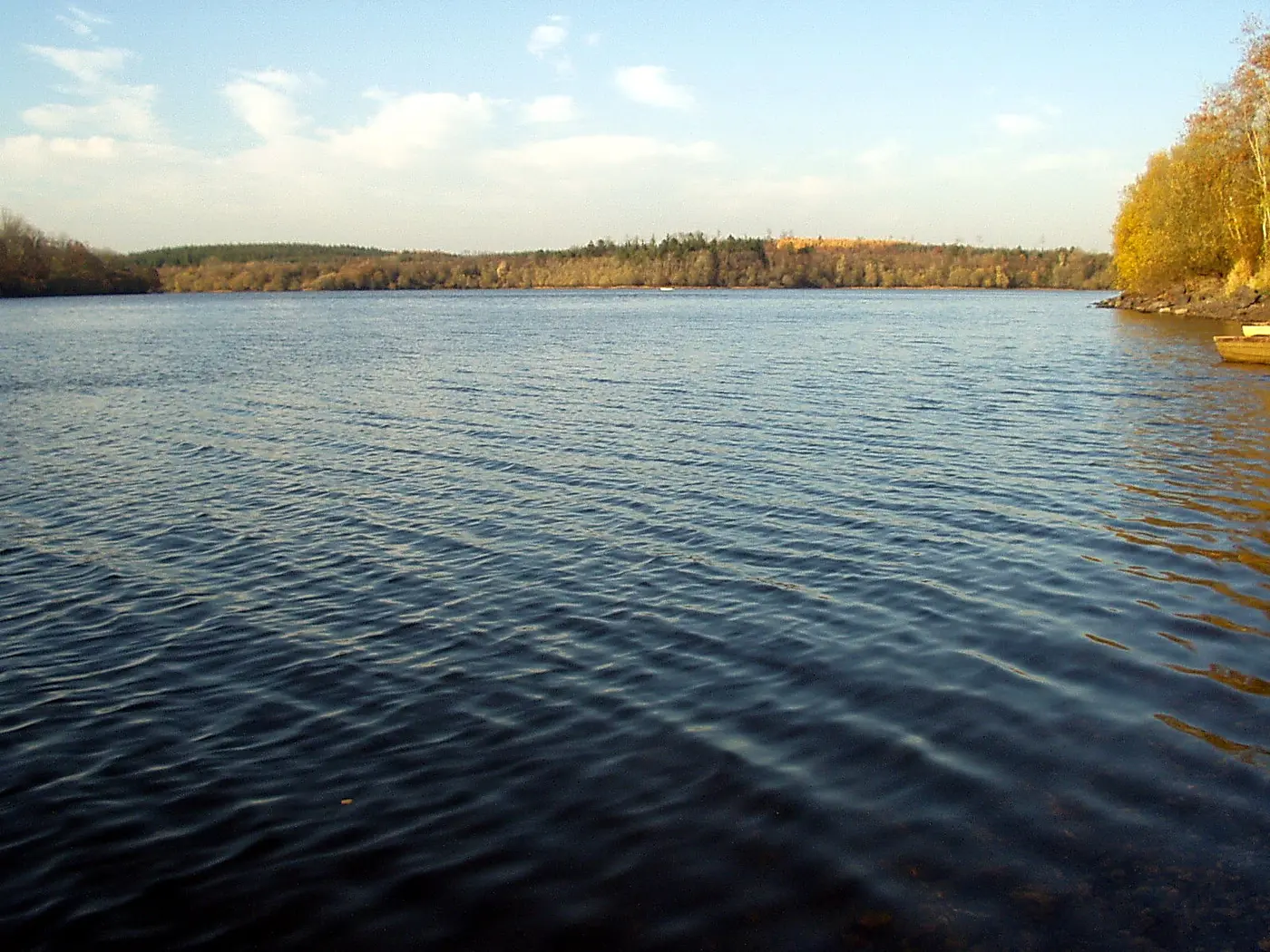
The county is characterised by drumlin countryside dotted with many lakes and hills. The north-western area of the county is sparsely populated and mountainous. The Cuilcagh mountain range contain the highest point, Cuilcagh, at .
Read the full article ↗ · Text from Wikipedia, licensed CC BY-SA 4.0.
Tap a name for its full page — story, homeland map and neighbours. Or see all surnames from County Cavan, with the other counties each name is tied to.
Towns. Bailieborough Coill an Chollaigh (2,974, 2022), Kingscourt Dún an Rí (2,955, 2022), Ballyjamesduff Baile Shéamais Dhuibh (2,917, 2022), Belturbet Béal Tairbirt (1,610, 2022), Cavan An Cabhán, Cootehill Muinchille, Virginia Achadh an Iúir. What every town name means →
Saints. St Killian (8 July).
Legends set here. Shannon Pot — Sionann’s well. On the atlas →
At the 2022 census, 26,591 people in Cavan said they could speak Irish. 479 speak it every day outside school, and 1,415 weekly.
1 primary school here teaches entirely through Irish (2025/26, 181 pupils).
CSO, Census 2022, table SAP2022T3T2CTY. Every county compared →
Cuilcagh (Binn Chuilceach), 665 metres, in the Breifne Mountains, on the county boundary and shared with a neighbouring county.
Rivers and loughs: River Shannon, River Erne, River Inny, River Blackwater, River Annalee, River Dee, River Glyde, Lough Sheelin.
MountainViews, via Wikipedia. Every county's highest point → · Rivers and loughs →
Hurling: no senior title.
Football: 5 senior titles (1933, 1935, 1947, 1948, 1952); 6 finals lost.
-
Saint Kilian ↗
· 640–689
German-Irish saint, born at Mullagh -
T. P. McKenna ↗
· 1929–2011
Irish actor, born at Mullagh -
Francis Sheehy-Skeffington ↗
· 1878–1916
Irish suffragist, pacifist and writer, born at Bailieborough -
Henry Brooke ↗
· 1703–1783
Irish writer -
Marcus Daly ↗
· 1841–1900
American businessman, born at Ballyjamesduff -
Máedóc of Ferns ↗
Irish bishop and saint -
Thomas Fitzpatrick ↗
· 1799–1854
American trapper -
Reginald Dorman-Smith ↗
· 1899–1977
British politician -
Eric Dorman-Smith ↗
· 1895–1969
British Army general -
Patrick Thomas O'Reilly ↗
· 1833–1892
Catholic bishop, born at Cavan -
Séamus Dolan ↗
· 1914–2010
Irish politician, born at Blacklion -
John Charles McQuaid ↗
· 1895–1973
Catholic archbishop, born at Cootehill -
Charlotte Brooke ↗
· 1740–1793
Irish writer -
Timothy J. Campbell ↗
· 1840–1904
American politician -
John P. Wilson ↗
· 1923–2007
Irish politician -
Patrick "Paddy" Smith ↗
· 1901–1982
Irish politician, born at Bailieborough -
John Foy ↗
· 1882–1960
American distance runner, born at Cootehill -
Thomas Brady ↗
· 1752–1827
Irish-Austrian general, born at Cavan -
Agnes O'Farrelly ↗
· 1874–1951
Irish academic and activist for Irish language revival; Camogie executive, born at Virginia -
James O'Reilly ↗
· 1855–1934
Irish/American Catholic bishop, born at Lisgrea -
Matthew Gibney ↗
Australian bishop, born at Killeshandra -
Patrick Baxter ↗
· 1891–1959
Irish politician -
Justin McKenna ↗
· 1896–1950
Irish politician -
Michael Donohoe ↗
· 1864–1958
American politician -
Edward Frederick Clarke ↗
· 1850–1905
Canadian politician, born at Bailieborough -
Mary Anne Sadlier ↗
· 1820–1903
Irish American novelist, born at Cootehill -
Edward James Saunderson ↗
· 1837–1906
Irish unionist politician, born at Castle Saunderson -
Henry Aloysius Gogarty ↗
· 1884–1931
Vicar Apostolic of Kilima-Njaro, Tanzania ; Bishop, C.S.Sp., born at Cavan -
Joe Beef ↗
· 1835–1889
Canadian businessman -
John Joe O'Reilly ↗
Gaelic footballer, born at Killeshandra
From Wikidata: people whose recorded birthplace is in the county, who have a Wikipedia article and are no longer living, with dates shown only where the article confirms them, ordered by how many languages Wikipedia covers them in. Traditional birthplaces of early saints are as Wikidata records them. Dates are left off where the sources disagree.
Cavan had 243,158 people in 1841 and has 81,704 now (-66%). Its peak was 243,158 in 1841; its low point 52,618 in 1971, -78% of 1841. It has never regained the population it had before the Famine.
| 1821 | 1831 | 1841 | 1851 | 1861 | 1871 | 1881 | 1891 | 1901 | 1911 | 1926 | 1936 | 1946 | 1951 | 1956 | 1961 | 1966 | 1971 | 1979 | 1981 | 1986 | 1991 | 1996 | 2002 | 2006 | 2011 | 2016 | 2022 |
|---|---|---|---|---|---|---|---|---|---|---|---|---|---|---|---|---|---|---|---|---|---|---|---|---|---|---|---|
| 195,076 | 227,933 | 243,158 | 174,071 | 153,906 | 140,735 | 129,476 | 111,917 | 97,541 | 91,173 | 82,452 | 76,670 | 70,355 | 66,377 | 61,740 | 56,594 | 54,022 | 52,618 | 53,720 | 53,855 | 53,965 | 52,796 | 52,944 | 56,546 | 64,003 | 73,183 | 76,176 | 81,704 |
Census returns as tabulated in the county's Wikipedia article. All 32 counties, 1821 to today →
- Calf House · dolmen
- Drumlane · round tower · incomplete · 12 m
- Finn McCools Fingers · tomb
- 3 castles · Bailieborough Castle, Cabra Castle, Castle Saunderson
Every pin is placed by its documented coordinates. All the monuments of Ireland →
Everything on the site about County Cavan
The county
History
Monuments and heritage
Coast and country
People and culture
What is the Irish name for County Cavan?
An Cabhán. Cavan is one of the 9 counties of Ulster (Cúige Uladh).
Who ruled County Cavan in the Middle Ages?
Around 1014 it was held by Bréifne (O'Rourke); by 1450, East Bréifne (O'Reilly). The full era-by-era chronology is on this page.
What surnames come from County Cavan?
Names historically associated with Cavan include Adams, Brady, Carolan, Clarke, Comiskey, Dolan, Drennan, Early, among others.
What does An Cabhán mean?
An Cabhán, said “un ka-VAWN”, means the hollow — from cabhán, a hollow or a hollow place. Named for the town. The county is built on the old kingdom of Bréifne.
What is the population of County Cavan?
81,704 at the 2022 census, against 243,158 in 1841, before the Famine.
What is the county town of Cavan?
Cavan. County Cavan covers about 1,932 km², which makes it the 19th largest of the 32 counties.
Who are famous people from County Cavan?
Among the best-known people born in Cavan are Saint Kilian, T. P. McKenna, Francis Sheehy-Skeffington, Henry Brooke, Marcus Daly, Máedóc of Ferns. The full list, with their birthplaces, is on this page.
What did the Famine do to County Cavan?
The census counted 243,158 people in Cavan in 1841 and 174,000 in 1851 (the 1851 figure is approximate): a change of -28% in ten years, through death and emigration.
A clean copy for school projects or the family file; collapsed sections print in full.
- Wikipedia — County Cavan ↗
- CSO — Census of Population 2022 ↗
- NISRA — Census 2021 ↗
- Wikipedia — List of Irish counties by population ↗
- 1841 census of Ireland (county table) ↗
- Historical population of Ireland (county series) ↗
- Logainm.ie — the State's Placenames Database of Ireland ↗
- Wikipedia — Counties of Ireland ↗
- Wikipedia — the county articles ↗
- Woulfe, Irish Names and Surnames (1923), for the surnames ↗
The chronology of who held the county is this site's own reading of the standard histories onto today's county borders, and says so where the fit is rough. Quoted passages are marked and licensed. Spotted an error? Say so — corrections are credited.
- 1911 Census — Cavan ↗
- 1901 Census — Cavan ↗
- Griffith's Valuation — search Cavan ↗
- Down Survey maps — Cavan ↗
- Schools' Folklore Collection — Cavan ↗
- Placenames of Cavan (Logainm) ↗
Free, from the holding institutions. How to begin: the six-step guide → · Spotted an error on this page? Suggest a correction.