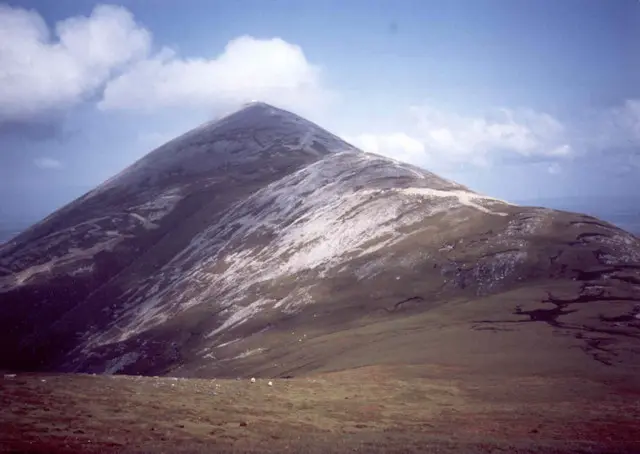
Croagh Patrick (Cruach Phádraig, Patrick's stack, and to everyone in Mayo simply the Reek) is where Patrick is said to have fasted for forty days in the fifth century. There has been a church on the summit since that century; the present chapel dates from the early twentieth. The mountain was a ritual site long before either: it was the focus of a prehistoric landscape, and the pilgrimage very likely began as a rite of Lughnasa, the harvest festival at the start of August, which is why it falls when it does.
The earliest written record is grim. The Annals of Ulster for 1113 note that 'a ball of fire came on the night of the feast of Patrick on Cruacháin Aighle and destroyed thirty of those fasting' — lightning, on a mountaintop, on a night of pilgrims. Historically the climb was made on St Patrick's Day, on the Assumption and on the last Friday in July, Crom Dubh's Friday, named for the pagan figure the saint is said to have overcome; Reek Sunday's other name is Domhnach Crom Dubh, and its other other name, Garland Sunday, is shared with the wells and hills of Lughnasa across the country.
Until 1970 pilgrims climbed after sunset and reached the summit in the dark. Today most climb by day from Murrisk on the north side, though the old approach was from the east along the Tóchar Phádraig, Patrick's causeway, from Ballintubber Abbey. The barefoot climbers, the stations walked sunwise, the Mass at the top and the sight of a whole hillside of people moving upward at dawn are the oldest continuously kept religious custom in Ireland.
The stations of the traditional pilgrimage, walked sunwise while praying. Most modern pilgrims climb, hear Mass at the summit and come down; the rounds are older than any of that.
- Leacht Benáin
Benan's grave: seven times around the cairn, praying, at the foot of the final ascent. - The summit
Fifteen times around the circular perimeter of the top, then seven times around Leaba Phádraig, Patrick's bed. - Reilig Mhuire
Mary's cemetery: seven times around each of three ancient burial cairns on the western shoulder.
When is Reek Sunday?
The last Sunday in July, every year. It is also called Garland Sunday and Domhnach Crom Dubh, Crom Dubh's Sunday.
Why do people climb Croagh Patrick?
In honour of St Patrick, who is said to have fasted forty days on the summit in the fifth century. Mass is said in the summit chapel, and some climb barefoot as a penance. The pilgrimage has been kept for at least 1,500 years and probably began as a Lughnasa harvest rite before Christianity.
How high is Croagh Patrick?
764 metres, 2,507 feet — a pyramid of quartzite above Clew Bay near Westport, the fourth-highest mountain in Connacht.
Do people really climb it barefoot?
Some do, as an act of penance, on a path of loose quartzite scree. Most do not, and the mountain rescue teams on the day would prefer it stayed that way.
What is the connection with Lughnasa?
The date. Lughnasa, the old harvest festival, fell at the start of August, and hilltop gatherings were part of it across Ireland; Garland Sunday, Reek Sunday's other name, is the Lughnasa Sunday. The pilgrimage almost certainly took over a rite that was already there.
Lughnasa · St Patrick · St Patrick's Day · County Mayo · Holy wells and pattern days