County Down
“un DOON” · the fort, from dún, a fort
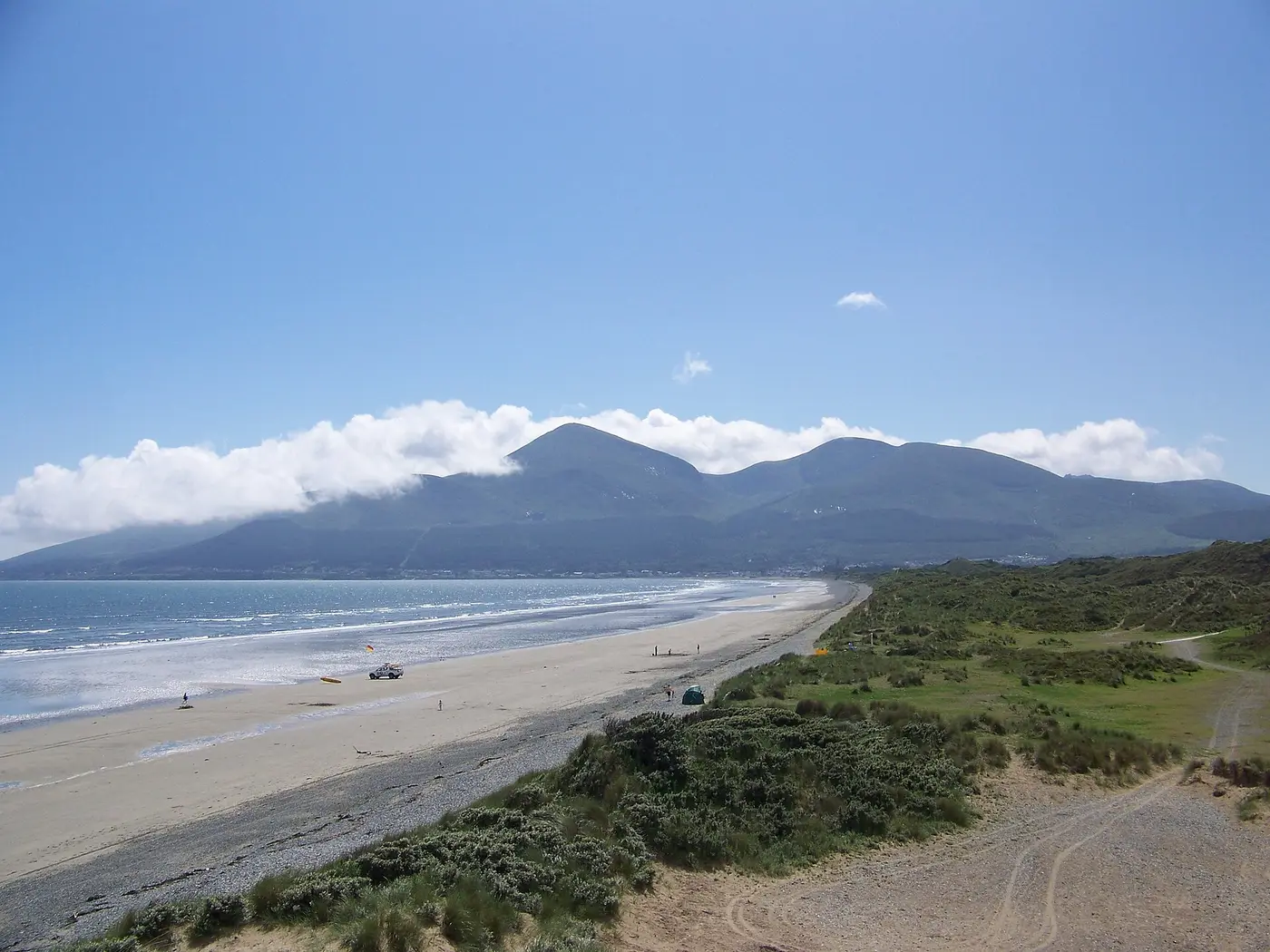
Known as Mourne Country. For the Mourne Mountains in the south of the county, where Slieve Donard carries the highest known passage tomb in Ireland on its summit.
A fact like this for every county and every age →
Compare with another county → · Printable one-page summary →
Ptolemy placed the Voluntii here in the 2nd century. From the 400s until 1177 Down was the heart of the kingdom of the Ulaid, and fierce resistance stopped the Vikings, who raided it often in the 8th and 9th centuries, from ever settling; in 1001 Sigtrygg Silkbeard raided it in revenge for being refused sanctuary.
The Normans came in 1177, and waves of English and Scottish settlers followed over the next four centuries; the county was planted privately rather than by the Crown. In 1689 the Protestants of Down rose against James II, were beaten at the Break of Dromore, and saw the whole county fall to the Jacobites until Schomberg's army landed in Belfast Lough, took Bangor and cleared the east of Ulster.
Drawn from the History section of the Wikipedia article on County Down ↗, rewritten here and adding nothing it does not say; licensed CC BY-SA 4.0. The chronology above is this site's own; where the two differ, the article is the one to check.
Down contains two significant peninsulas: Ards Peninsula and Lecale peninsula.
The county has a coastline along Belfast Lough to the north and Carlingford Lough to the south (both of which have access to the sea). Strangford Lough lies between the Ards Peninsula and the mainland. Down also contains part of the shore of Lough Neagh. Smaller loughs include Lough Island Reavy and Castlewellan Lake near Castlewellan, Clea Lough near Killyleagh, Lough Money and Loughinisland near Downpatrick and, within the Mourne Mountains, Silent Valley Reservoir, Ben Crom Reservoir, Spelga Dam and Lough Shannagh.
The River Lagan forms most of the border with County Antrim. The River Bann also flows through the southwestern areas of the county. Other rivers include the Clanrye and Quoile.
Read the full article ↗ · Text from Wikipedia, licensed CC BY-SA 4.0.
Tap a name for its full page — story, homeland map and neighbours. Or see all surnames from County Down, with the other counties each name is tied to.
Towns. Bangor Beannchar (64,122, 2021), Newry An tIúr (28,026, 2021), Downpatrick Dún Pádraig (11,541, 2021), Holywood Ard Mhic Nasca (10,735, 2021), Comber An Comar (9,512, 2021), Warrenpoint An Pointe (8,821, 2021), Donaghadee Domhnach Daoi (7,320, 2021), Kilkeel Cill Chaoil (6,632, 2021), Dromore Droim Mór (6,492, 2021), Ballynahinch Baile na hInse (6,335, 2021), Moira Maigh Rath (4,879, 2021), Saintfield Tamhnaigh Naomh (3,578, 2021). What every town name means →
Saints. St Patrick (17 March), St Gall (16 October), St Columbanus (23 November).
Legends set here. Slieve Donard — the guardian in the mountain. On the atlas →
First names that belong here. Brónach, Pádraig, Fiachna, Comhghall.
At the 2021 census, 23,518 people in Down aged 3 and over said they could speak Irish, and 12,978 could speak, read, write and understand it. 6,358 speak it daily, and for 723 it is their main language.
NISRA, Census 2021, Flexible Table Builder (county geography, built by NISRA from Data Zones; Belfast is split between Antrim and Down). All six counties →
Slieve Donard (Sliabh Dónairt), 850 metres, in the Mourne Mountains.
Wrecks on its coast: Loch Sunart (1879), PS Eleanor (1881), SS Georgetown Victory (1946), MV Princess Victoria (1953). Shipwrecks of Ireland →
Rivers and loughs: River Bann, River Lagan, Lough Neagh.
MountainViews, via Wikipedia. Every county's highest point → · Rivers and loughs →
Hurling: no senior title.
Football: 5 senior titles (1960, 1961, 1968, 1991, 1994); 1 final lost.
-
Francis Hutcheson ↗
· 1694–1746
Scottish philosopher, born at Saintfield -
Hans Sloane ↗
· 1660–1753
Irish botanist, doctor, and collector, born at Killyleagh -
Thomas Andrews ↗
· 1873–1912
British businessman and shipbuilder, born at Comber -
Francis Rawdon-Hastings, 1st Marquess of Hastings ↗
· 1754–1826
Governor-General of India -
John Butler Yeats ↗
· 1839–1922
Irish artist, born at Banbridge -
Amy Carmichael ↗
· 1867–1951
Missionary in India -
Henry Pottinger ↗
· 1789–1856
1st Governor of Hong Kong -
Francis Crozier ↗
Irish naval officer and polar explorer, born at Banbridge -
E. R. Dodds ↗
· 1893–1979
Irish classical scholar, born at Banbridge -
Harry Ferguson ↗
· 1884–1960
Irish engineer and inventor -
Noel Brotherston ↗
· 1956–1995
Northern Irish footballer, born at Dundonald -
Clodagh Rodgers ↗
· 1947–2025
British singer, born at Warrenpoint -
Tommy Casey ↗
· 1930–2009
Northern Irish footballer, born at Comber -
Patrick Brontë ↗
· 1777–1861
Irish Anglican clergyman and writer -
Sarah Grand ↗
· 1854–1943
British feminist writer, born at Donaghadee -
Desmond Titterington ↗
· 1928–2002
Racecar driver, born at Cultra -
Joseph M. Scriven ↗
· 1819–1886
Irish philanthropist, born at Banbridge -
Robert Ross ↗
· 1766–1814
Anglo-Irish officer in the British Army, born at Rostrevor -
Eldred Pottinger ↗
· 1811–1843
British artillerist and adventurer -
Hugh Cairns, 1st Earl Cairns ↗
· 1819–1885
British statesman who served as Lord Chancellor of Great Britain, born at Cultra -
Alexander Henry Haliday ↗
Irish entomologist, born at Holywood -
Bithia Mary Croker ↗
Irish writer, born at Warrenpoint -
Robert Lloyd Praeger ↗
· 1865–1953
Irish naturalist, writer, librarian, and archaeologist, born at Holywood -
Arthur Kennedy ↗
· 1809–1883
British colonial administrator, born at Cultra -
Thomas L. Young ↗
· 1832–1888
Union United States Army officer, born at Killyleagh -
William Cairns ↗
· 1828–1888
British colonial administrator -
Catherine Gage ↗
· 1815–1892
Irish botanist -
Brian Faulkner ↗
· 1921–1977
British politician -
Sarah Cecilia Harrison ↗
· 1863–1941
Irish artist, born at Holywood
From Wikidata: people whose recorded birthplace is in the county, who have a Wikipedia article and are no longer living, with dates shown only where the article confirms them, ordered by how many languages Wikipedia covers them in. Traditional birthplaces of early saints are as Wikidata records them. Dates are left off where the sources disagree.
Down had 361,446 people in 1841 and has 553,261 now (+53%). its low point 204,303 in 1911, -43% of 1841. It is one of the counties that has recovered its pre-Famine population.
| 1821 | 1831 | 1841 | 1851 | 1861 | 1871 | 1881 | 1891 | 1901 | 1911 | 1926 | 1937 | 1951 | 1961 | 1966 | 1971 | 1981 | 1991 | 2001 | 2011 | 2021 |
|---|---|---|---|---|---|---|---|---|---|---|---|---|---|---|---|---|---|---|---|---|
| 325,410 | 352,012 | 361,446 | 320,817 | 299,302 | 277,294 | 248,190 | 224,008 | 205,889 | 204,303 | 209,228 | 210,687 | 241,181 | 266,939 | 286,631 | 311,876 | 417,978 | 454,411 | 489,004 | 531,665 | 553,261 |
Census returns as tabulated in the county's Wikipedia article. All 32 counties, 1821 to today →
- Annadorn Dolmen · dolmen
- Ballyalton Court Cairn · tomb
- Ballynoe stone circle · stone circle
- Drumbo · round tower · incomplete · 10.25 m
- Goward Dolmen · dolmen
- Legananny · tomb
- Legananny Dolmen · dolmen
- Lisnagade · fort
- Maghera · round tower · incomplete · 5.4 m
- Nendrum · round tower · incomplete · 4.4 m
- St Cooey's Wells · holy well
- Struell Wells · holy well
- 24 castles · Ardglass Castle, Audley's Castle, Bagenal's Castle, Ballyroney Castle, Bangor Castle and more
Every pin is placed by its documented coordinates. All the monuments of Ireland →
Everything on the site about County Down
The county
History
Monuments and heritage
Coast and country
People and culture
What is the Irish name for County Down?
An Dún. Down is one of the 9 counties of Ulster (Cúige Uladh).
Who ruled County Down in the Middle Ages?
Around 1014 it was held by Ulaid; by 1450, Clandeboye O'Neills & MacDonnells. The full era-by-era chronology is on this page.
What surnames come from County Down?
Names historically associated with Down include Agnew, Bell, Campbell, Devaney, Doran, Ferguson, Garvey, Gill, among others.
What does An Dún mean?
An Dún, said “un DOON”, means the fort — from dún, a fort. From Downpatrick (Dún Pádraig, Patrick's fort) where tradition puts his grave.
What is the population of County Down?
553,261 at the 2021 census, against 361,446 in 1841, before the Famine.
What is the county town of Down?
Downpatrick. County Down covers about 2,489 km², which makes it the 12th largest of the 32 counties.
Who are famous people from County Down?
Among the best-known people born in Down are Francis Hutcheson, Hans Sloane, Thomas Andrews, Francis Rawdon-Hastings, 1st Marquess of Hastings, John Butler Yeats, Amy Carmichael. The full list, with their birthplaces, is on this page.
What did the Famine do to County Down?
The census counted 361,446 people in Down in 1841 and 320,817 in 1851: a change of -11% in ten years, through death and emigration.
A clean copy for school projects or the family file; collapsed sections print in full.
- Wikipedia — County Down ↗
- CSO — Census of Population 2022 ↗
- NISRA — Census 2021 ↗
- Wikipedia — List of Irish counties by population ↗
- 1841 census of Ireland (county table) ↗
- Historical population of Ireland (county series) ↗
- Logainm.ie — the State's Placenames Database of Ireland ↗
- Wikipedia — Counties of Ireland ↗
- Wikipedia — the county articles ↗
- Woulfe, Irish Names and Surnames (1923), for the surnames ↗
The chronology of who held the county is this site's own reading of the standard histories onto today's county borders, and says so where the fit is rough. Quoted passages are marked and licensed. Spotted an error? Say so — corrections are credited.
- 1911 Census — Down ↗
- 1901 Census — Down ↗
- Griffith's Valuation — search Down ↗
- Down Survey maps — Down ↗
- Schools' Folklore Collection — Down ↗
- Placenames of Down (Logainm) ↗
- PRONI records (Northern Ireland) ↗
- Placenames NI ↗
Free, from the holding institutions. How to begin: the six-step guide → · Spotted an error on this page? Suggest a correction.