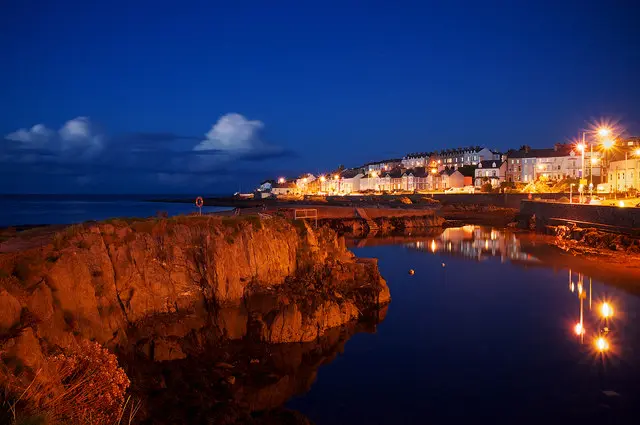
Bangor
'horned' or 'peaked' — perhaps of a pointed enclosure
Comgall's monastery of 558 was one of the great schools of Europe: Columbanus and Gall both left from here for the Continent, and the Antiphonary of Bangor is among the oldest surviving Irish manuscripts. The Vikings burned it repeatedly. It is now a seaside town on Belfast Lough.
St Comgall founded the monastery of Bangor in 555, according to the Annals of Ulster, and it became one of the great schools of early Christian Europe; three thousand monks are said to have looked to him when he died in 602, and the monks sang the office in relays day and night, a practice Bernard of Clairvaux still spoke of in the 12th century. The Antiphonary of Bangor was written here, and Bangor is one of only four Irish places on the Hereford Mappa Mundi of about 1300. From Bangor, Columbanus and twelve companions, among them St Gall, set out around 590 to found monasteries across Burgundy, Switzerland and Italy. Vikings raided it in the 8th and 9th centuries.
The modern town began when the Scot James Hamilton was granted lands in North Down in 1605, and James I made Bangor a borough in 1612. The railway from Belfast later made it a seaside resort.
Drawn from the History section of the Wikipedia article on Bangor ↗, rewritten here and adding nothing it does not say; licensed CC BY-SA 4.0.
- Bangor Castle · castle · under 1 km
- Carrickfergus Castle · castle · 11 km
Straight-line distances from the town centre, from each site's documented coordinates.
- Nendrum Monastery · Three concentric drystone enclosures, a round tower stump, and a sundial from around 900. Beside them, dug out of the shore, the oldest excavated tide mill anywhere in the world — tree-ring dated to 619, rebuilt in 787.
All of these are pinned on the Hidden Ireland map.
All towns and cities → · The 12 cities of Ireland · Know Bangor better? Add to the story.