Carrickfergus
'Fergus's rock' — a king said to have drowned there
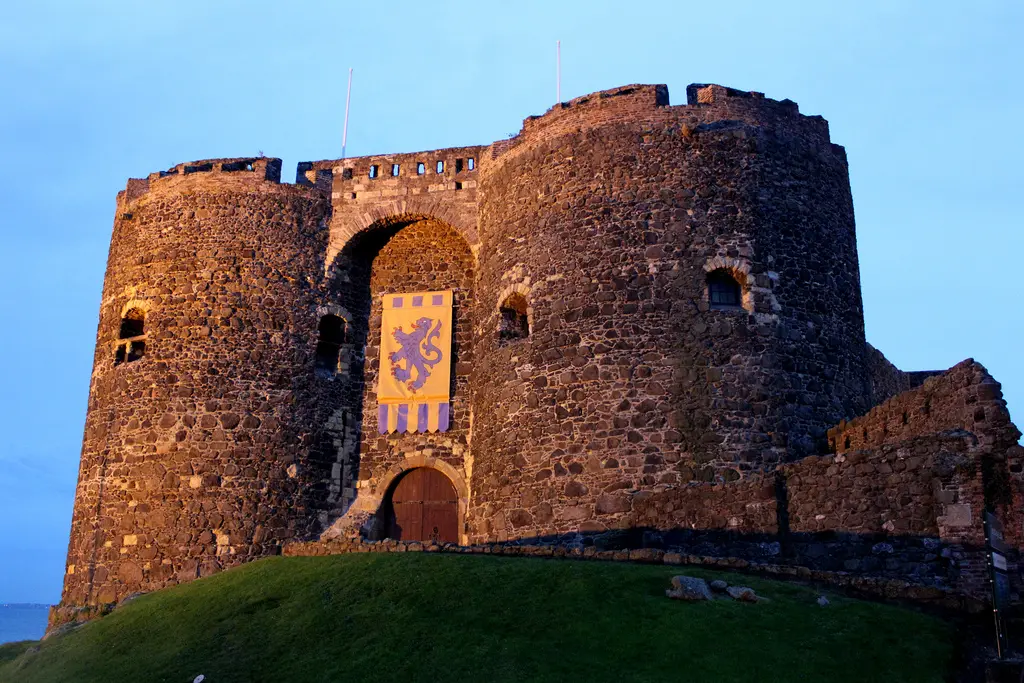
Its Norman castle, begun by John de Courcy about 1177, guarded Belfast Lough for eight centuries and is one of the best preserved in Ireland. William of Orange landed here in 1690 on his way to the Boyne, and John Paul Jones fought a famous action against HMS Drake off the town in 1778.
Carrickfergus is Carraig Fhearghais, said to be named after Fergus Mór, the legendary king of Dál Riata, whose ship ran aground on the rock. It became a town after John de Courcy invaded Ulster and began Carrickfergus Castle on the rock in 1177; Hugh de Lacy completed it, and it is one of the best-preserved Norman castles in Ireland. For centuries the town was bigger and more important than Belfast, and Belfast Lough was called Carrickfergus Bay into the 17th century. Edward Bruce took the town in 1315 and the castle in 1316, and the Scots largely destroyed the town in 1402.
In 1597 the MacDonnells defeated the English here. Sir Arthur Chichester planted the town and built its walls after 1599. The first presbytery in Ireland was set up here by Covenanter chaplains in 1642. William of Orange landed at Carrickfergus on 14 June 1690, on his way to the Boyne. In February 1760 French troops under François Thurot captured the town and held it to ransom, and in 1711 it saw the last witchcraft trial in Ireland, when eight women were convicted of bewitching a girl.
Drawn from the History section of the Wikipedia article on Carrickfergus ↗, rewritten here and adding nothing it does not say; licensed CC BY-SA 4.0.
- Ballylumford Dolmen · dolmen · 14 km
- Carrickfergus Castle · castle · under 1 km
- Bangor Castle · castle · 11 km
- Belfast Castle · castle · 12 km
- Olderfleet Castle · castle · 14 km
Straight-line distances from the town centre, from each site's documented coordinates.
All towns and cities → · Every town name in Irish · Know Carrickfergus better? Add to the story.