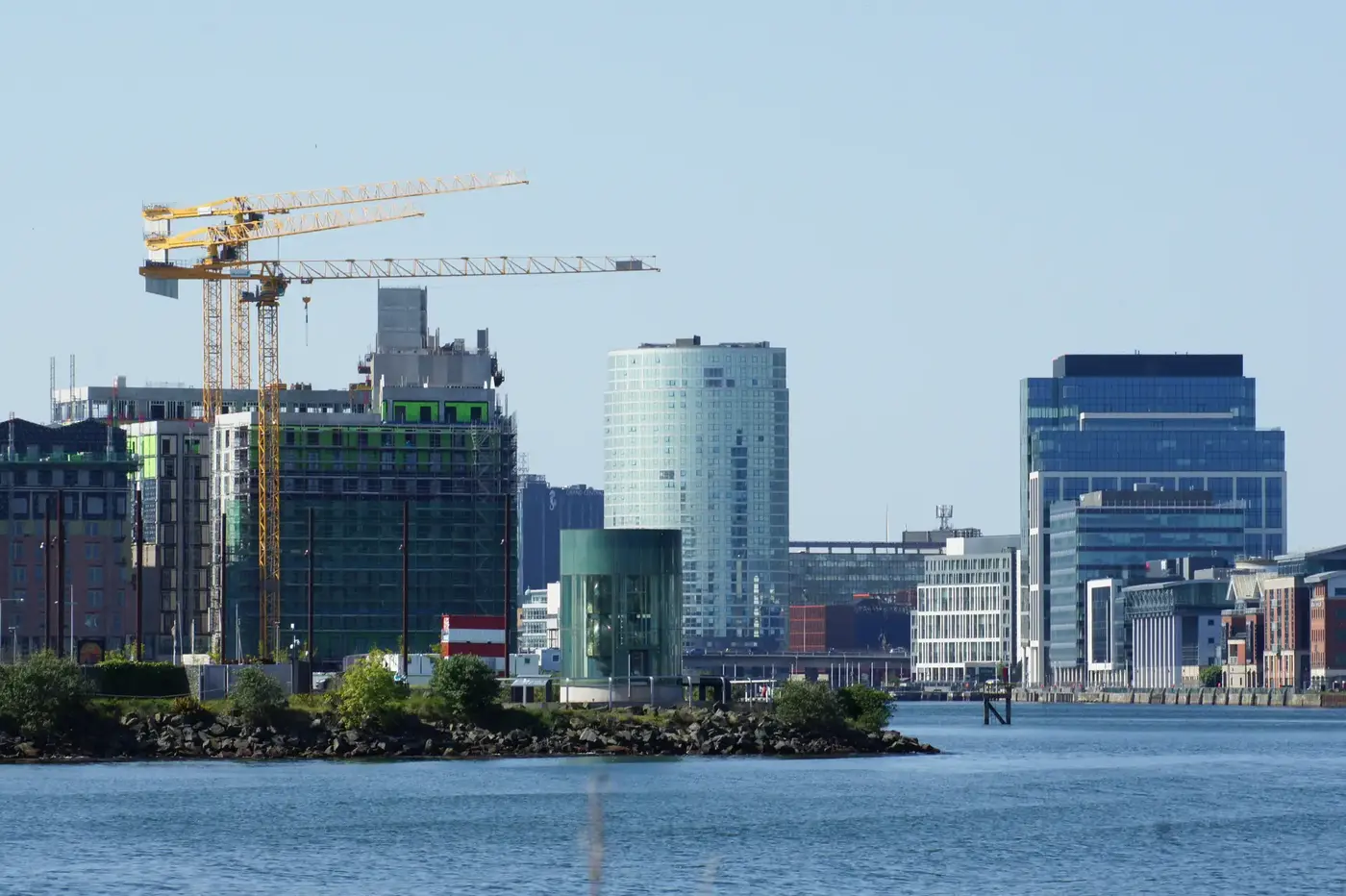
Belfast
'mouth of the sandbank ford' — the crossing of the Farset river
A small castle town until the seventeenth century, then a Presbyterian and radical city, then the industrial engine of Ireland: linen, rope, tobacco and the largest shipyard in the world, which launched Titanic in 1912. It was the birthplace both of the United Irishmen and of unionism, and it spent thirty years at the centre of the Troubles.
Belfast is Béal Feirste, the mouth of the Farset, the river that met the Lagan at a sandbar ford along today's High Street, where the first settlement grew. The Giant's Ring henge nearby is about 5,000 years old. The Normans built a fort, a church and a mill at the ford early in the 13th century; the O'Neills of Clandeboye took the castle in the 14th century, and it changed hands until their power was broken in the Nine Years' War. Their stronghold is remembered in Castlereagh, the grey castle, and their inauguration chair is in the Ulster Museum.
In 1613 Sir Arthur Chichester planted the town, building a castle on today's Castle Place and bringing in mostly English and Manx settlers. Scottish Presbyterians followed and were briefly expelled by a Parliamentarian army in 1649. William of Orange passed through in 1690 on the way to the Boyne. Scots and Huguenots brought linen, and in the 18th century Belfast's trade reached the Americas; profits paid for the Lagan Canal, new docks and the White Linen Hall, which drew the linen trade away from Dublin. In 1786 the merchant house of Cunningham and Greg proposed to build ships for the slave trade and was defeated by local opposition.
Drawn from the History section of the Wikipedia article on Belfast ↗, rewritten here and adding nothing it does not say; licensed CC BY-SA 4.0.
- Giant's Ring · dolmen · 6 km
- Drumbo · round tower · 9 km
- Belfast Castle · castle · 5 km
Straight-line distances from the town centre, from each site's documented coordinates.
- Nendrum Monastery · Three concentric drystone enclosures, a round tower stump, and a sundial from around 900. Beside them, dug out of the shore, the oldest excavated tide mill anywhere in the world — tree-ring dated to 619, rebuilt in 787.
All of these are pinned on the Hidden Ireland map.
All towns and cities → · The 12 cities of Ireland · Know Belfast better? Add to the story.