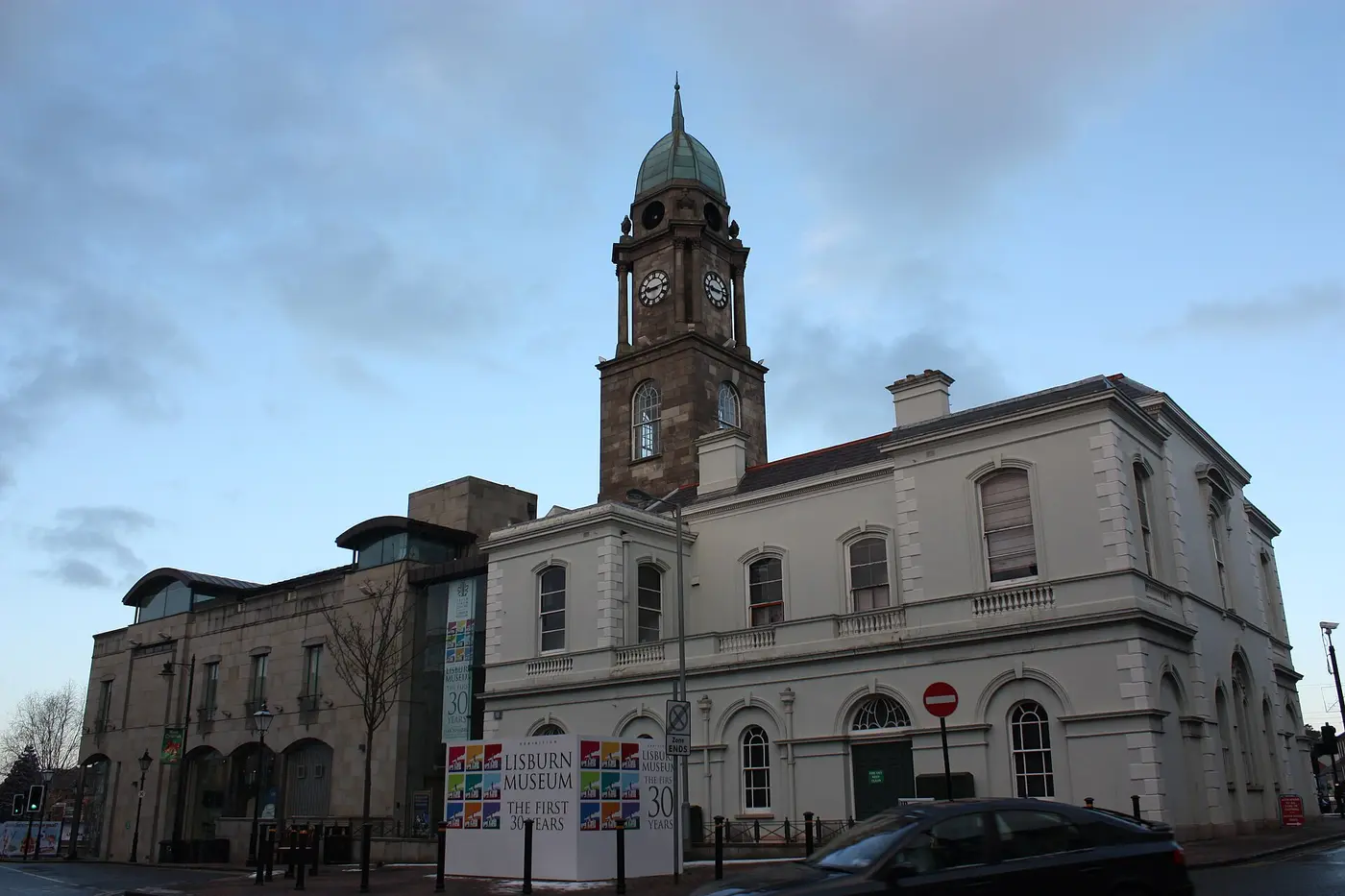
Lisburn
'fort of the gamblers'
A linen town made by Huguenot refugees: Louis Crommelin was brought here in 1698 to organise the trade, and the damask linen of the Lagan valley went to courts across Europe. It was granted city status in 2002.
Lisburn grew from Lisnagarvey, a fort north of today's Wallace Park. In 1609 James I granted the lands of Killultagh to Sir Fulke Conway, who was building a timber house and a brick bawn there by 1611, and his agent George Rawdon laid out the streets still used today — Market Square, Bridge Street, Castle Street and Bow Street — with a church in 1623 and a weekly market chartered in 1628, still held every Tuesday. In 1641 the rebels were driven back from the town three times, though it burned; in 1649 Cromwell's forces beat a Scots and Royalist army at the Battle of Lisnagarvey.
The town burned again by accident in 1707, which gave it the motto Ex igne resurgam, out of the fire I shall arise. The Friends' Meeting House was one of the few buildings spared; Quakers had come in 1655, and in 1766 the linen merchant John Hancock endowed what is now Friends' School. The Huguenots who arrived in 1698 are why Lisburn calls itself the birthplace of Ireland's linen industry.
Drawn from the History section of the Wikipedia article on Lisburn ↗, rewritten here and adding nothing it does not say; licensed CC BY-SA 4.0.
- Drumbo · round tower · 5 km
- Giant's Ring · dolmen · 7 km
- Hillsborough Castle · castle · 6 km
Straight-line distances from the town centre, from each site's documented coordinates.
All towns and cities → · The 12 cities of Ireland · Know Lisburn better? Add to the story.