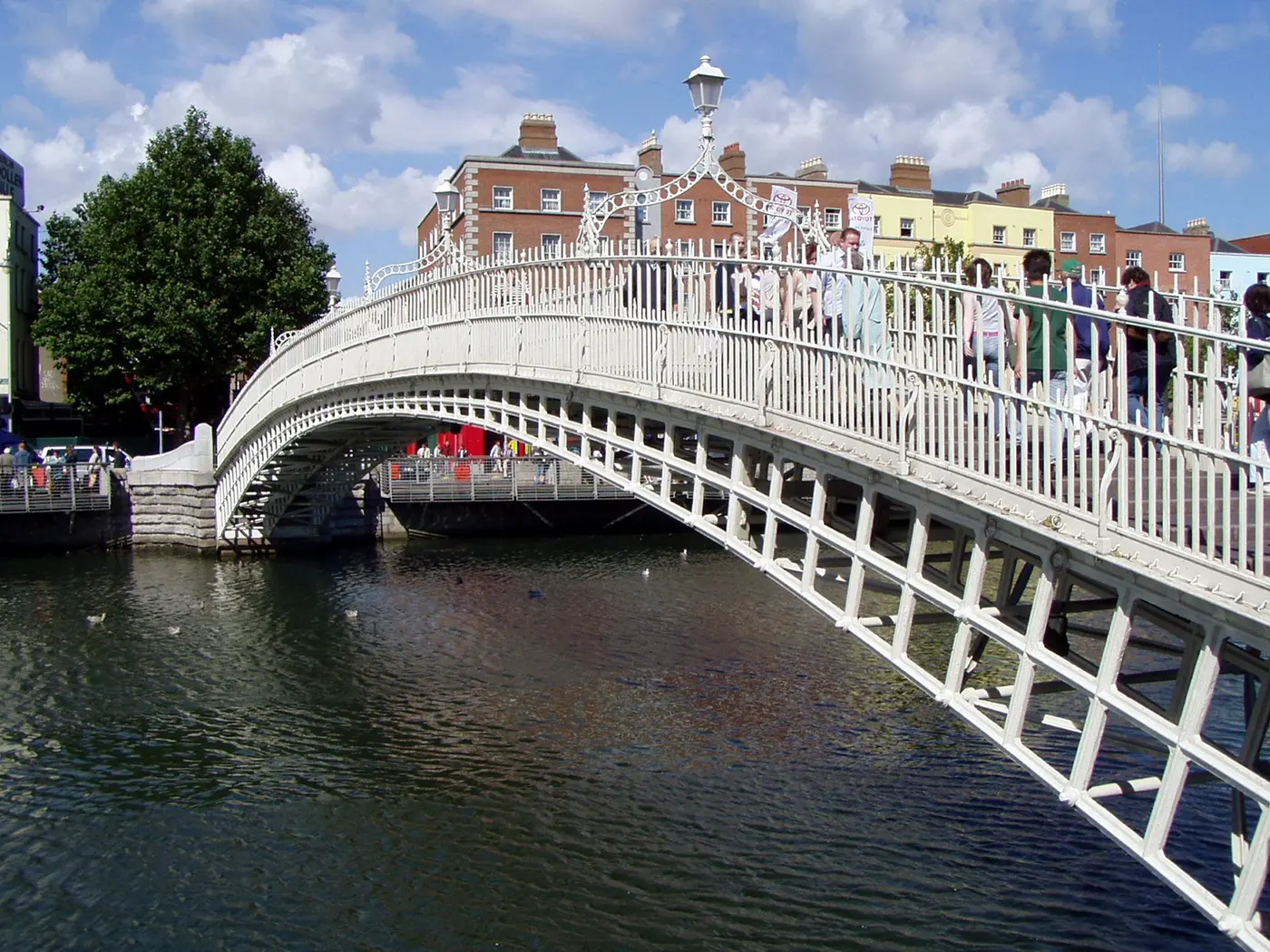
County Dublin
“BAL-ya AW-ha KLEE-a” · town of the hurdled ford, from baile (town) + áth (ford) + cliath (hurdle)
Known as The Dubs. Dublin has no single settled nickname the way the others do, and none appears in the standard reference. The Dubs is what people say, and the Pale is what the county was for four centuries. The origin is not settled.
A fact like this for every county and every age →
Compare with another county → · Printable one-page summary →
The oldest trace of people in Dublin is five wooden fish traps found near Spencer Dock in 2007, made with stone axes between about 6100 and 5700 BC. The Vikings founded the town in the 9th century, and under them it became the largest slave market in western Europe. Irish kings pushed back: the Norse were exiled as early as 902, Máel Sechnaill II took the town in 980 and freed its Irish slaves, and after Brian Boru's victories, Clontarf in 1014 above all, Dublin was a lesser kingdom.
In 1170 Diarmait Mac Murchada and his Normans stormed Dublin while its king was still negotiating, and it became the centre of English rule. That rule shrank to the Pale around the city by the early 16th century, until Henry VIII proclaimed the Kingdom of Ireland in 1542 with Dublin its capital. Most of the Georgian city was built between about 1750 and 1800. The Act of Union took the parliament away, and by the late 1800s Dublin was one of the poorest cities in Europe: in 1911 more than 20,000 families lived in one-room tenements, and 845 people lived on Henrietta Street alone.
Dublin became capital of the Irish Free State in December 1922 and later of the Republic. From the 1960s new suburbs — Tallaght, Coolock, Ballymun, Clondalkin, Blanchardstown — rehoused the city's poor, and from the 1990s Dublin drove the Celtic Tiger, entering the 21st century as one of Europe's richest cities.
Drawn from the History section of the Wikipedia article on County Dublin ↗, rewritten here and adding nothing it does not say; licensed CC BY-SA 4.0. The chronology above is this site's own; where the two differ, the article is the one to check.
Dublin is the third smallest of Ireland's 32 counties by area, and the largest in terms of population. It is the third-smallest of Leinster's 12 counties in size and the largest by population. Dublin shares a border with three counties – Meath to the north and west, Kildare to the west and Wicklow to the south. To the east, Dublin has an Irish Sea coastline which stretches for .
Read the full article ↗ · Text from Wikipedia, licensed CC BY-SA 4.0.
Tap a name for its full page — story, homeland map and neighbours. Or see all surnames from County Dublin, with the other counties each name is tied to.
Towns. Dublin Baile Átha Cliath (1,263,219, 2022), Swords Sord (40,776, 2022), Balbriggan Baile Brigín (24,322, 2022), Malahide Mullach Íde (18,608, 2022), Rush Ros Eó (10,875, 2022), Skerries Na Sceirí (10,743, 2022), Lusk Lusca (8,806, 2022), Dún Laoghaire Dún Laoghaire, Howth Binn Éadair. What every town name means →
Saints. St Laurence O'Toole (14 November).
Legends set here. Gleann na Smól — Oisín returns. On the atlas →
At the 2022 census, 467,679 people in Dublin said they could speak Irish. 16,440 speak it every day outside school, and 29,624 weekly.
41 primary schools here teach entirely through Irish (2025/26, 10,125 pupils), and 10 secondary schools.
CSO, Census 2022, table SAP2022T3T2CTY. Every county compared →
Kippure (Cipiúr), 757 metres, in the Wicklow Mountains.
Wrecks on its coast: Rochdale and Prince of Wales (1807), Royal Canal night boat Longford (1845), PS Queen Victoria (1853), RMS Tayleur (1854), Kingstown lifeboat disaster (1895), RMS Leinster (1918). Shipwrecks of Ireland →
Rivers and loughs: River Liffey.
MountainViews, via Wikipedia. Every county's highest point → · Rivers and loughs →
Hurling: 6 senior titles (1889, 1917, 1920, 1924, 1927, 1938); 15 finals lost.
Football: 31 senior titles (1891, 1892, 1894, 1897, 1898, 1899, 1901, 1902, 1906, 1907, 1908, 1921, 1922, 1923, 1942, 1958, 1963, 1974, 1976, 1977, 1983, 1995, 2011, 2013, 2015, 2016, 2017, 2018, 2019, 2020, 2023); 13 finals lost.
-
James Joyce ↗
· 1882–1941
Irish novelist and poet, born at Rathgar -
William Butler Yeats ↗
· 1865–1939
Irish poet and playwright, born at Sandymount -
Sinéad O'Connor ↗
· 1966–2023
Irish singer-songwriter, born at Glenageary -
Maureen O'Hara ↗
· 1920–2015
Irish–American actress and singer, born at Ranelagh -
Roger Casement ↗
· 1864–1916
Irish diplomat, activist, nationalist and poet, born at Sandymount -
Liam Cosgrave ↗
· 1920–2017
Irish politician, born at Castleknock -
William Orpen ↗
· 1878–1931
Irish artist, born at Stillorgan -
Ronnie Drew ↗
· 1934–2008
Irish musician, born at Dún Laoghaire -
Dave Allen ↗
· 1936–2005
Irish comedian and satirist, born at Firhouse -
George Abraham Grierson ↗
· 1851–1941
Irish linguistic scholar and civil servant, born at Glenageary -
Sandie Jones ↗
· 1951–2019
Irish singer, born at Crumlin -
Barney McKenna ↗
· 1939–2012
Irish musician, born at Donnycarney -
Sophie Bryant ↗
· 1850–1922
Irish mathematician, born at Sandymount -
Sarah Purser ↗
· 1848–1943
Irish artist, born at Dún Laoghaire -
Edward Allman-Smith ↗
· 1886–1969
Field hockey player and soldier, born at Balbriggan -
Thomas Kinsella ↗
· 1928–2021
Irish writer, poet, translator and publisher, born at Inchicore -
Hilary Weston ↗
· 1942–2025
Irish–Canadian mogul & vice-regal, born at Dún Laoghaire -
Arthur Shields ↗
· 1896–1970
Irish actor, born at Portobello -
Charles W. Jones ↗
· 1834–1897
American politician, born at Balbriggan -
Harry Reynolds ↗
· 1874–1940
Irish racing cyclist, born at Balbriggan -
Louie Bennett ↗
· 1870–1956
Irish suffragist -
Philomena Lynott ↗
· 1930–2019
Irish author, born at Crumlin -
Thomas Southerne ↗
· 1660–1746
Irish dramatist, born at Oxmantown -
John FitzGibbon, 1st Earl of Clare ↗
· 1748–1802
Irish politician, born at Donnybrook -
Sinéad de Valera ↗
· 1878–1975
Wife of Eamon de Valera, born at Balbriggan -
Charles B. Fitzsimons ↗
· 1924–2001
Irish actor, born at Ranelagh -
Martin O'Donoghue ↗
· 1933–2018
Irish politician, born at Crumlin -
Lord Henry Somerset ↗
· 1849–1932
British politician, born at Dún Laoghaire -
William Nassau Lees ↗
· 1825–1889
British Army officer in India and orientalist -
Bertie Kerr ↗
· 1896–1973
Irish footballer
From Wikidata: people whose recorded birthplace is in the county, who have a Wikipedia article and are no longer living, with dates shown only where the article confirms them, ordered by how many languages Wikipedia covers them in. Traditional birthplaces of early saints are as Wikidata records them.
Dublin had 372,773 people in 1841 and has 1,458,154 now (+291%). its low point 372,773 in 1841, 0% of 1841. It is one of the counties that has recovered its pre-Famine population.
| 1821 | 1831 | 1841 | 1851 | 1861 | 1871 | 1881 | 1891 | 1901 | 1911 | 1926 | 1936 | 1946 | 1951 | 1956 | 1961 | 1966 | 1971 | 1979 | 1981 | 1986 | 1991 | 1996 | 2002 | 2006 | 2011 | 2016 | 2022 |
|---|---|---|---|---|---|---|---|---|---|---|---|---|---|---|---|---|---|---|---|---|---|---|---|---|---|---|---|
| 335,892 | 380,167 | 372,773 | 405,147 | 410,252 | 405,262 | 418,910 | 419,216 | 448,206 | 477,196 | 505,654 | 586,925 | 636,193 | 693,022 | 705,781 | 718,332 | 795,047 | 852,219 | 983,683 | 1,003,164 | 1,021,449 | 1,025,304 | 1,058,264 | 1,122,821 | 1,187,176 | 1,270,603 | 1,345,402 | 1,458,154 |
Census returns as tabulated in the county's Wikipedia article. All 32 counties, 1821 to today →
- Aideen's Grave · dolmen
- Brennanstown Portal Tomb · dolmen
- Clondalkin · round tower · complete · 27.5 m
- Kilgobbin Cross · high cross
- Kiltiernan Tomb · dolmen
- Lusk · round tower · complete to cornice · 26.6 m
- Mount Venus · tomb
- Rathmichael · round tower · incomplete · 1.9 m
- St James' Church, Dublin (Church of Ireland) · holy well
- St. Fintan's Cemetery, Sutton · holy well
- Swords · round tower · complete · 26 m
- 7 castles · Ashtown Castle, Baggotrath Castle, Drimnagh Castle, Dublin Castle, Killiney Castle and more
Every pin is placed by its documented coordinates. All the monuments of Ireland →
Everything on the site about County Dublin
The county
History
Monuments and heritage
Coast and country
What is the Irish name for County Dublin?
Baile Átha Cliath. Dublin is one of the 12 counties of Leinster (Cúige Laighean).
Who ruled County Dublin in the Middle Ages?
Around 1014 it was held by Norse Kingdom of Dublin; by 1450, The English Pale. The full era-by-era chronology is on this page.
What surnames come from County Dublin?
Names historically associated with Dublin include Byrne, Casey, Díaz, Doyle, Fitzsimons, Hackett, Kilcoyne, McCormack, among others.
What does Baile Átha Cliath mean?
Baile Átha Cliath, said “BAL-ya AW-ha KLEE-a”, means town of the hurdled ford — from baile (town) + áth (ford) + cliath (hurdle). The English name is the other Irish name: Duibhlinn, the black pool, where the Poddle met the Liffey.
What is the population of County Dublin?
1,458,154 at the 2022 census, against 372,773 in 1841, before the Famine.
What is the county town of Dublin?
Dublin. County Dublin covers about 922 km², which makes it the 30th largest of the 32 counties.
Who are famous people from County Dublin?
Among the best-known people born in Dublin are James Joyce, William Butler Yeats, Sinéad O'Connor, Maureen O'Hara, Roger Casement, Liam Cosgrave. The full list, with their birthplaces, is on this page.
What did the Famine do to County Dublin?
The census counted 372,773 people in Dublin in 1841 and 405,000 in 1851 (the 1851 figure is approximate): a change of +9% in ten years, through death and emigration.
A clean copy for school projects or the family file; collapsed sections print in full.
- Wikipedia — County Dublin ↗
- CSO — Census of Population 2022 ↗
- NISRA — Census 2021 ↗
- Wikipedia — List of Irish counties by population ↗
- 1841 census of Ireland (county table) ↗
- Historical population of Ireland (county series) ↗
- Logainm.ie — the State's Placenames Database of Ireland ↗
- Wikipedia — Counties of Ireland ↗
- Wikipedia — the county articles ↗
- Woulfe, Irish Names and Surnames (1923), for the surnames ↗
The chronology of who held the county is this site's own reading of the standard histories onto today's county borders, and says so where the fit is rough. Quoted passages are marked and licensed. Spotted an error? Say so — corrections are credited.
- 1911 Census — Dublin ↗
- 1901 Census — Dublin ↗
- Griffith's Valuation — search Dublin ↗
- Down Survey maps — Dublin ↗
- Schools' Folklore Collection — Dublin ↗
- Placenames of Dublin (Logainm) ↗
Free, from the holding institutions. How to begin: the six-step guide → · Spotted an error on this page? Suggest a correction.