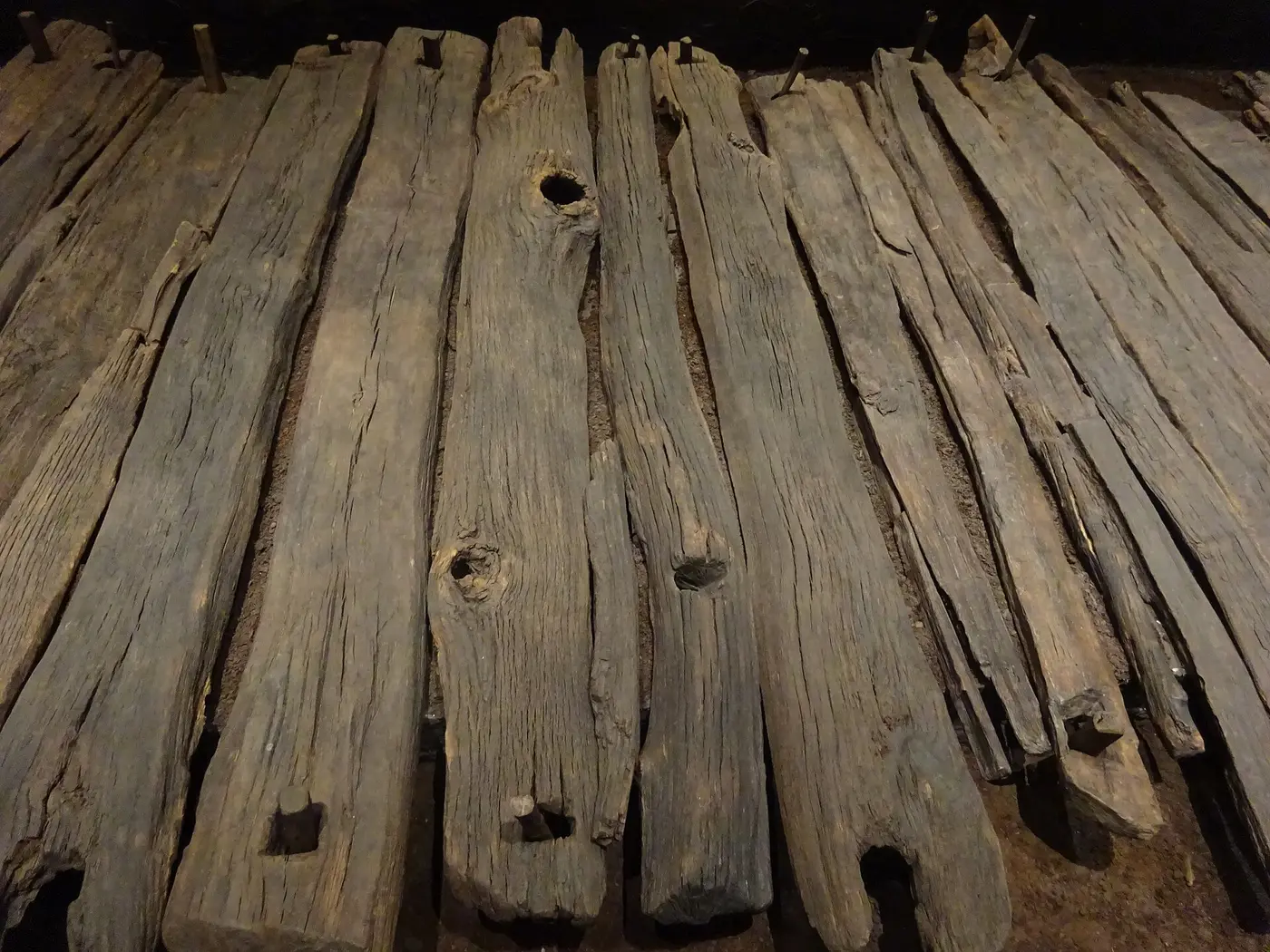
County Longford
“un LONG-fort” · the fortress, from longphort — a word Irish took from Norse for a ship-camp
Known as The Slashers. No nickname appears in the standard reference. The Slashers is what is used, after Myles 'the Slasher' O'Reilly, who was killed at the bridge of Finnea in 1646. The origin is not settled.
A fact like this for every county and every age →
Compare with another county → · Printable one-page summary →
In the first millennium Longford was probably a frontier of the kingdom of Meath, and from the 5th to the 12th century it was the kingdom of Tethbae. In 1070 it was taken by the O'Quinns, the O'Farrells and other Conmhaicne peoples, and became Muintir Annaly. After the Normans came it was granted to Hugh de Lacy; there was an English settlement at Granard and monasteries at Abbeylara, Abbeyshrule, Abbeyderg and on the islands of Lough Ree and Lough Gowna.
Edward Bruce's army sacked Granard in 1315 and the O'Farrells took back their country; the county's name comes from their fortress, the longphort. It was shired in 1586, and James I moved it from Connacht into Leinster in 1608. It was planted in 1620, and the Cromwellian settlement of the 1650s finished the change of ownership.
In 1798 the French army under Humbert, which had landed at Killala, was defeated at Ballinamuck on 8 September, after Cornwallis had beaten the rebels at Granard; heavy reprisals followed. In the War of Independence the North Longford flying column under Seán Mac Eoin was one of the most active on the Irish side.
Drawn from the History section of the Wikipedia article on County Longford ↗, rewritten here and adding nothing it does not say; licensed CC BY-SA 4.0. The chronology above is this site's own; where the two differ, the article is the one to check.
Most of Longford lies in the basin of the River Shannon with Lough Ree forming much of the county's western boundary. The north-eastern part of the county, however, drains towards the River Erne and Lough Gowna. Lakeland, bogland, pasture-land and wetland typify Longford's generally low-lying landscapes: the highest point of the county is in the north-west – Carn Clonhugh (also known as Cairn Hill or Corn Hill) between Drumlish and Ballinalee in the parish of Killoe, at . Cairn Hill is the site of a television transmitter broadcasting to much of the Irish midlands.
Read the full article ↗ · Text from Wikipedia, licensed CC BY-SA 4.0.
Tap a name for its full page — story, homeland map and neighbours. Or see all surnames from County Longford, with the other counties each name is tied to.
Towns. Longford An Longfort, Edgeworthstown Meathas Troim, Ballymahon Baile Uí Mhatháin. What every town name means →
Legends set here. Brí Léith — Midir and Étaín. On the atlas →
At the 2022 census, 14,993 people in Longford said they could speak Irish. 291 speak it every day outside school, and 782 weekly.
1 primary school here teaches entirely through Irish (2025/26, 106 pupils).
CSO, Census 2022, table SAP2022T3T2CTY. Every county compared →
Carn Clonhugh (Carn Clainne Aodha), 278 metres, in the North Midlands.
Rivers and loughs: River Shannon, River Inny, Lough Ree.
MountainViews, via Wikipedia. Every county's highest point → · Rivers and loughs →
Hurling: no senior title.
Football: no senior title.
-
Francis Ysidro Edgeworth ↗
· 1845–1926
Irish economist, born at Edgeworthstown -
Sir Henry Wilson, 1st Baronet ↗
· 1864–1922
British Army staff officer of the World War I -
Padraic Colum ↗
· 1881–1972
Irish writer -
George Edward Dobson ↗
· 1848–1895
Irish zoologist -
George Monro ↗
· 1700–1757
British Army officer -
Michael Pakenham Edgeworth ↗
· 1812–1881
Irish botanist and photographer in India, born at Edgeworthstown -
Ruairí Ó Brádaigh ↗
· 1932–2013
Irish politician, born at Longford -
Henry Essex Edgeworth ↗
· 1745–1807
Irish Catholic priest, born at Edgeworthstown -
Kitty Kiernan ↗
· 1892–1945
Fiancée of Michael Collins, born at Granard -
Mary Mathews Adams ↗
· 1840–1902
American poet, philanthropist, born at Granard -
Tommy Bond ↗
· 1856–1941
Major League Baseball player, born at Granard -
Bernard A. Maguire ↗
· 1818–1886
Irish-American Jesuit priest, born at Edgeworthstown -
John Christopher Drumgoole ↗
· 1816–1888
Irish-American Roman Catholic priest and activist, born at Abbeylara -
Bernard O'Reilly ↗
· 1803–1856
Irish-American Catholic bishop -
Ivo Fairbairn-Crawford ↗
· 1884–1959
British athlete, born at Longford -
Seán Mac Eoin ↗
· 1893–1973
Irish politician and soldier, born at Ballinalee -
Frank E. Butler ↗
· 1847–1926
American Wild West marksman -
John Talbot, 10th Earl of Shrewsbury ↗
English Earl, born at Longford -
James Dooley ↗
· 1877–1950
New South Wales politician and Premier -
Patrick Belton ↗
Irish politician, born at Lanesborough–Ballyleague -
Jane Grier ↗
· 1856–1902
Irish textile artist, born at Longford -
James Patrick Farrell ↗
· 1865–1921
Irish politician, born at Longford -
James Morgan ↗
· 1816–1878
(1816-1878) newspaper proprietor and politician, born at Longford -
Luke Belton ↗
· 1918–2006
Irish politician -
Willie Browne ↗
· 1936–2004
Irish footballer, born at Longford -
Brendan O'Reilly ↗
· 1929–2001
Irish journalist and presenter, born at Granard -
Eleanor Whitton ↗
· 1879–1956
Irish animal rights campaigner -
Horsey Browne ↗
· 1903–1931
Irish rugby union player, born at Longford -
Louis Belton ↗
· 1943–2023
Irish politician -
John Holmes ↗
· 1828–1879
Canadian politician and surveyor
From Wikidata: people whose recorded birthplace is in the county, who have a Wikipedia article and are no longer living, with dates shown only where the article confirms them, ordered by how many languages Wikipedia covers them in. Traditional birthplaces of early saints are as Wikidata records them. Dates are left off where the sources disagree.
Longford had 115,491 people in 1841 and has 46,751 now (-60%). Its peak was 115,491 in 1841; its low point 28,250 in 1971, -76% of 1841. It has never regained the population it had before the Famine.
| 1821 | 1831 | 1841 | 1851 | 1861 | 1871 | 1881 | 1891 | 1901 | 1911 | 1926 | 1936 | 1946 | 1951 | 1956 | 1961 | 1966 | 1971 | 1979 | 1981 | 1986 | 1991 | 1996 | 2002 | 2006 | 2011 | 2016 | 2022 |
|---|---|---|---|---|---|---|---|---|---|---|---|---|---|---|---|---|---|---|---|---|---|---|---|---|---|---|---|
| 107,570 | 112,558 | 115,491 | 82,348 | 71,694 | 64,501 | 61,009 | 52,647 | 46,672 | 43,820 | 39,847 | 37,847 | 36,218 | 34,553 | 32,969 | 30,643 | 28,989 | 28,250 | 30,785 | 31,140 | 31,496 | 30,296 | 30,166 | 31,068 | 34,391 | 38,970 | 40,873 | 46,634 |
Census returns as tabulated in the county's Wikipedia article. All 32 counties, 1821 to today →
- 3 castles · Castle Forbes, County Longford, Coolamber Hall House, Granard Motte
Every pin is placed by its documented coordinates. All the monuments of Ireland →
Everything on the site about County Longford
The county
History
Monuments and heritage
Coast and country
People and culture
What is the Irish name for County Longford?
An Longfort. Longford is one of the 12 counties of Leinster (Cúige Laighean).
Who ruled County Longford in the Middle Ages?
Around 1014 it was held by Mide (Kingdom of Meath); by 1450, Annaly (O'Farrell). The full era-by-era chronology is on this page.
What surnames come from County Longford?
Names historically associated with Longford include Coffey, Gaynor, Masterson, McCormack, McGinley, Merrigan, O'Farrell, Quinn, among others.
What does An Longfort mean?
An Longfort, said “un LONG-fort”, means the fortress — from longphort — a word Irish took from Norse for a ship-camp. The same word gives the longphorts the Vikings built up the rivers.
What is the population of County Longford?
46,751 at the 2022 census, against 115,491 in 1841, before the Famine.
What is the county town of Longford?
Longford. County Longford covers about 1,091 km², which makes it the 29th largest of the 32 counties.
Who are famous people from County Longford?
Among the best-known people born in Longford are Francis Ysidro Edgeworth, Sir Henry Wilson, 1st Baronet, Padraic Colum, George Edward Dobson, George Monro, Michael Pakenham Edgeworth. The full list, with their birthplaces, is on this page.
What did the Famine do to County Longford?
The census counted 115,491 people in Longford in 1841 and 82,000 in 1851 (the 1851 figure is approximate): a change of -29% in ten years, through death and emigration.
A clean copy for school projects or the family file; collapsed sections print in full.
- Wikipedia — County Longford ↗
- CSO — Census of Population 2022 ↗
- NISRA — Census 2021 ↗
- Wikipedia — List of Irish counties by population ↗
- 1841 census of Ireland (county table) ↗
- Historical population of Ireland (county series) ↗
- Logainm.ie — the State's Placenames Database of Ireland ↗
- Wikipedia — Counties of Ireland ↗
- Wikipedia — the county articles ↗
- Woulfe, Irish Names and Surnames (1923), for the surnames ↗
The chronology of who held the county is this site's own reading of the standard histories onto today's county borders, and says so where the fit is rough. Quoted passages are marked and licensed. Spotted an error? Say so — corrections are credited.
- 1911 Census — Longford ↗
- 1901 Census — Longford ↗
- Griffith's Valuation — search Longford ↗
- Down Survey maps — Longford ↗
- Schools' Folklore Collection — Longford ↗
- Placenames of Longford (Logainm) ↗
Free, from the holding institutions. How to begin: the six-step guide → · Spotted an error on this page? Suggest a correction.