County Fermanagh
“far MAN-akh” · men of Manach, from fear (man) + Manach
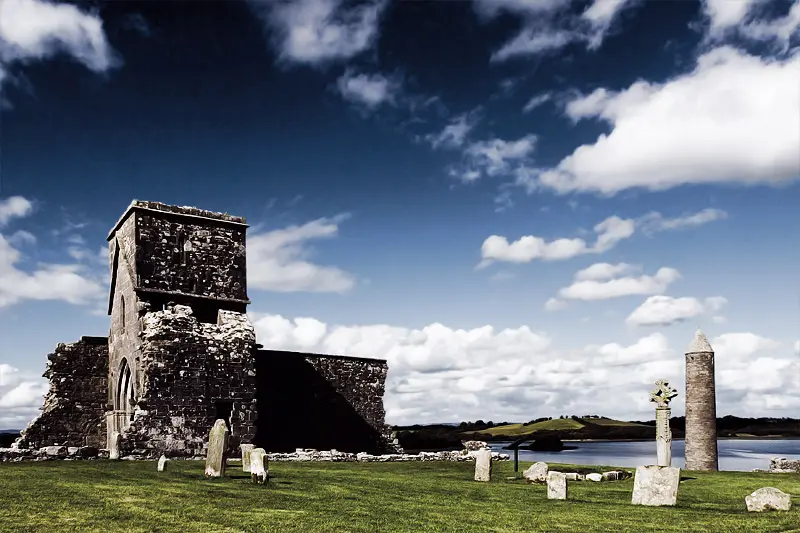
Known as The Lakeland County. For Lough Erne, upper and lower, which take up so much of the county that Fermanagh is often said to be half water. Devenish Island and its round tower sit in the middle of it.
A fact like this for every county and every age →
Compare with another county → · Printable one-page summary →
The Menapii are the only Celtic tribe on Ptolemy's map whose later home can be followed: they settled around Lough Erne as the Fir Manach, who gave their name to Fermanagh and Monaghan. The Annals of Ulster, covering the years 431 to 1540, were written on Belle Isle on Lough Erne. Fermanagh was the country of the Maguires, whose line of chiefs begins with Donn Carrach Maguire, who died in 1302.
The county was created under Elizabeth I but brought under English government only by the Plantation of Ulster, when Hugh Maguire's lands were confiscated and divided between Scottish and English undertakers, servitors and some native Irish. When the Great Northern Railway's lines closed in 1957, Fermanagh became the first county in the UK, other than islands, with no railway at all.
Drawn from the History section of the Wikipedia article on County Fermanagh ↗, rewritten here and adding nothing it does not say; licensed CC BY-SA 4.0. The chronology above is this site's own; where the two differ, the article is the one to check.
Fermanagh spans an area of 1,851 km2 (715 sq; mi), accounting for 13.2% of the landmass of Northern Ireland. Nearly a third of the county is covered by lakes and waterways, including Upper and Lower Lough Erne and the River Erne. Forests cover 14% of the landmass (42,000 hectares). It is the only county in Northern Ireland that does not border Lough Neagh.
Fermanagh is by far the least populous of Northern Ireland's six counties, with just over one-third the population of Tyrone, the next least populous county.
It is approximately from Belfast and from Dublin. The county town, Enniskillen, is the largest settlement in Fermanagh, situated in the middle of the county.
Places of interestAgriculture and tourism are two of the most important industries in Fermanagh. The main types of farming in the area are beef, dairy, sheep, pigs and some poultry. Most of the agricultural land is used as grassland for grazing and silage or hay rather than for other crops.
The waterways are extensively used by cabin cruisers, other small pleasure craft and anglers. The main town of Fermanagh is Enniskillen (, 'Ceithleann's island'). The island town hosts a range of attractions including the Castle Coole Estate and Enniskillen Castle, which is home to the museum of The Royal Inniskilling Fusiliers and the 5th Royal Inniskilling Dragoon Guards. Fermanagh is also home to The Boatyard Distillery, a distillery producing gin.
Read the full article ↗ · Text from Wikipedia, licensed CC BY-SA 4.0.
Tap a name for its full page — story, homeland map and neighbours. Or see all surnames from County Fermanagh, with the other counties each name is tied to.
Towns. Enniskillen Inis Ceithleann (14,120, 2021), Lisnaskea Lios na Scéithe, Belleek Béal Leice. What every town name means →
Legends set here. Lough Erne — Érne’s flight. On the atlas →
At the 2021 census, 6,020 people in Fermanagh aged 3 and over said they could speak Irish, and 2,703 could speak, read, write and understand it. 1,216 speak it daily, and for 138 it is their main language.
NISRA, Census 2021, Flexible Table Builder (county geography, built by NISRA from Data Zones; Belfast is split between Antrim and Down). All six counties →
Cuilcagh (Binn Chuilceach), 665 metres, in the Breifne Mountains, on the county boundary and shared with a neighbouring county.
Rivers and loughs: River Erne, Lower Lough Erne, Upper Lough Erne, Lough Melvin.
MountainViews, via Wikipedia. Every county's highest point → · Rivers and loughs →
Hurling: no senior title.
Football: no senior title.
-
Andrew Graham ↗
· 1815–1908
Irish astronomer -
John Armstrong ↗
· 1717–1795
American civil engineer and soldier -
Basil Brooke, 1st Viscount Brookeborough ↗
· 1888–1973
Northern Irish politician -
Edward Daly ↗
· 1933–2016
Catholic bishop, born at Belleek -
John Joseph Lynch ↗
· 1816–1888
Canadian Catholic archbishop -
Hugo Hamilton of Hageby ↗
· 1655–1724
Swedish military commander of Scots-Irish background, born at Monea Castle -
Emily Valentine ↗
· 1878–1967
British female rugby player -
James Gunn ↗
· 1843–1911
Union United States Army officer -
Samuel B. Horne ↗
· 1843–1928
American soldier (1843–1928); Medal of Honor recipient, born at Belleek -
Clare Cathcart ↗
· 1965–2014
Northern Irish actress -
David Irvine ↗
Canadian politician -
Francis Carney ↗
American politician -
Frank Maguire ↗
Publican, politician -
William Caldwell ↗
· 1750–1822
Loyalist partisan in the American Revolutionary War, Indian Superintendent in Upper Canada -
Arthur Dixon ↗
· 1837–1917
American politician -
Connor Maguire, 2nd Baron of Enniskillen ↗
· 1616–1645
Irish Baron -
Hugh Maguire ↗
Irish chieftain -
Michael Barrett ↗
· 1841–1868
Irish member of the Fenian Brotherhood, born at Drumkeeran -
James Marshall Ferris ↗
· 1828–1893
Canadian politician -
Robert Newton Anderson ↗
· 1871–1948
Anglo-Irish politician -
Thomas Clarke ↗
Australian colonial politician and businessman -
Francis Conway Mason ↗
· 1843–1915
(1843-1915) politician -
George Kerr ↗
· 1849–1913
Ontario politician -
Michael Magner ↗
· 1840–1897
Irish soldier (1840–1897); recipient of the Victoria Cross -
Robert Thompson ↗
· 1840–1922
New Zealand politician, born 1840, born at Newtownbutler -
Henrietta Frances de Grey ↗
· 1784–1848
Anglo-Irish political hostess and philanthropist, born at Florence Court -
Thomas Crawford ↗
· 1847–1932
Canadian politician -
Maire Quinn ↗
· 1872–1947
Irish actress and republican activist -
William Thompson ↗
· 1733–1799
Methodist leader born in 1733, born at Newtownbutler -
William Wilson ↗
· 1832–1903
Queensland politician
From Wikidata: people whose recorded birthplace is in the county, who have a Wikipedia article and are no longer living, with dates shown only where the article confirms them, ordered by how many languages Wikipedia covers them in. Traditional birthplaces of early saints are as Wikidata records them. Dates are left off where the sources disagree.
Fermanagh had 156,481 people in 1841 and has 63,585 now (-59%). Its peak was 156,481 in 1841; its low point 49,886 in 1966, -68% of 1841. It has never regained the population it had before the Famine.
| 1821 | 1831 | 1841 | 1851 | 1861 | 1871 | 1881 | 1891 | 1901 | 1911 | 1926 | 1937 | 1951 | 1961 | 1966 | 1971 | 1981 | 1991 | 2001 | 2011 |
|---|---|---|---|---|---|---|---|---|---|---|---|---|---|---|---|---|---|---|---|
| 130,997 | 149,763 | 156,481 | 116,047 | 105,768 | 92,794 | 84,879 | 74,170 | 65,430 | 61,836 | 57,984 | 54,569 | 53,044 | 51,531 | 49,886 | 50,255 | 51,594 | 54,033 | 57,527 | 61,805 |
Census returns as tabulated in the county's Wikipedia article. All 32 counties, 1821 to today →
- Devenish I · round tower · complete · 25 m
- Devenish II · round tower · incomplete · 0.5 m
- Drumskinny · stone circle
- 9 castles · Belle Isle Castle, Castle Balfour, Crevenish Castle, Crom Castle, Monea castle and more
Every pin is placed by its documented coordinates. All the monuments of Ireland →
Everything on the site about County Fermanagh
The county
History
Monuments and heritage
Coast and country
People and culture
What is the Irish name for County Fermanagh?
Fear Manach. Fermanagh is one of the 9 counties of Ulster (Cúige Uladh).
Who ruled County Fermanagh in the Middle Ages?
Around 1014 it was held by Airgíalla (Oriel); by 1450, Fermanagh (Maguire). The full era-by-era chronology is on this page.
What surnames come from County Fermanagh?
Names historically associated with Fermanagh include Bannon, Beattie, Bell, Breslin, Cassidy, Corcoran, Corrigan, Devine, among others.
What does Fear Manach mean?
Fear Manach, said “far MAN-akh”, means men of Manach — from fear (man) + Manach. A people, not a place: the Fir Manach who held the land around Lough Erne.
What is the population of County Fermanagh?
63,585 at the 2021 census, against 156,481 in 1841, before the Famine.
What is the county town of Fermanagh?
Enniskillen. County Fermanagh covers about 1,691 km², which makes it the 25th largest of the 32 counties.
Who are famous people from County Fermanagh?
Among the best-known people born in Fermanagh are Andrew Graham, John Armstrong, Basil Brooke, 1st Viscount Brookeborough, Edward Daly, John Joseph Lynch, Hugo Hamilton of Hageby. The full list, with their birthplaces, is on this page.
What did the Famine do to County Fermanagh?
The census counted 156,481 people in Fermanagh in 1841 and 116,047 in 1851: a change of -26% in ten years, through death and emigration.
A clean copy for school projects or the family file; collapsed sections print in full.
- Wikipedia — County Fermanagh ↗
- CSO — Census of Population 2022 ↗
- NISRA — Census 2021 ↗
- Wikipedia — List of Irish counties by population ↗
- 1841 census of Ireland (county table) ↗
- Historical population of Ireland (county series) ↗
- Logainm.ie — the State's Placenames Database of Ireland ↗
- Wikipedia — Counties of Ireland ↗
- Wikipedia — the county articles ↗
- Woulfe, Irish Names and Surnames (1923), for the surnames ↗
The chronology of who held the county is this site's own reading of the standard histories onto today's county borders, and says so where the fit is rough. Quoted passages are marked and licensed. Spotted an error? Say so — corrections are credited.
- 1911 Census — Fermanagh ↗
- 1901 Census — Fermanagh ↗
- Griffith's Valuation — search Fermanagh ↗
- Down Survey maps — Fermanagh ↗
- Schools' Folklore Collection — Fermanagh ↗
- Placenames of Fermanagh (Logainm) ↗
- PRONI records (Northern Ireland) ↗
- Placenames NI ↗
Free, from the holding institutions. How to begin: the six-step guide → · Spotted an error on this page? Suggest a correction.