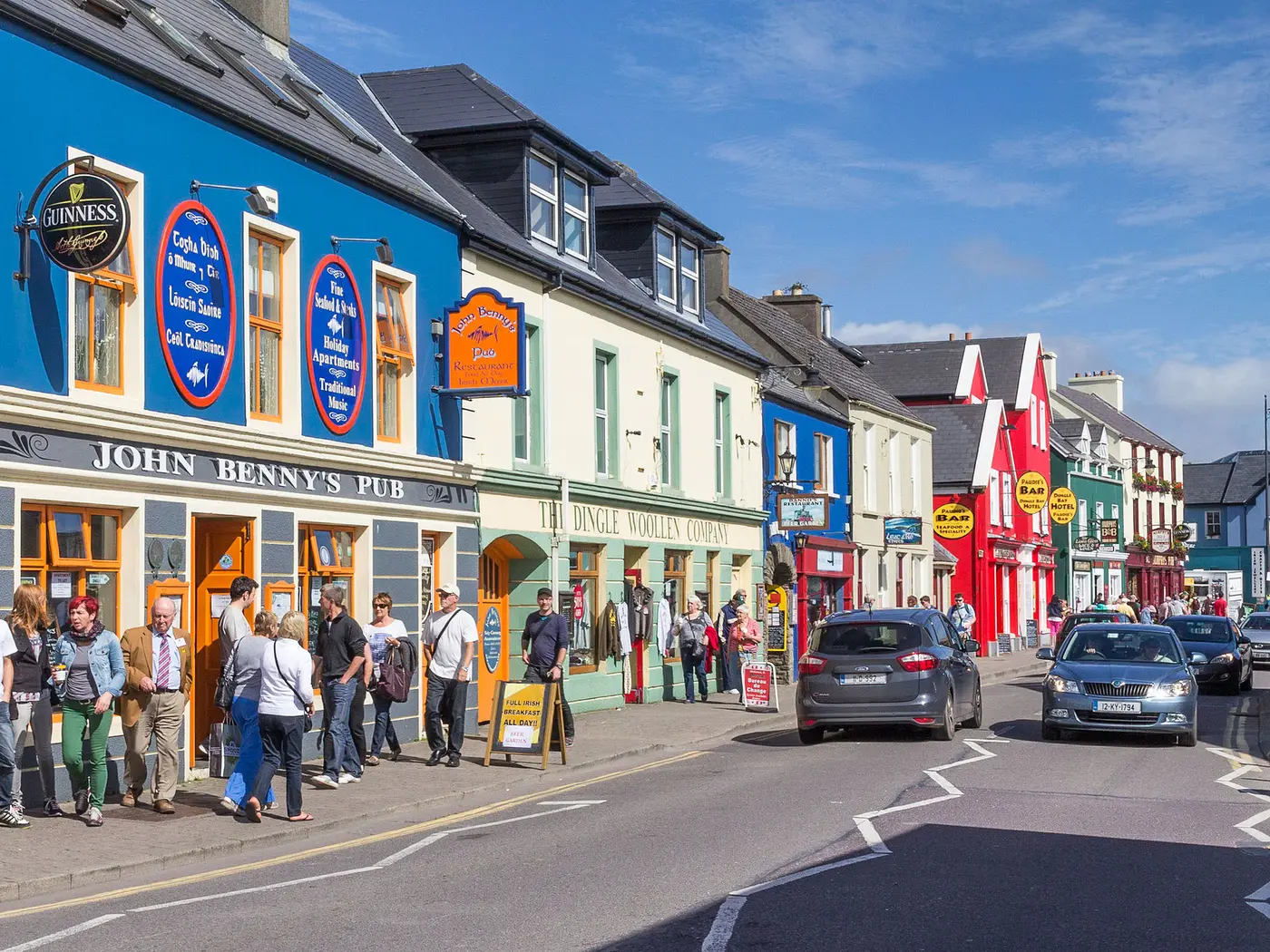
Dingle
'the fortress'
The most westerly town in Ireland and a Gaeltacht port that traded wine with Spain in the sixteenth century — Spanish ships came to the harbour and Irish priests left from it in the penal years. A bottlenose dolphin called Fungie lived in the harbour from 1983 until he vanished in 2020.
Ogham stones were set up at Ballintaggart in the 4th and 5th centuries. Dingle grew as a port after the Normans came; by the 13th century more goods were exported through it than through Limerick, and by the 16th it was one of Ireland's main ports, sending out fish and hides and bringing in wine. French and Spanish fishing fleets used it, and in 1529 the Earl of Desmond and the envoy of Emperor Charles V signed the Treaty of Dingle here. Pilgrims sailed from Dingle to Santiago de Compostela, and the parish church was rebuilt with Spanish help and dedicated to St James.
On 17 July 1579 James FitzMaurice FitzGerald landed at Dingle to begin the Second Desmond Rebellion, which ended with the massacre at Smerwick in 1580. James I granted the town a charter in 1607, with admiralty rights over the coast "as far as an arrow would fly", and traces of its walls remain. Dingle was burned or sacked several times in the 17th century; in the 18th the Fitzgeralds, Knights of Kerry, built up a linen industry worth £60,000 a year by the 1750s, which died out when British mills took over.
Drawn from the History section of the Wikipedia article on Dingle ↗, rewritten here and adding nothing it does not say; licensed CC BY-SA 4.0.
- Ballintaggart Ogham Stones · ogham stone · 2 km
- Emlagh East Ogham Stone · ogham stone · 4 km
- Ballybowler North Ogham Stone · ogham stone · 5 km
- Kilmalkedar · ogham stone · 7 km
- Reask · tomb · 9 km
- Dunbeg Fort · fort · 10 km
- Gallarus Castle · castle · 7 km
- Rahinnane Castle · castle · 8 km
Straight-line distances from the town centre, from each site's documented coordinates.
- Kilmalkedar · A 12th-century church with an 'alphabet stone', an ogham stone pierced with a hole for sealing oaths, and a sundial — 1,400 years of Dingle history in one field.
- Great Blasket Island · An island of storytellers that produced three classic memoirs in Irish, evacuated in 1953 when the last young man died and no one could row for the doctor.
- Gallarus Oratory · A dry-stone church shaped like an upturned boat, watertight after (probably) 1,200 years — not a single stone has moved.
All of these are pinned on the Hidden Ireland map.
All towns and cities → · Every town name in Irish · Know Dingle better? Add to the story.