Carlow
traditionally read as 'four lakes'
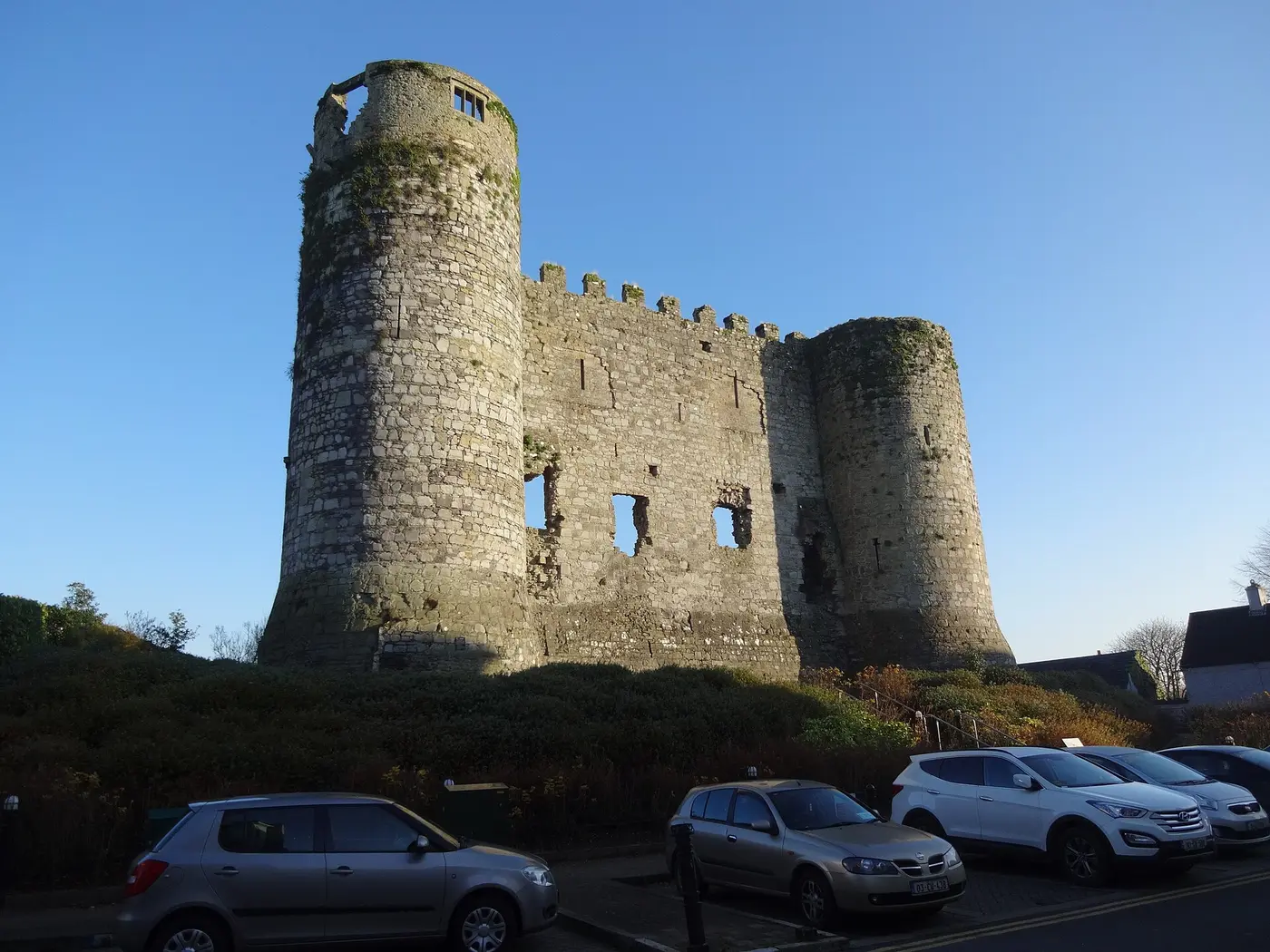
A Norman river town on the Barrow guarding the road south, its castle blown up in 1814 by an attempt to convert it into a lunatic asylum. Carlow's sugar factory, opened in 1926, was an early industry of the new state.
The Brownshill Dolmen, a portal tomb just outside the town, is the area's great prehistoric monument, and early monasteries at St Mullin's and Old Leighlin — where a synod met in 630 to decide the date of Easter — are nearby. William Marshal built Carlow Castle between about 1207 and 1213 to guard the crossing of the Barrow, and from 1361 to 1374 it was the capital of the English lordship of Ireland. The castle stood largely intact until 1814, when an attempt to turn it into an asylum destroyed most of it; the west wall and two towers remain.
Edward I made Carlow a borough in 1296. The bridge over the Barrow at Graiguecullen dates to 1569 and was rebuilt and renamed Wellington Bridge in 1815. The Catholic cathedral, finished in 1833, was the first built in Ireland after Catholic emancipation, and St Patrick's College beside it dates from 1793. The Barrow was made navigable to Athy by 1800, and the Great Southern and Western Railway reached Carlow in 1846; its engineer, William Dargan, came from nearby Killeshin. The Famine is said to have taken half the population.
Drawn from the History section of the Wikipedia article on Carlow ↗, rewritten here and adding nothing it does not say; licensed CC BY-SA 4.0.
- Brownshill dolmen · dolmen · 3 km
- Nurney Cross · high cross · 9 km
- Castledermot · round tower · 10 km
- Carlow Castle · castle · under 1 km
- Clogrennane Castle · castle · 4 km
- Ballyloughan Castle · castle · 10 km
- Castlemore Moat · castle · 11 km
- Leighlinbridge Castle · castle · 12 km
- Kilkea Castle · castle · 12 km
Straight-line distances from the town centre, from each site's documented coordinates.
- Browneshill dolmen · A capstone of some 100 tonnes, the heaviest in Europe, raised by farmers without wheels or metal. Nobody is sure how.
- Dunmore Cave · Where the annals say Vikings massacred a thousand people in 928. Bones of women and children were found inside in 1973 — and a Viking silver hoard in 1999.
All of these are pinned on the Hidden Ireland map.
All towns and cities → · Every town name in Irish · Know Carlow better? Add to the story.