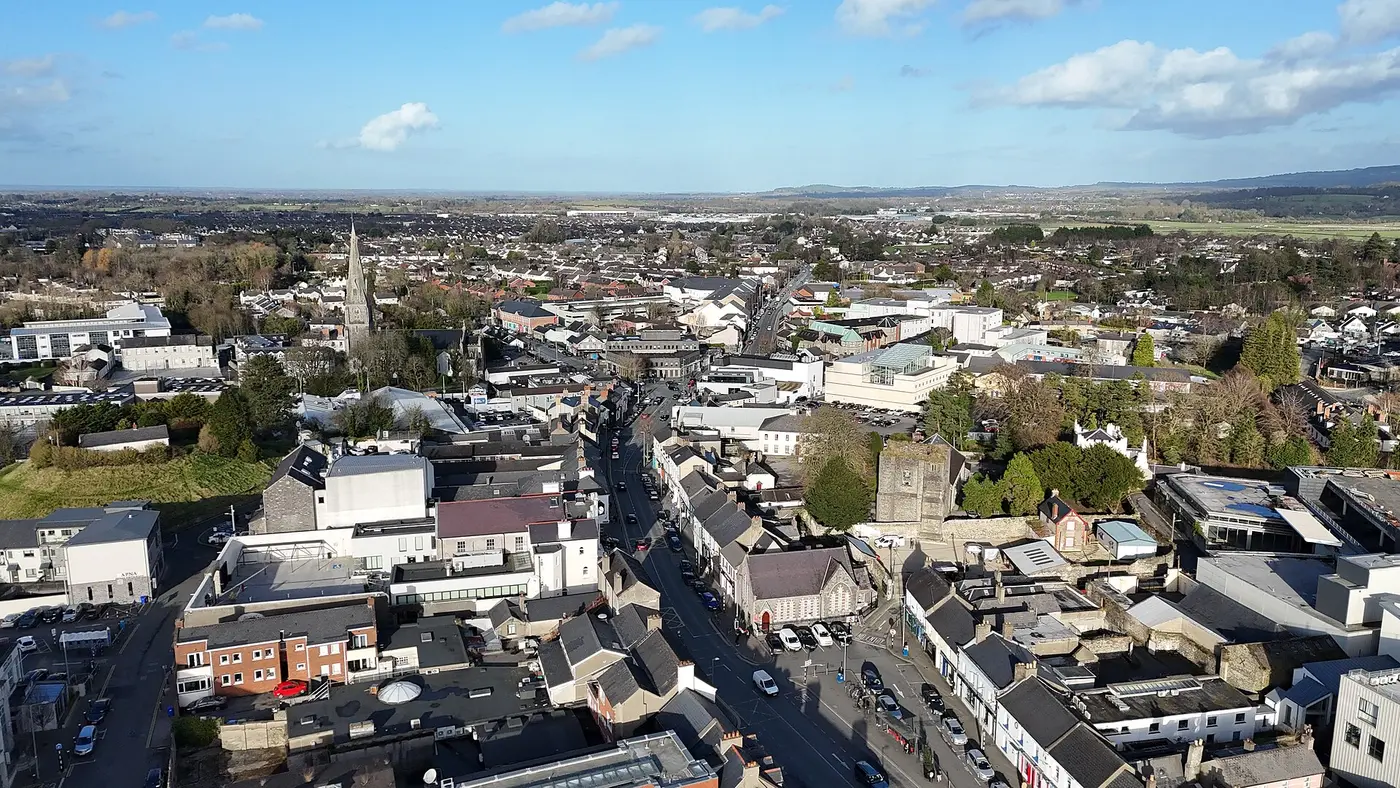
Naas
'assembly place of the kings'
An assembly place of the kings of Leinster before the Normans came, and a town of the Pale afterwards. It sits in horse country: the Curragh racecourse, Punchestown and the National Stud are all within a few miles.
Naas is Nás na Ríogh, the assembly place of the kings of Leinster; in legend it takes its name from Nás, a wife of Lugh, said to be buried on the Moat Hill. In the Middle Ages it became a walled market town, raided at times by the O'Byrnes and O'Tooles from the Wicklow hills, and walls were built around 1415. Henry IV gave it its first charter in 1409, and the Irish parliament sometimes met here, as in 1441. St David's Castle dates from about 1210.
On 3 March 1577 Rory Óg O'More burned Naas to avenge his kinsmen; the Lord Deputy wrote that the raiders ran through the town "lyke hagges and furies of hell" with fire on poles. New charters followed from Elizabeth I, James I and Charles II. The town hall was built as a gaol and finished in 1796. On 24 May 1798 about 1,000 rebels attacked the town in one of the first battles of the rising and were beaten off.
Drawn from the History section of the Wikipedia article on Naas ↗, rewritten here and adding nothing it does not say; licensed CC BY-SA 4.0.
- Killashee · round tower · 3 km
- Oughter Ard · round tower · 9 km
- St. Mark's Cross · high cross · 11 km
- St. John's Church, Ballymore Eustace · high cross · 11 km
- Dún Ailinne · royal site · 14 km
- Old Kilcullen · round tower · 14 km
- Saint David's Castle · castle · under 1 km
- Jigginstown Castle · castle · 1 km
- Barretstown Castle · castle · 9 km
- Reeves Castle · castle · 12 km
- Rathcoffey Castle · castle · 12 km
Straight-line distances from the town centre, from each site's documented coordinates.
- Piper’s Stones, Athgreany · Sixteen granite boulders of a Bronze Age circle, with one stone standing apart to the north-east. Dance here on a Sunday, they said, and you join them: the outlier is the piper, the ring is his congregation, caught mid-reel.
- Dún Ailinne · The royal site of Leinster: a 13-hectare hilltop enclosure whose vast timber circles were built for ceremonies, then dismantled and burned.
- Hill of Allen — Fionn's fort · Almu, the white fortress of Fionn mac Cumhaill and the Fianna. A 19th-century folly now crowns the hill; the quarry has eaten half of it.
- Gleann na Smól — Oisín returns · After 300 years in Tír na nÓg, Oisín came home, touched the ground helping men lift a stone, and aged in an instant — to tell Patrick the tales of the Fianna.
All of these are pinned on the Hidden Ireland map.
All towns and cities → · Every town name in Irish · Know Naas better? Add to the story.