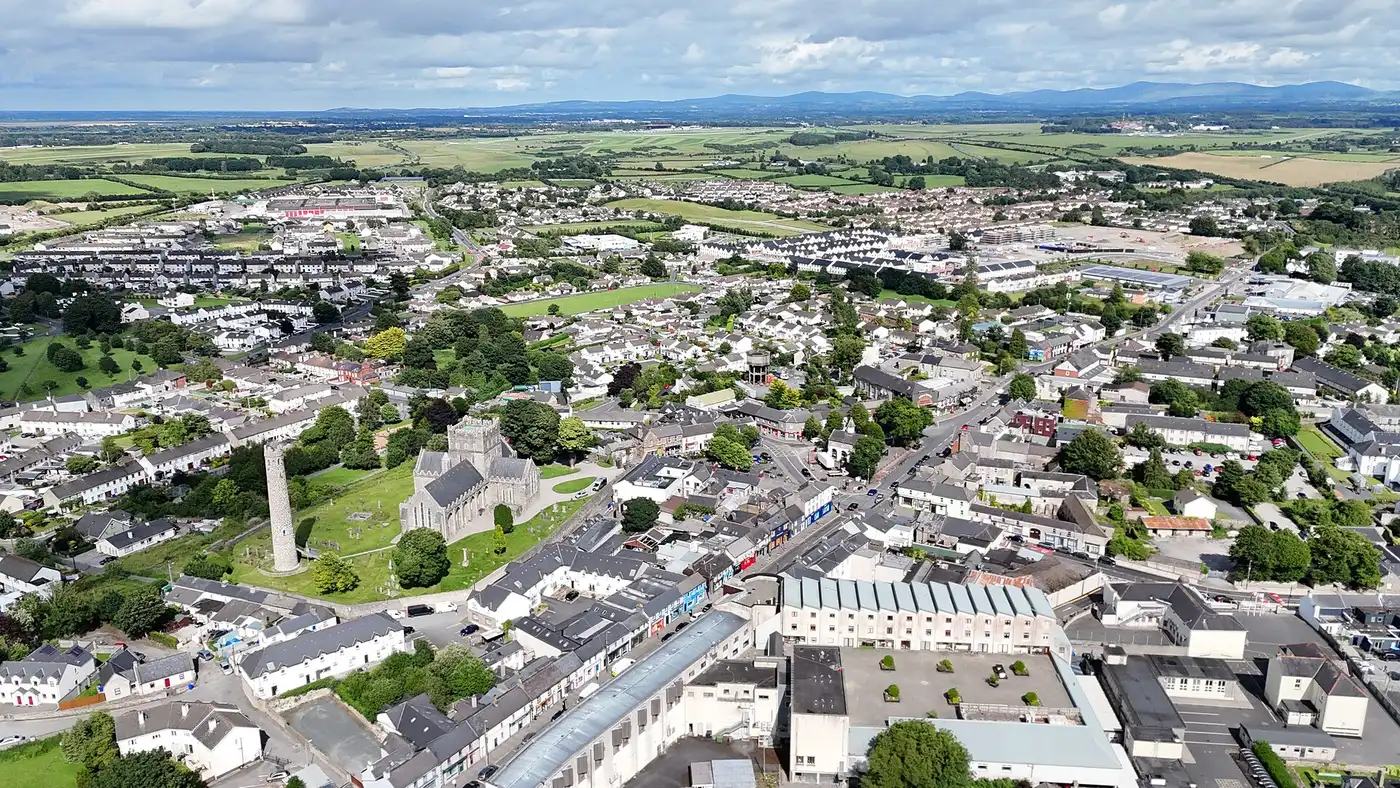
Kildare
'church of the oak' — St Brigid's foundation
Brigid founded her double monastery of women and men here under an oak in the fifth century, and a perpetual fire burned in her honour until the Reformation; the flame was restored in 1993. The Curragh, the great plain beside the town, has been common grazing and a horse-racing ground for centuries and holds the Irish Derby.
Kildare is Cill Dara, the church of the oak. In the 5th century St Brigid founded a church and monastery here, under an oak on a hill at the edge of the Curragh, and it became one of the three most important Christian foundations in early Ireland. The land, the story goes, came from the King of Leinster at nearby Dún Ailinne, who offered her as much as her cloak would cover — and the cloak spread over the whole Curragh.
Lord William de Vesci brought the Carmelites to Kildare in 1290 and the Franciscans to the Grey Abbey, and built the first castle. The Carmelites' White Abbey was surrendered on 3 April 1539 under Henry VIII, but the friars kept ministering in secret and came back openly in the 1750s; the present church was begun in 1884.
Drawn from the History section of the Wikipedia article on Kildare ↗, rewritten here and adding nothing it does not say; licensed CC BY-SA 4.0.
- Kildare · round tower · under 1 km
- Dún Ailinne · royal site · 10 km
- Old Kilcullen · round tower · 11 km
- Kildare Castle · castle · under 1 km
Straight-line distances from the town centre, from each site's documented coordinates.
- Piper’s Stones, Athgreany · Sixteen granite boulders of a Bronze Age circle, with one stone standing apart to the north-east. Dance here on a Sunday, they said, and you join them: the outlier is the piper, the ring is his congregation, caught mid-reel.
- Dún Ailinne · The royal site of Leinster: a 13-hectare hilltop enclosure whose vast timber circles were built for ceremonies, then dismantled and burned.
- Rock of Dunamase · A fortress on a rock over the midland plain, sacked by Vikings out of Dublin in 845. Diarmait Mac Murchada is said to have given it with his daughter Aoife to Strongbow in 1170 — a dowry that helped bring the Normans in. Cromwell’s men blew it up in 1650.
- Hill of Allen — Fionn's fort · Almu, the white fortress of Fionn mac Cumhaill and the Fianna. A 19th-century folly now crowns the hill; the quarry has eaten half of it.
All of these are pinned on the Hidden Ireland map.
All towns and cities → · Every town name in Irish · Know Kildare better? Add to the story.